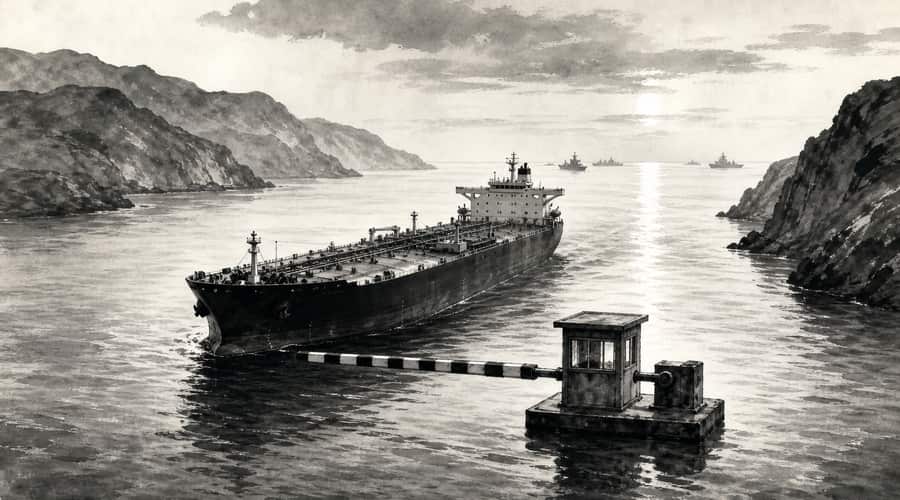
A fifth of the world's oil and gas trade moves through the Strait of Hormuz, and this week Washington decided that fact is worth a 20% toll. It isn't. It's a shakedown with a flag on it.
On Monday, President Trump said the United States would charge a 20% fee on the value of cargo passing through the Strait of Hormuz and reinstate a blockade aimed at Iranian shipping. He said the U.S. would be known as the guardian of the Hormuz strait, according to reports from the Associated Press and Business Insider. It sounds like a security policy. It is a toll booth.
You don't get a vote on this if you buy gasoline, a bottle of shampoo, or a car built from parts that crossed an ocean, because roughly a fifth of the world's oil and gas trade moves through this strip of water between Iran and Oman. Oil jumped about 5% after the announcement, with Brent crude trading near $80 a barrel, according to the Guardian and MarketWatch. Prices will keep moving every time either government threatens the passage.
Iran Got There First
This isn't only a Washington idea. Iran got there first. Reports in April said vessels were being asked to pay as much as $2 million to pass through Iran-approved routes in the strait, while Iran's embassy in India denied that Tehran was taking such payments. Keep both facts in the story, because they tell you the real shape of the dispute: Iran wants authority over the waterway, shippers want to move cargo, and every denial comes with a warship somewhere nearby.
There is no practical difference between voluntary and mandatory when a navy controls the route.
The Wall Street Journal reported two weeks ago that Iran had proposed security, environmental, and safety fees that could generate as much as $40 billion a year if the plan drew enough support. Oman did not simply sign up for that idea. U.S. officials and Gulf states have resisted unilateral tolls, and the International Maritime Organization has pushed back on the legal basis for charging ships to move through an international waterway.
Trump's answer to Iran's toll wasn't to reject the principle. It was to outprice it. Twenty percent on the value of cargo is the number he gave, alongside a promise that the United States would keep the strait open for everyone except Iran. The hard problem is obvious: nobody has established that the U.S. Navy can guarantee safe passage through a channel where traffic has already been disrupted, ships have been attacked, and insurers are pricing in war risk.
Freedom of navigation through international straits isn't a courtesy either government is extending. It's a right, built into the United Nations Convention on the Law of the Sea, resting on the simple fact that the Strait of Hormuz connects the Persian Gulf to open ocean and no single coastline gives one country ownership of the water in between. Charging companies for the privilege of moving oil that keeps refineries in India, Japan, Germany, and the United States running isn't a service fee. It's a shakedown of a chokepoint neither government built and neither one fully controls.
Frankly, the 20% figure tells you exactly what this is. A security charge scaled to the value of your cargo isn't pricing risk. It's pricing your wallet. A tanker carrying $80 million in crude pays far more protection money than a cheaper cargo, even if the physical danger is the same. That isn't insurance. That's a cut.
Who Pays, and What Happens Next
The people who actually pay this bill were never in the room when Trump made his announcement or when Tehran floated its own revenue plan. They're refiners in South Korea, shipping insurers in London, manufacturers waiting on parts, and eventually anyone filling a gas tank or buying anything that arrived on a container ship. AP described the strait as a conduit for a fifth of global oil and gas trade. Small charges become enormous when they're multiplied across a route that carries millions of barrels a day.
Both governments are betting that global trade has nowhere else to go. They're mostly right. The Strait of Hormuz is about 21 nautical miles wide at its narrowest point, but the shipping lanes are only a few miles wide, split between inbound and outbound traffic. That is why the waterway matters. The world doesn't have a clean backup route, and whoever controls the one everyone needs will always be tempted to charge for it.
The choice isn't between Tehran's toll booth and Washington's. It's refusing to let either side build one. If a government can turn an international strait into a revenue line whenever its navy is close enough, every oil buyer, manufacturer, airline, and driver down the chain will pay for a precedent they never approved.
Also read: The UN's AI Summit Showed Robots Racing While Governments Argue Over Rules • Iran's New Leader Vows Revenge While Markets Watch the Strait of Hormuz • China's Net-and-Cable Rocket Catch Reignites the Race Against SpaceX