
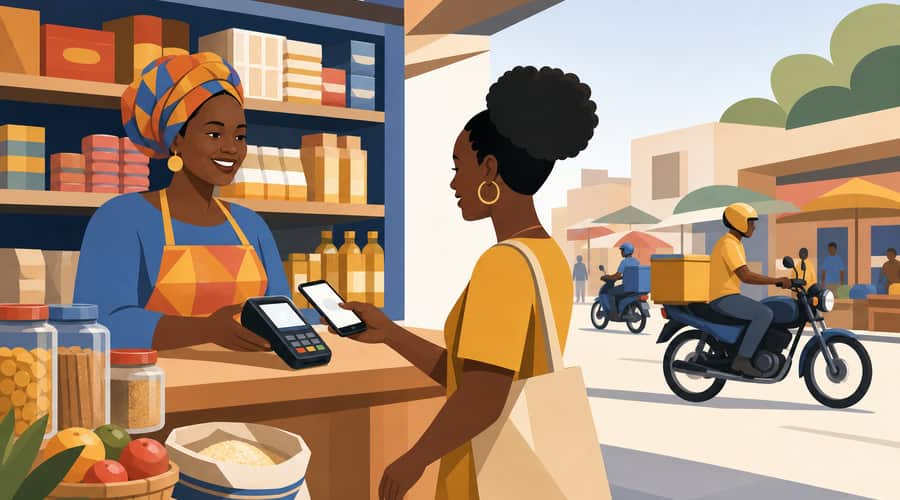
Everyone talks about Africa's risk. Fewer people are pricing what happens if its cash economy keeps moving into trackable digital rails.
Africa is not a no-risk market. Nobody serious says that. The problem is that investors have spent years staring at the risk and missing the size of the commercial machine underneath it: shops, agents, riders, family wholesalers and small traders moving money every day without the paperwork banks usually require.
Start with the demographic correction, because it matters. The United Nations' 2024 World Population Prospects does not put Nigeria on track to become the world's third most populous country by 2050. It puts Nigeria at about 359 million people by then, behind India, China, the United States and Pakistan. That's still enormous. Across the continent, the UN projects Africa's population at roughly 2.5 billion people in 2050, about a quarter of humanity. If you're building for the next consumer market, you can't treat that as a footnote.
The market usually prices the continent as a list of warnings: currency swings, political turnover, weak grids, thin public data. Those warnings are real. But they don't explain the value already moving through informal commerce. The International Labour Organization has repeatedly found that informal work accounts for more than 80% of employment in Africa, and estimates of informal economic activity often run near 40% of output in developing markets. On a continent with nominal GDP around $3 trillion, you don't need heroic math to see the trillion-dollar shadow.
That is the blind spot.
The cash economy is getting a ledger
Mobile money is where the story stops being theoretical. According to GSMA's latest industry reporting, African mobile money services processed about $1.1 trillion in transactions in 2024 and held more than half of the world's registered mobile money accounts. The World Bank's Global Findex still shows hundreds of millions of adults in the region outside formal banking. Those two facts sit awkwardly together: huge payment flow, thin access to credit, insurance, savings.
That's exactly why the better African fintech companies are not just payment apps. They're data businesses with a payments front door.
Moniepoint is the cleanest example. The Lagos-based company, founded by Tosin Eniolorunda and Felix Ike as TeamApt, built much of its reach through point-of-sale terminals used by small merchants. Reuters reported in October 2024 that Moniepoint raised $110 million from investors including Google's Africa Investment Fund and Development Partners International, giving it unicorn status. In 2025, the company extended that Series C round, taking total Series C funding above $200 million. It didn't raise that money to chase corporate treasury accounts. It raised it because a provision store that takes payments through its terminal starts producing a credit trail.
Techpoint Africa reported that Moniepoint disbursed more than 1 trillion naira in loans to about 70,000 businesses in 2025, with provision stores taking the largest share. That detail is the whole thing. A small shop selling rice, soap and airtime can become legible to a lender without first becoming a branch-banking customer. Once you understand that, Africa's informal economy stops looking like a problem waiting for charity. It starts looking like a market waiting for underwriting.
OPay is Lagos-based too, backed by a $400 million Series C in 2021. It works from a similar base: agents, wallets, transaction history. Wasoko and MaxAB are a rougher but useful case from another corner of the market. TechCrunch reported that the two B2B commerce startups completed their all-stock merger in August 2024, creating a combined platform serving more than 450,000 merchants and reaching an estimated 65 million consumers. That merger also tells you something uncomfortable. Scale is valuable, but logistics is expensive and margins are unforgiving.
Frankly, that's why the upside is interesting. Easy markets don't stay mispriced for long.
The next bet is not just payments
The Financial Times recently noted, citing Boston Consulting Group, that Africa is the world's fastest-growing fintech market and that fintech revenue on the continent could reach $65 billion by 2030. That is a useful number, but the better signal is what the revenue is expected to come from. Payments opened the door. Credit, insurance, cross-border transfers and merchant software are what come next.
The International Finance Corporation has also put a much larger figure on the digital shift, estimating that artificial intelligence could add $1.3 trillion to Africa's economy by 2030 if the infrastructure and skills gap narrows. Don't read that as a magic AI forecast. Read it as a data forecast. Mobile transfers, airtime top-ups, merchant orders and delivery records are already throwing off the kind of behavioral data that lenders and insurers need. The question is who gets to turn it into useful financial products.
None of this cancels the risks. Growth-stage funding for African startups has been uneven. Currencies still punish dollar investors, and regulators can move suddenly. Nigeria's 2024 pause on new customer onboarding for several fintechs showed exactly that: scale brings scrutiny. Good. A financial system serving millions of first-time users should be scrutinized.
But you should be clear about the trade. Africa is moving toward one in four people on Earth. It already processes about $1.1 trillion a year in mobile money - and still leaves hundreds of millions of adults outside full-service finance. The old market story priced the danger. It hasn't priced what happens when the shopkeeper on the dirt road finally has a ledger.
Also read: UK Enlists Wall Street and Crypto Giants to Build a Live Tokenized Repo Market • Mastercard Weighs Selling Majority Stake in Britain's Payment Plumbing • Hachette, Elsevier and Scott Turow Sue Google Over Gemini's Book Training