OpenAI's first hardware product won't start with a screen. The harder question is whether you actually want a ChatGPT camera moving around your home.
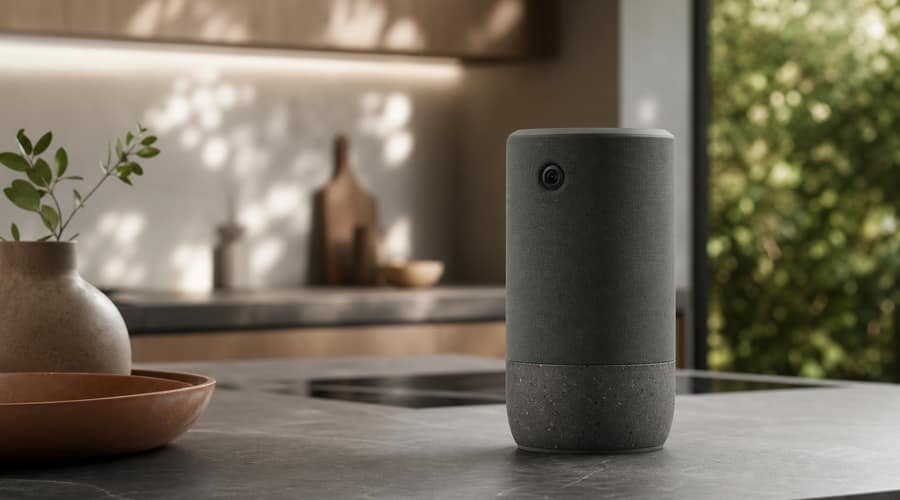
Bloomberg reported this week that OpenAI is building a moveable, screen-free smart speaker meant to be its first major consumer device. The Verge said the product is expected to arrive in 2027 and will use a camera, environmental sensors, a rechargeable battery and mechanical parts that can move on their own. That is the pitch. You talk to it. It listens, looks around and answers through ChatGPT with more context than a phone app or a speaker sitting blind on a shelf. No screen, no app to open.
The device is meant to control smart-home equipment, play media, answer questions and respond to messages. Bloomberg's reporting, as summarized by The Verge, says it will use GPT-Live, OpenAI's upgraded voice model announced last week. That's the engine under the hood. Earlier reporting from Business Insider on OpenAI's filings in its trademark fight with Iyo said the company didn't expect to ship the product before the end of February 2027. The reported price range, $200 to $300, puts it near mainstream smart speakers, not near Apple's Vision Pro fantasy pricing. That matters. If OpenAI wants this in your kitchen, it can't be a status object.
None of this happens without Jony Ive. OpenAI announced in May 2025 that it was buying Ive's hardware startup, io Products, in a deal valued at nearly $6.5 billion, with Ive's LoveFrom taking design and creative responsibilities across OpenAI and io. The Associated Press reported at the time that Ive wouldn't become an OpenAI employee and that LoveFrom would remain independent. That's an odd structure, but it fits the ambition. Sam Altman doesn't want OpenAI to live forever as a tab in your browser. He wants an object in the room.
Apple Takes The Fight To Court
The hardware story now comes wrapped in a lawsuit. Apple sued OpenAI in federal court in Northern California on July 10, accusing the company, io Products and two former Apple employees, Tang Tan and Chang Liu, of misappropriating trade secrets for OpenAI's device work. The Verge reported that Apple claims more than 400 former Apple employees now work at OpenAI. It also reported that Tan, now OpenAI's chief hardware officer, allegedly emailed himself Apple supplier information before leaving, while Liu allegedly accessed Apple systems after his departure and downloaded confidential hardware files.
Those are heavy claims. Apple also says OpenAI told Apple employees interviewing for jobs to bring CAD or design artifacts and prototypes to interviews. OpenAI denies the core accusation. The company told The Verge it has no interest in other companies' trade secrets and said Tuesday that it wasn't aware of evidence giving Apple's complaint merit. You don't have to decide the lawsuit today to see the risk. A first hardware product is hard enough without a court fight over whether the work is clean.
The reversal is sharp. In 2024, Apple brought ChatGPT into Siri and Apple Intelligence. Two years later, Apple is accusing OpenAI of using former Apple talent and Apple secrets to build a rival consumer device. That is not just legal theatre. Apple has been defending the home and personal-device boundary since the first HomePod shipped in 2018, even if Amazon's Echo and Google's Nest speakers reached many more homes.
The Home Is A Harder Market Than Chat
Here's the thing. A screen-free speaker with a camera, facial recognition and enough autonomy to reposition itself is asking for more trust than Alexa ever needed. Amazon and Google trained people to accept microphones in the room. OpenAI is asking them to accept a device that can see, remember context and possibly help them buy things by voice. That could be useful. It could also feel like too much. The same feature that makes the product smarter also makes it harder to ignore.
OpenAI is betting that ChatGPT's daily habit is strong enough to carry new hardware where earlier AI gadgets failed. Humane's AI Pin flopped. Rabbit's R1 became a cautionary tale almost immediately. The HomePod never became an iPhone. OpenAI has one advantage those devices didn't: people already know what ChatGPT does. But brand awareness alone won't win the kitchen counter - the product has to be useful before the novelty wears off.
The bigger lineup is still further away. Bloomberg says OpenAI is exploring roughly five devices, including smart glasses and a home lamp, but the speaker is the test case. If it arrives in 2027 as a genuinely helpful companion, OpenAI gets a new argument for why AI belongs outside the screen. If it arrives as a camera-laden speaker with a lawsuit hanging over it, Apple won't be the only skeptical party in the room. Your trust will be the real product test.
Also read: Australia is rushing to approve AI data centers before backlash grows • Grok Build Quietly Uploaded Developers Entire Codebases to xAI Cloud • Prime Intellect Raises $130 Million to Let Companies Own Their AI Models