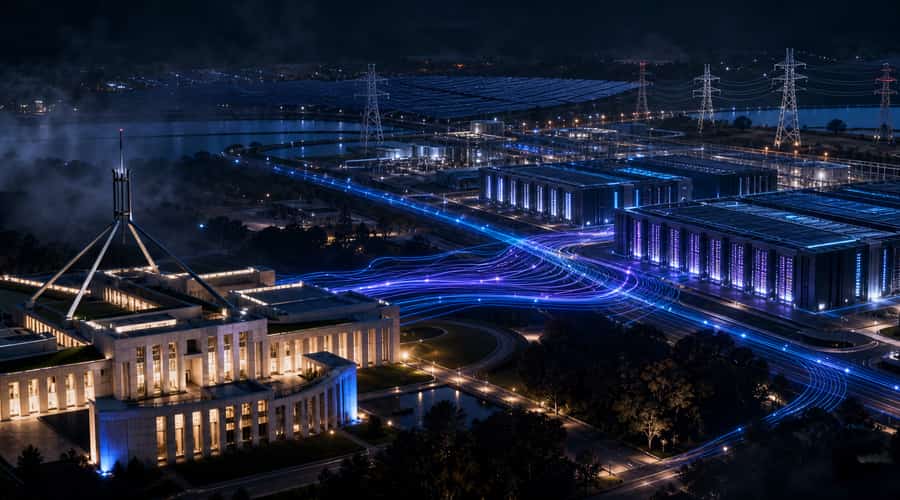
Australia wants AI infrastructure built faster, but the real fight is not paperwork. It is power, water, copyright and public trust.
Anthony Albanese is trying to move before the AI data center fight reaches full size. Guardian Australia reported on July 14 that the prime minister will create a new Office of AI inside the Department of the Prime Minister and Cabinet and promise faster approvals for AI projects, including data centers, in a Sydney speech on Wednesday, July 15.
That is the bet. Give investors one clearer door into government, not a maze of agencies, and Australia starts to look like a place where AI infrastructure can actually get built.
Look, this isn't only a technology policy announcement. It is industrial policy. If AI models are the visible product, the hidden product is electricity, land, cooling, fiber, planning consent and political tolerance. A country that can't approve those inputs quickly won't host much of the next AI buildout. No matter how often ministers talk about productivity.
The new office is supposed to coordinate standards and cross-government policy. Industry and Innovation Minister Tim Ayres and Assistant Science and Technology Minister Andrew Charlton are both involved. News.com.au reported that ministers across industry, education, employment, energy and national security are expected to work through the framework. AI doesn't sit in one portfolio. It sits in hospitals, classrooms, military systems, public service procurement and copyright law all at once.
The government is already a buyer. Guardian Australia reported that the Department of Finance has started a multi-stage procurement process asking industry for AI tools for service delivery and policymaking, including chat tools already being used to improve government efficiency. Canberra isn't only regulating AI from the outside. It wants to use it.
That risk is real. Public sector AI has to be boring before it is clever. If your welfare, immigration, tax or health system uses models that people can't challenge, a bad decision stops being a software issue and becomes a state power issue. Australia already has a bitter memory of automated government failure in Robodebt. The new office should not need that lesson explained.
Albanese is also expected to frame AI as a security problem. Guardian Australia reported that his prepared remarks refer to extremists and state actors using AI to create propaganda aimed at young people and to spread disinformation targeting democracies. Defence Minister Richard Marles and Home Affairs Minister Tony Burke are already working with national security agencies and Five Eyes partners on AI threats.
That part is easy to say in a speech. The harder work is deciding what Australia will approve, where it will approve it and what trade-offs communities will actually accept.
Data centers are now a local politics problem
New York just warned Canberra. The Associated Press reported on July 14 that Governor Kathy Hochul signed an executive order imposing the first statewide US moratorium on hyperscale data centers, pausing large projects for a year while regulators write rules on environmental impact, energy demand and water use. That is not an anti-technology fringe position. It is what happens when electricity bills and water supply turn into household arguments. Noise does too.
Australia is not immune. The Herald Sun reported on July 14 that residents near Hillside, west of Melbourne, are opposing Syncline's proposed Plumpton AI data hub on 350 hectares of green wedge land. The plan is for two centers with 2.4 gigawatts of capacity, more than Victoria's biggest coal plant. More than 3,000 people have signed an online petition, according to that report. Syncline says the project would use 80% renewable energy, avoid diesel operations and leave about 60% of the land open for public use.
Frankly, that is the argument Albanese's fast-track plan has to survive. A faster approval system that only accelerates conflict will not be enough. If a data center pulls power from a constrained grid, uses scarce water, adds noise or lands next to housing without serious consultation, residents won't care that it supports sovereign AI capability. They will see the bill and hear the hum.
The investment prize is large. The Australian reported this week that a Canaccord Genuity analysis put Australia's data center project pipeline at about 20 gigawatts, requiring at least $250 billion in capital expenditure and more than $300 billion including fit-outs. The same report said the Australian Energy Market Operator expects data centers to consume 10% of grid power by 2050. Those are mining-boom numbers. They also carry mining-boom politics.
The office has to say no
South Australia is already trying to make the energy story more credible. AdelaideNow reported two weeks ago that Firmus signed a 12-year wholesale energy deal with Gunvor Group to supply 600 megawatts of firm energy for its Project Southgate AI infrastructure expansion, with 1.2 gigawatts of new renewable generation and 1.5 gigawatt-hours of battery storage planned through 2032. That is the sort of detail investors and voters should demand: not a promise that AI will be clean, but the actual power plan.
Copyright is the other pressure point. Guardian Australia reported that Ayres said there won't be a text and data mining exception in Australia, even as AI companies push for greater freedom to train models on local content. That line will please writers, musicians, film-makers and journalists who don't want their work treated as free fuel for foreign platforms. It may annoy OpenAI, Google, Microsoft, Anthropic, you name it. So be it.
Any government can announce an office. The test is whether this one can say no as clearly as it says yes. Harder than it sounds. Faster approvals should reward projects that bring credible power, water, security and community plans, not just bigger capital budgets and better lobbyists. That's the bar. If Australia gets that right, it has a real chance to host part of the AI infrastructure boom on its own terms. If it doesn't, New York's moratorium will look less like a foreign story and more like a preview.
Also read: Grok Build Quietly Uploaded Developers Entire Codebases to xAI Cloud • Prime Intellect Raises $130 Million to Let Companies Own Their AI Models • Ollama Just Raised $65 Million to Become AI's Quiet Infrastructure Layer