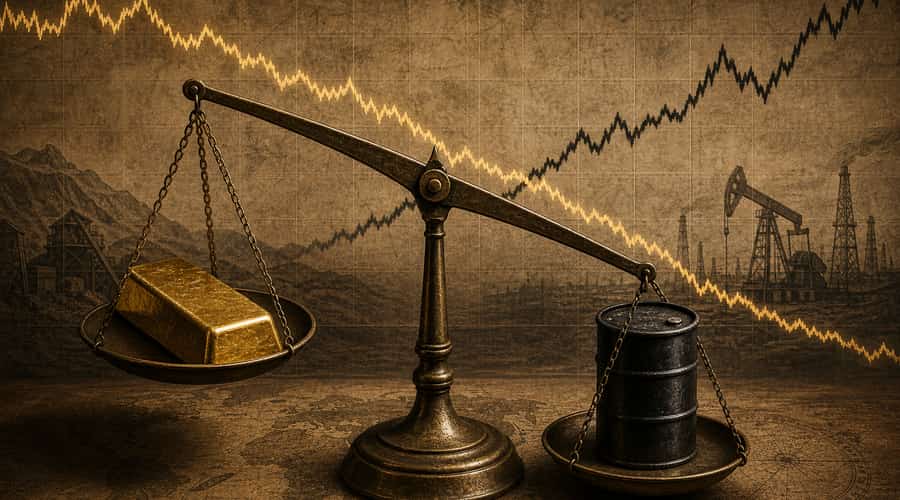
Gold is still far below its January record, but the cleaner story is not panic selling. Rates, the dollar and cooler inflation data are doing more work than the war headlines.
You've been told gold is the thing you buy when the world catches fire. This week the world is on fire, and gold still hasn't behaved like a simple war hedge. The Wall Street Journal reported that front-month Comex gold settled at $4,061.10 an ounce on July 14, up 1.6% for the day, but still down 23.64% from its January 29 record of $5,318.40. That is the part worth paying attention to. Gold bounced, but it did not reclaim the old safe-haven script.
The war news is real enough. The Guardian reported that the US and Iran traded fresh strikes around the Strait of Hormuz, while President Trump withdrew a proposed 20% toll on ships passing through the waterway but kept a blockade on Iranian ports. Iran's Revolutionary Guard has claimed the strait is closed. The US disputes that. Either way, a route used for about a fifth of global oil flows is now a military and market problem again.
Oil reacted first. Business Insider reported that Brent crude climbed to $86.29 a barrel on July 14 as Hormuz tensions rose, while West Texas Intermediate moved near $79.69. That puts inflation back in the room. Higher oil can push consumer prices up, and a hotter inflation path usually means the Federal Reserve has less room to cut rates. Gold pays no interest. When bond yields rise, that fact stops being theoretical.
Fear is losing.
The Rate Trade Is Still In Charge
The blunt point is this: gold is not priced by missiles alone. It is priced by missiles, real yields, the dollar, central bank expectations and investor positioning all at once. If you only watch the conflict map, you miss the trade that actually moves the metal.
MarketWatch reported that traders cut their expectations for near-term Fed rate hikes after the latest US consumer-price data came in cooler than expected, with CME FedWatch showing an 84.5% chance of no change at the July meeting and a 15.5% chance of a hike. That undercuts one of the draft's biggest claims. The market is not cleanly pricing a September hike at 58% after the CPI release. It is arguing with itself, and gold is caught in that argument.
That is why Tuesday's move looked messy. The same war that lifted oil also raised concern about future inflation, but softer CPI data weakened the case for immediate tightening. Gold rose on the day because yields and the dollar eased after the inflation print. It stayed far below the January high because the bigger rate story has not gone away.
You need both facts in your head at the same time. Gold can rally for a day and still be in a damaged trend.
Silver Shows The Same Strain
Silver is not giving you a cleaner signal. The Wall Street Journal reported that July Comex silver settled at $58.772 an ounce on July 14, up 1.97% for the session, but still almost 49% below its record high of $115.08. That is a huge fall for a metal that carries both monetary and industrial stories. If panic alone ruled the tape, silver would not look like that.
The pressure is not only geopolitical. Silver gets pulled by manufacturing demand, investor appetite and the same rate math that hits gold. When money can sit in short-term bonds and earn a real return, shiny metal has to work harder. It doesn't produce cash flow. It just sits there, waiting for the policy backdrop to make it attractive again.
Frankly, that is where the safe-haven slogan becomes lazy. Gold did not save investors from Paul Volcker's rate shock in 1980 just because inflation and the Iran hostage crisis were both on the front page. Rates beat fear then. They can do it again.
None of this makes bullion useless. It makes it conditional. Gold is a hedge against loose money, currency distrust and financial stress. It is weaker as a one-button trade against every bad headline. If you're holding it because you think war automatically means higher prices, July has already given you the correction.
The next move now sits with two institutions, not one battlefield. Traders will watch whether the US and Iran step back from another round of strikes, but they will also watch what the Fed says after cooler CPI and higher oil. That second part may sound dull compared with Hormuz. It is still where the gold price is being made.
Also read: Gold Is Falling While Missiles Fly Over the Strait of Hormuz • Gold's worst quarter in thirteen years exposes a flaw in the safe-haven thesis • Indian households are selling gold as prices fall and the math could weigh on bullion through 2026