Jensen Huang stood in Tokyo on Thursday and told Japan its AI era starts now, backing the claim with robotics and factory deals - and sovereign computing money too - rather than just a slogan.
Nvidia's chief executive did not come to Japan with a soft speech about cooperation. He appeared alongside Fujitsu CEO Takahito Tokita and the heads of Fanuc, Yaskawa Electric and Kawasaki Heavy Industries, with Associated Press reporting that the companies are now pushing a new physical AI effort using Nvidia technology. This is the kind of announcement you should take seriously, but not sentimentally. Japan has the robot makers. Nvidia has the chips and software stack. The fight now is over who turns that into working machines, not stage lines.
Huang said Japan's manufacturing culture makes it a natural place for physical AI, and he leaned hard on words such as kaizen and precision. Fine. The more useful detail is that the companies did not give a firm timetable for robots turning up in daily life, and AP reported that no joint venture has been decided. The first phase of the collaboration is expected later this year. That restraint matters. If you're reading this as a founder or investor - or a supplier - the headline is not that humanoid robots are suddenly ready for nursing homes and factory floors. They aren't. The headline is that Nvidia is moving deeper into the companies that might make them ready.
Why Tokyo, why now
None of this sits apart from Japan's politics. Prime Minister Sanae Takaichi's government has been pressing for domestic AI infrastructure, with AP reporting a plan to draw more than 370 trillion yen, about $2.3 trillion, in public and private investment into fields including AI and semiconductors - and data centers - by 2040. That's a huge number. It also tells you why Huang's visit was about more than robotics.
Japan knows it has fallen behind the United States and China in large-scale AI. You can see the anxiety in the way government and industry now talk about sovereign AI: local data centers and local compute capacity - anything that cuts dependence on infrastructure hosted somewhere else. Nvidia benefits from that anxiety. Every country that decides AI infrastructure is a national asset becomes a potential customer for more GPUs, networking, systems and software.
SoftBank is the clearest Japanese example. Nikkei Asia reported in May that SoftBank Corp had opened talks with Nvidia and Foxconn on a made-in-Japan AI server, after already testing a rack-integrated system built on Nvidia H200 GPUs with Foxconn and liquid-cooling company ZutaCore. Nvidia has separately said it is helping SoftBank build what it calls Japan's most powerful AI supercomputer, using Grace Blackwell systems. That's not a slogan either. It is racks and cooling - the unglamorous infrastructure that decides who can actually run the models.
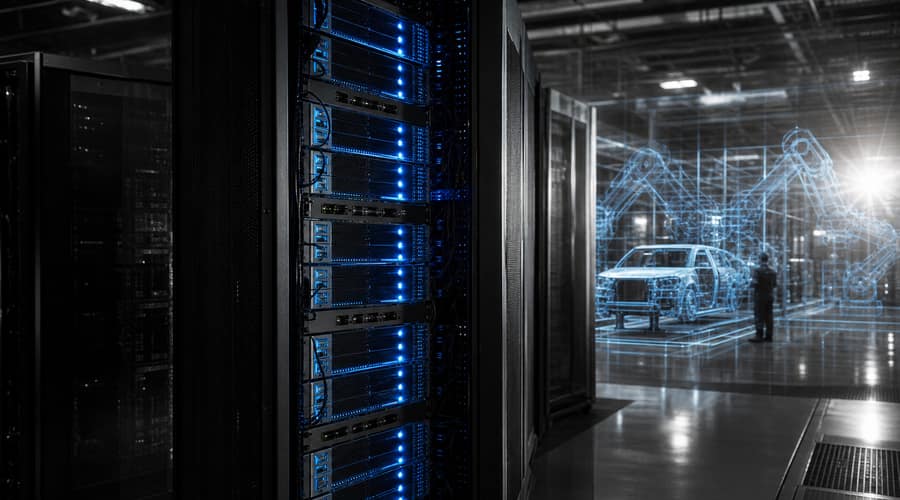
The same logic explains the Toyota angle. Bloomberg reported that Nvidia is expanding its decade-old partnership with Toyota Motor beyond the self-driving work the two companies began in 2017 with the Drive PX platform. Toyota is expected to use Nvidia's Omniverse software for digital twins of vehicle assembly lines and Isaac robotics tools for factory automation. Nemotron language models are pencilled in for software development too. Woven City, Toyota's demonstration smart city in Shizuoka prefecture, is part of the broader work too. You do not need to dress that up. It means Nvidia wants its tools inside the car and the factory - and in the city infrastructure that surrounds both.
The robotics bet
Frankly, the robotics side is the more interesting bet. Sovereign AI is now a familiar playbook: governments want domestic capacity. Telecoms and cloud firms buy the systems, and Nvidia sells into the buildout. Physical AI is harder. A chatbot can be wrong in a browser window - a robot that moves around people and hospitals - or works an assembly line - has far less room for one.
Japan is still the logical place to try this. Fanuc and Yaskawa sell industrial robots the world over, and Kawasaki Heavy Industries has been building manufacturing systems for decades. Fujitsu brings the domestic enterprise and infrastructure relationships to the table. Nvidia doesn't need to convince these companies that robotics matters. It needs them building on its stack, not a rival's. That's the real contest.
There is a useful warning inside the announcement too. AP reported that the companies gave no specific time frame for physical AI robots entering daily life, and that line should stay in the story. If a company can't say when the machines arrive, you shouldn't pretend the market has already arrived. The near-term money is more likely to show up in servers, simulation software, digital twins and factory automation projects than in friendly robots walking through homes.
Huang has made Japan part of Nvidia's sovereign AI and robotics pitch. Now Japan's manufacturers have to make the pitch real. The test will not be another Tokyo event. It will be whether SoftBank's racks and Toyota's factories - and Fujitsu's robotics partners - turn these announcements into systems that customers can measure, buy and run.
Also read: Palantir's CTO Warns China Is Stealing AI, but the Real Threat Is at Home • TSMC posts record revenue and hands Wall Street its verdict on the AI buildout • What Is an AI Browser and How Do Agentic Tools Like Comet Work