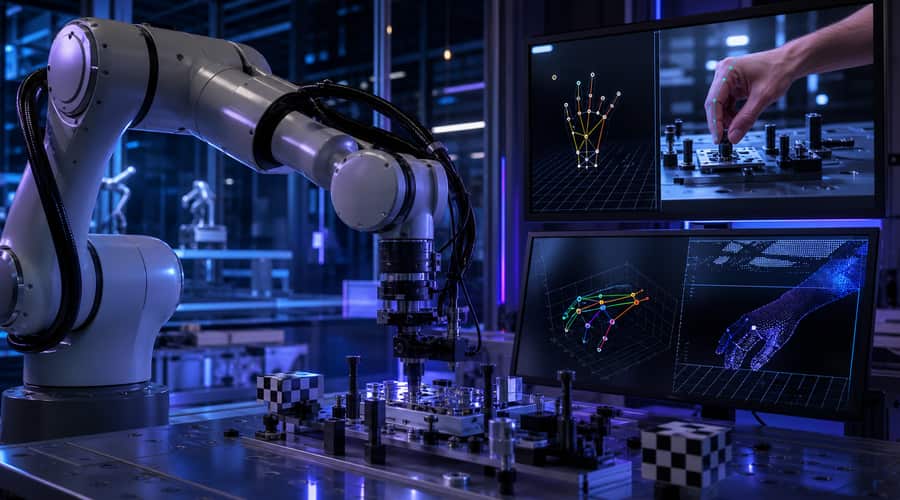
Munich's microagi just closed a $55 million seed round, the largest ever raised by a German startup, to pay people around the world to record themselves doing physical work so robots can learn to copy it.
Bercan Kilic spent his days shaving milliseconds off a Formula 1 car's aerodynamics at Red Bull Racing. Now he's trying to teach robots how to screw in a bolt. Kilic left Red Bull, where he joined in 2023, to found microagi. This week the company announced a $55 million seed round led by Hummingbird, with Northzone, LocalGlobe, Village Global and redalpine also writing checks. According to Business Insider, which first reported the round, it's the largest seed round any German startup has ever raised. That's a striking marker for a company barely out of its first year.
You won't find microagi building its own robots or its own foundation model. That's the point. Factories already own the hardware. What they don't have is a way to teach a robotic arm the specific, fiddly motions of one particular job on one particular line. microagi takes existing robots and existing robot models and retrains them on footage of how a task actually gets done at a given factory, then hands the adapted model back. It's a narrower bet than building a humanoid from scratch. And it's why investors are willing to write a check this size before the company has much of a track record to point to.
Paying strangers to fold laundry on camera
The unusual part of the business isn't the factory contracts. It's Shift. The data-collection arm microagi runs alongside it. Shift pays people, more than 20,000 of them across 15 countries, to strap on head-mounted cameras and sensor-equipped gloves and record themselves doing ordinary physical tasks: stacking boxes, wiring a plug, folding clothes. That footage becomes training data for the human-motion models that eventually get pointed at a robot arm. Shift went semi-viral earlier this year for a promotion offering free apartment cleanings in New York in exchange for letting the cleaners film every motion. People said yes. The company got hours of unscripted, real-world footage. It couldn't have staged that as convincingly. That's the trade: a free chore for a stranger, a data point for a robot that will never say thank you.
Kilic isn't building this alone. His co-founders include Yoan Iliev, an engineer from Mercedes' F1 team, and Anton Poletaev, a former researcher at the Alan Turing Institute. RWTH Aachen engineer Nico Nussbaum rounds out the technical side, alongside Artjem Weissbeck, who's started companies before. It's a team built from motorsport precision engineering and academic robotics research. An odd pairing on paper. But it makes sense for a company whose entire pitch is turning millimeter-level physical motion into machine-readable data.
Everyone wants to own the same layer
microagi isn't alone in chasing this. Physical Intelligence, Skild AI and Generalist AI are all racing to build general-purpose robot foundation models, the kind that could, in theory, learn a new task without a company like microagi retraining it by hand. Scale AI, Turing and micro1 are already selling labeled data to AI labs. Some of them have started eyeing the same human-motion datasets Shift is built to produce. The distinction that matters here is simple: microagi is betting the retraining layer stays valuable even after the foundation models get good. Why? Because every factory floor is different, and no general model will nail every one of them out of the box. Whether that bet holds is the real question hanging over this round.
Germany hasn't historically been where you'd look for a robotics funding story this size. Seed rounds of $55 million are rare anywhere outside Silicon Valley, rarer still for a company built around paying gig workers to fold laundry on camera. But physical AI, robots that touch the real world instead of just generating text or images, has become the industry's next obsession. microagi wants a piece of it. Investors are moving fast to back anyone with a credible angle on the unglamorous problem of training data. Kilic spent his F1 career optimizing a car nobody could touch without an engineering degree. Now he's betting the future of robotics runs through footage of ordinary people doing ordinary chores. That's the whole bet. A lot of investors just agreed to find out if he's right.
Also read: Jason M Riggs on Why AI Spending Keeps Outrunning AI Leadership • Scribble Network Wants To Close The Gap Between Knowing And Fixing AI Visibility • TYLsemi Emerges From Stealth With $43 Million to Rebuild AI Chip Supply Chains