A Chinese open-weight model did not destroy the AI trade by itself. It exposed how much of the chip rally depended on investors believing expensive compute would stay scarce.
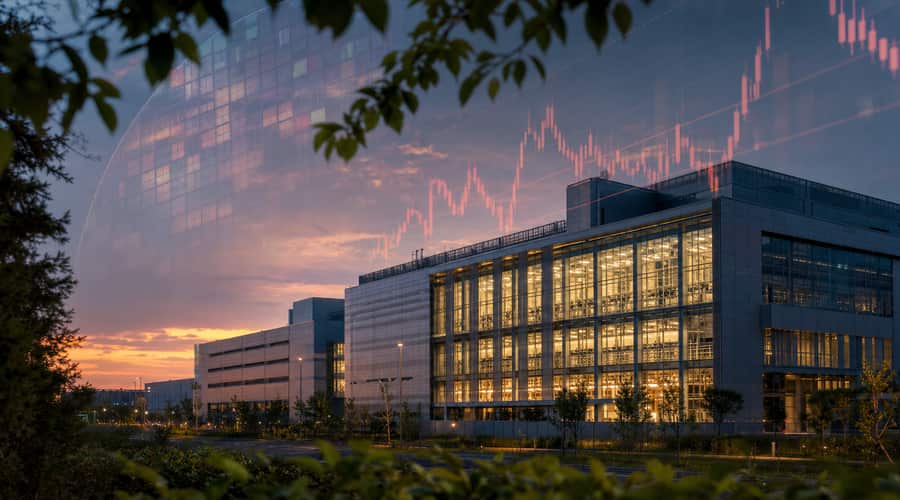
The Philadelphia Semiconductor Index closed Friday more than 20% below its late June record, putting the 30-stock chip gauge into bear-market territory. Bloomberg reported that the SOX fell as much as 5.7% during the session and had erased about $3.3 trillion in chip-company market value since June 22. You don't need a finance degree to read that move. The trade cracked.
The immediate trigger was Moonshot AI, the Beijing startup founded by Yang Zhilin. Moonshot unveiled Kimi K3 on Thursday, a 2.8 trillion-parameter open-weight model that the company says comes close to leading systems from OpenAI and Anthropic on several coding and reasoning tests. CNBC and other outlets framed it as another Chinese model challenging the cost structure behind American AI. The weights are expected to be publicly released by July 27, according to MarketWatch and other reports, so this is not yet a simple case of anyone downloading the whole thing today. The promise is enough to move money.
The fear is simple. If a Chinese lab can approach frontier performance with a model designed around lower-cost access and open-weight distribution, investors have to ask whether every new AI workload needs another mountain of Nvidia GPUs. That question hits chip stocks directly, because the past two years of valuations have rested on the opposite assumption.
Bloomberg's market framing captured the mood neatly: chip stocks sank into a bear market after a 105% AI rally fizzled. That rally began from the March low and ran into June on the belief that AI infrastructure spending had no obvious ceiling. Applied Materials, Lam Research, Intel, KLA and Arm Holdings each fell about 4% on Friday. Micron and Nvidia dropped more than 2%. The comparison to January 2025, when DeepSeek's low-cost model shocked Nvidia's valuation, is not forced. Traders remember that day.
The selloff was not confined to semiconductors. CNBC reported that the S&P 500 fell 1%, the Nasdaq Composite dropped 1.4%, and the Dow lost 406 points on Friday. For the week, the Nasdaq lost more than 2%, its worst stretch since March. When a model release in Beijing can knock that much confidence out of New York, you are not looking at a small technical debate inside AI labs. You are looking at a market narrative under stress.
The chip story has become too neat
Frankly, the panic says less about Kimi K3 alone than about how fragile the AI capex forever thesis had become. For two years, the bull case for chipmakers has been easy to say: whoever spends the most on compute wins, so demand for advanced GPUs keeps climbing. Kimi K3 pushes against that story. It says better models may come from efficiency, architecture and open distribution, not only from buying more expensive silicon.
That does not make the chip thesis dead. The SOX is still up sharply from its March low, and some of Friday's damage was already being bought by investors looking for a dip, according to Yahoo Finance. Memory makers Micron, Samsung Electronics and SK Hynix had already been under pressure before Kimi K3 became the headline. This correction has more than one cause.
Still, Friday changed the question chipmakers have to answer. Investors are not panicking because AI has failed. They are panicking because AI might get cheaper faster than the industry priced in. That's a harder problem than one bad earnings report, because it is not about this quarter's revenue. It is about whether the next decade of GPU orders looks anything like the last two years.
Moonshot is not a household name in the United States yet, not the way DeepSeek became one overnight in January 2025. Yang Zhilin's company is backed by major Chinese investors, and Bloomberg reported in May that Moonshot was valued at more than $20 billion after a Meituan-led funding round. That is not a fringe lab tossing a benchmark onto the internet. It is a serious Chinese AI company using openness and cost as weapons.
Open weights change the pressure
Closed-model companies can still argue that the best systems remain ahead. They have a case. Several reports noted that Kimi K3 appears strongest in coding and front-end tasks, while top US models still lead on some broader capability tests. But you should not dismiss the market reaction as ignorance. Investors are not trying to settle an AI leaderboard. They are pricing the risk that good-enough models become cheap enough to blunt part of the hardware boom.
That is the real issue for Nvidia, AMD, memory suppliers and chip-equipment makers. The market does not need Kimi K3 to beat every American model in every test. It only needs enough companies to decide that an open-weight Chinese model, hosted on their own terms, can handle routine enterprise work at a lower price. Platforms like OpenAI, Anthropic, Google, you name it, still have stronger brands and deep distribution. But price has a way of becoming a brutal editor.
Moonshot's model may not be the end of the AI chip rally. It is too early for that. The full weights are not out yet, benchmark claims still need outside testing, and running a 2.8 trillion-parameter model is not cheap just because the model is open. Keep those caveats. They are real.
But the market is right to be nervous. A rally built on infinite demand has very little room for evidence that demand may become more efficient. Kimi K3 gave investors that evidence, or at least enough of it to make them sell first and check the benchmarks later.
Also read: Congress Takes the CLARITY Act to Wall Street as the Senate Clock Runs Out, DeepSeek Keeps Beating Billion-Dollar AI Labs on a Fraction of Their Budget, Kimi K3 Forces Wall Street to Question America's Grip on AI Leadership