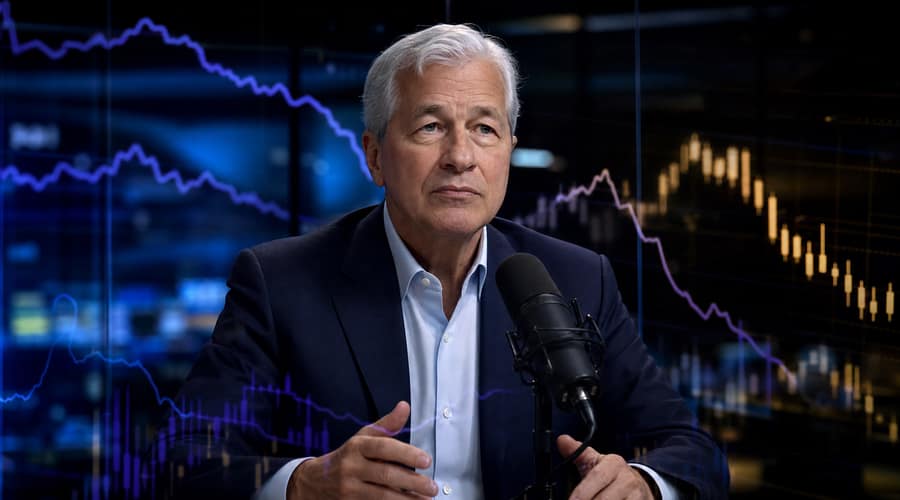
Jamie Dimon says he wouldn't buy the broad stock market or long-dated U.S. Treasurys at these prices. When the CEO of JPMorgan Chase says both sides of the classic portfolio look thin, you should listen.
Jamie Dimon didn't hide behind polite market language. In an episode of Wilfred Frost's "The Master Investor Podcast" posted on July 21, 2026, the JPMorgan Chase chairman and CEO said he wouldn't be a buyer of long-dated government bonds here, and he wouldn't buy the S&P 500 at this level either. Asked about long bonds, his answer was blunt: "Personally, no."
Why Dimon Won't Buy Either One
That's a hard call from the man running the biggest bank in the United States. The podcast page says the conversation took place on July 16 in Washington. MarketWatch reported that Dimon saw little upside in Treasurys, even if inflation falls toward the Federal Reserve's 2 percent target. He put fair value for the 10-year Treasury yield around 4 percent to 4.5 percent, with short-term rates around 3.3 percent. Rates are already close enough to make the trade look poor. Not much room left.
Bond math is unforgiving. When yields rise, prices fall. So if you're buying long bonds today, you need a real reason to believe yields have room to move lower. Dimon is saying he doesn't see it.
His stock-market view is slightly different, but it comes from the same place. The podcast description says he isn't buying the broad equity market at current levels because investors may be underestimating deficits, interest rates, geopolitical instability, and the timing of AI returns. He isn't calling every company overvalued. He'd rather pick individual stocks than buy the index. That's a narrower point, but it still matters.
The market has given investors plenty of reasons to feel comfortable. AP reported that, as of July 14, the S&P 500 was up 10.2 percent for 2026, while the Nasdaq had gained 12.3 percent. MarketWatch reported on July 15 that the S&P 500 was again near record levels. Dimon isn't arguing that the tape is weak. He's saying the price you pay now doesn't leave enough room for the risks you can already see.
Frankly, that's the part worth taking seriously. A calm market can still be expensive.
The Credit Market Is Already Nervous
You can see the same argument in AI infrastructure debt. Oracle is the clearest case. The Motley Fool reported in April that Oracle's non-current debt had risen to roughly $124.7 billion at the end of its fiscal third quarter, up from about $85 billion a year earlier. Oracle itself announced in February that it planned to raise $45 billion to $50 billion in gross cash proceeds during calendar 2026 through a mix of debt and equity to fund Oracle Cloud Infrastructure demand from customers including OpenAI, Meta, Nvidia, AMD, xAI and TikTok.
That isn't small borrowing. It is a giant balance-sheet bet on future AI demand.
The pressure has not stayed theoretical. Business Insider reported this month that S&P Global downgraded Oracle to BBB-, one notch above junk, citing heavy infrastructure spending and exposure to OpenAI. FT reported on July 21 that Oracle could also face more than $7 billion in collateral tied to a Wisconsin data center project after state regulators upheld stricter credit rules for large power users. The details are dry, but they matter. Credit markets notice strain before equity markets are ready to admit it.
Meta is not Oracle, and it has a stronger balance sheet. Still, the direction is similar. Reuters reported in April that Meta sold $25 billion of investment-grade bonds after lifting its 2026 capital expenditure forecast to $125 billion to $145 billion. Its March 2026 filing said the company had $59 billion of long-term debt outstanding and expected that same capex range to support its AI efforts and core business.
None of this proves the AI trade is fake. It proves the AI trade is expensive to finance, and that distinction matters if you're a founder, investor, or employee whose company depends on generous capital markets. AI infrastructure can pay off and still disappoint investors who paid for perfection too early. Dimon made that point directly on the podcast: AI will probably pay off, but not necessarily in the way or timetable investors expect.
So don't treat his comments as a crash forecast. Treat them as a pricing warning. If the most influential banker in America won't buy the broad market here, and won't buy long bonds either, you should stress test the assumptions sitting inside your own plans: exit timing, fundraising windows, hiring pace, and debt costs. A correction doesn't need one dramatic trigger. It only needs enough investors deciding the reward no longer covers the risk.
Dimon just said he's one of them.
Also read: Natural raised $30 million to give AI agents their own bank accounts • South Korea Opens a Formal Sanctions Case Against Upbit's Parent Dunamu • Revolut secures a full banking licence from Australia's APRA