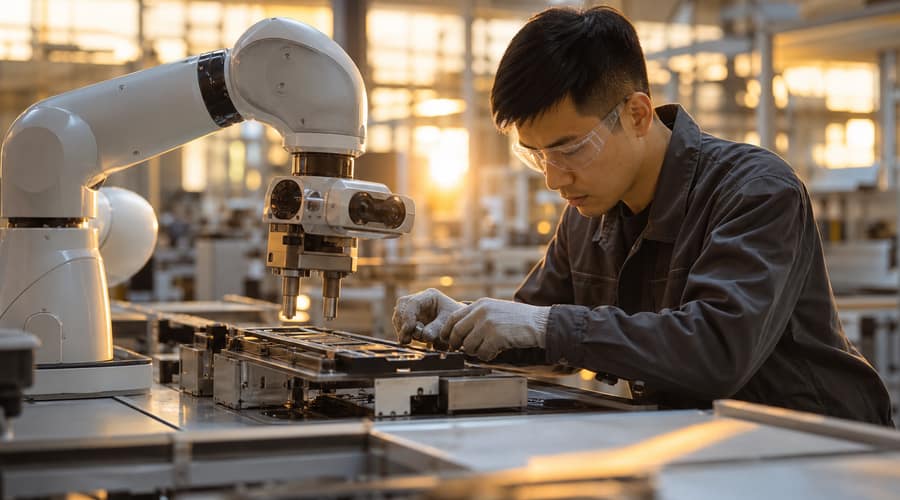
China's AI cobot boom is real, but the strongest version of the story is more specific than the science fiction frame: factories are buying robot arms because labor is getting scarcer, wages are rising, and the hardware now pays for itself.
The robot standing beside a worker in Shenzhen or Shanghai doesn't need a face to matter. It needs a camera, force sensing, a model that can follow instructions, and enough restraint not to injure the person next to it. That's the cobot story in China right now. Not a glossy humanoid future. A working factory tool.
The timing is current. The Associated Press reported that Shanghai's World AI Conference, held from July 17 to July 20, showcased more than 400 humanoid robots, according to Chinese state media. That spectacle gets attention, and you can see why. But the quieter industrial shift is happening in collaborative robots, where machines already fit into electronics assembly, warehouse movement, polishing, laboratory handling, and hospital logistics.
According to Tianxia Gongchang Research, China's domestic cobot market reached about RMB 2.9 billion in 2025, with roughly 49,500 units shipped and year-over-year growth of 45.59%. The International Federation of Robotics gives the broader scale: China installed 295,000 industrial robots in 2024, equal to 54% of global deployments, and Chinese manufacturers sold more units than foreign suppliers in their home market for the first time, with a 57% domestic share.
The math is blunt
China's labor problem isn't theoretical. Universal Robots, citing UN population prospects, has pointed to a projected loss of 143 million workers from 2023 to 2043. Tianxia Gongchang Research says China's manufacturing minimum wage has risen 6% to 8% a year since 2018, and that a cobot priced around RMB 80,000 to RMB 100,000 sits inside a payback calculation most factory managers can understand without a strategy deck.
That is the point. A cobot doesn't have to replace every worker to win the budget meeting. It only has to take over the job that is hard to staff, punishing to run, or just too expensive to cover across shifts. If you operate a line where one motion happens thousands of times a day, the argument stops being futuristic very quickly.
The AI layer makes this different from the older robot arms locked behind cages. Tianxia Gongchang Research describes JAKA's Lumi platform as a 12-degree-of-freedom system with RGB-D sensing, force sensing, tactile skin, and a natural-language task interface. Dobot's autonomous mobile manipulation robots combine cobot arms with AMR bases for transport and pick-and-place work, while Flexiv's Rizon line is built around seven-axis motion and force control for contact-heavy tasks such as abrasion, inspection, and assembly.
These are not all the same machine. That's worth saying, because robotics coverage often collapses every arm, dog, and humanoid into one word. A six-axis cobot loading a CNC machine is a completely different thing from a bipedal humanoid folding towels - the sensors are different, the control logic is different, the jobs and price points are nothing alike. Not a warehouse AMR with a gripper either. The market is moving because companies are matching the right narrow machine to the right narrow job, and getting specific about which is which.
Robots still need teachers
This is the strange part. China's robot boom still depends heavily on human labour. Rest of World reported in January that local governments had funded more than 40 robot training centers, with about two dozen already operating, where workers repeat motions such as folding clothes, wiping tables, and opening appliances so humanoid robots can learn from the data. In June, Rest of World also reported that JD.com planned to generate 10 million hours of robotics training data over two years in Suqian, using residents, care workers, farm workers, and eventually far larger data-collection groups.
So yes, workers are teaching machines some of the tasks those machines may later do. The irony is obvious. But it also shows why broad humanoid deployment is still a harder story than the shipment numbers suggest. Motion labeling, error correction, real-world testing - it is still work, and a lot of it. For now, a lot of the robot economy is people helping robots become useful.
The production numbers are still hard to ignore. Omdia data reported by TechNode put AgiBot's 2025 humanoid shipments at 5,168 units, or 39% of the global market. Forbes, also citing Omdia, put Unitree at 4,200 units, though Jiemian later reported that Unitree said it shipped more than 5,500 humanoid robots to end customers in 2025. That distinction matters, because the field is young and shipment numbers can mix sales, demos, pilots, and partner units if you're not careful.
BYD adds another kind of pressure. TechTimes, citing CnEVPost and TechNode, reported in June that BYD had been working for roughly four years on a humanoid program codenamed Yao-Shun-Yu, with about 150 prototypes in use and plans for 20,000 robots inside its own factories this year. That is not a pilot in the start-up sense. It is an automaker using its own production lines as the proving ground.
Your cobot colleague probably isn't coming for your job next quarter. But if you work in manufacturing, logistics, or healthcare in China, there's a fair chance you're already near one, or will be soon. Frankly, that is enough. Science fiction stopped being the useful frame sometime around 2024. The question now is which jobs get redesigned first, and how much of the rest of the world has to buy its automation from companies already learning at Chinese factory scale.
Also read: Singapore tightens cybersecurity rules for critical infrastructure after China-linked hack hit all four major telcos • Higgsfield AI tells creators they own their videos but quietly claims a perpetual worldwide license to train on them • The world's best green fund is up 34% by betting Japan holds the answer to AI's power crisis