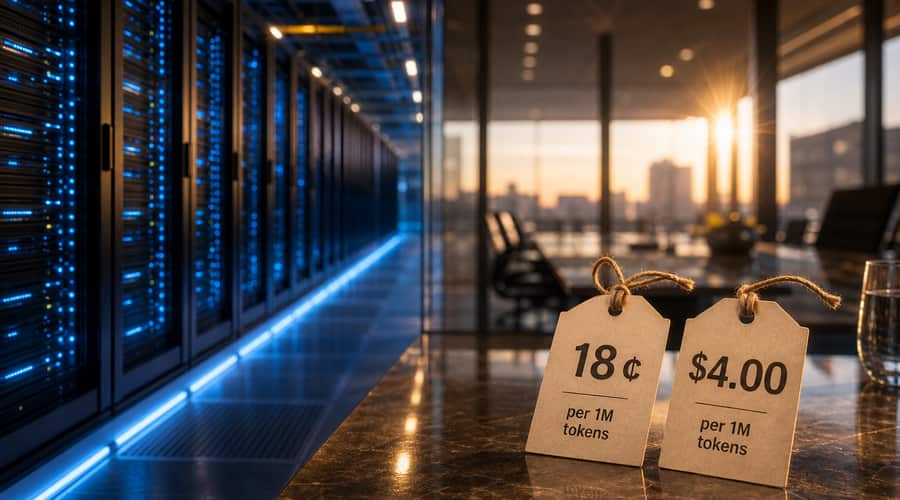
Satya Nadella's argument is simple: cheap Chinese AI will win plenty of developers, but enterprises still pay for trust, governance, and the ability to audit what runs inside their perimeter.
The price gap is not subtle. Some leading Chinese AI models now charge cents per million tokens, while top US frontier models can run several dollars per million. That spread is already moving real money. The New Stack reported in June that Lindy moved 100 percent of its AI agent traffic from Anthropic to DeepSeek v4, after CEO Flo Crivello said the switch would save the startup millions of dollars.
That's not a footnote. For a small company burning through tokens every time an agent searches, reasons, retries, and calls more tools, model choice becomes a finance decision before it becomes a philosophy. If you can get acceptable performance at a fraction of the cost, you don't need a white paper. You switch.
Satya Nadella's answer is that the startup market isn't the whole market. Business Insider reported that, in an interview with CNN's Fareed Zakaria, the Microsoft CEO said trust in US technology and its wider digital ecosystem would matter more over time than the short-term pull of cheaper Chinese models. He is talking about enterprises, not hobby projects. Large organizations won't casually hand proprietary workflows, customer data, and internal reasoning traces to infrastructure they can't audit or govern.
They'll pay for control. Frankly, many already do.
The trust wrapper is the product
Nadella has been working this argument from more than one angle. In a July 12 essay on X, he warned that companies can end up "paying for intelligence twice," first with money and then with the proprietary knowledge they feed back into AI systems. His prescription was not to stop using AI. It was to make sure enterprises own their data, evaluations, traces, memory, orchestration, and adapted model weights.
That maps neatly onto Microsoft's business. A company using Azure AI Foundry or Microsoft 365 Copilot is not only buying access to a model. It's buying the surrounding controls: identity, compliance, data residency, admin policies, audit logs, and the contractual machinery a procurement team can live with. The model matters, but the wrapper matters too.
Axios reported in June that Microsoft was considering adding DeepSeek as a lower-cost option for Copilot Cowork, hosted on Azure and covered by Microsoft's security, compliance, and data-residency controls. That detail changes the argument. Microsoft does not have to pretend Chinese models don't exist - and it isn't. It can say: use them here, inside our perimeter, under our rules, and we'll stand behind them contractually. That's a harder position to attack on price alone.
The open-weight fight makes the same point from a different direction - one that involves much bigger names. Tom's Hardware reported that Nvidia, Microsoft, Meta, IBM, Dell, Palantir, Hugging Face, and others signed a July 24 letter urging Washington not to impose premature restrictions on downloadable AI models. OpenAI, Anthropic, and Google were not on the list. The split is revealing. Infrastructure companies benefit when more models can run on more clouds and more chips. Closed model labs have a different incentive.
Sanctions make cheap models look less simple
The geopolitical picture shifted again last week. Business Insider reported that Treasury Secretary Scott Bessent warned Chinese AI companies could face sanctions if they used industrial-scale distillation to steal US intellectual property. Bessent did not name specific companies in those remarks. Separately, Anthropic has accused DeepSeek, Moonshot AI, and MiniMax of illicitly extracting Claude's capabilities, and House committees opened an April investigation into Chinese models from DeepSeek, Alibaba, Moonshot AI, and MiniMax.
No broad sanctions had been implemented as of the latest reports. But the warning alone changes the calculation for risk-averse buyers. A Series B startup switching from Anthropic to DeepSeek to reduce burn is making a survival decision. A Fortune 500 company doing the same has a legal department, a board, and customer contracts to think about - and possibly government work on top of that.
That is where Nadella's bet gets stronger. If a model is cheap but sits inside a procurement gray zone, the cost advantage narrows quickly. You may save on inference and spend the savings explaining the decision to compliance.
Still, Microsoft should not confuse enterprise caution with permanent protection. OpenRouter's public rankings have shown Chinese open-weight models taking major share on its platform, and AP reported that Chinese systems from Moonshot, Alibaba, Z.ai, and DeepSeek are gaining traction because they are open, widely available, and increasingly capable. Z.ai's GLM-5.2 and Moonshot's Kimi K3 are not distant science projects. Developers are trying them now.
The real contest is not America versus China in the abstract. It is cheap model access versus trusted deployment. Nadella is right that the second matters more to large customers, but the first is moving faster than most incumbents like to admit. Price wins first. If Microsoft can put lower-cost models inside a cloud enterprises already trust, it has an answer. If it can't, price will keep pulling usage away from the companies that assumed trust alone would be enough.
Also read: Meta sold 80% of its Louisiana data center to Blue Owl Capital the day regulators approved the gas plants to power it • Congress wants to freeze state AI laws for three years and state lawmakers are refusing to go quietly • Amazon and Microsoft are spending $400 billion on AI this year and investors want to know when it pays off