Meta's Louisiana data center financing shows the problem with the AI buildout: the company gets flexibility, while utility customers are being asked to trust contracts they didn't get to scrutinize.
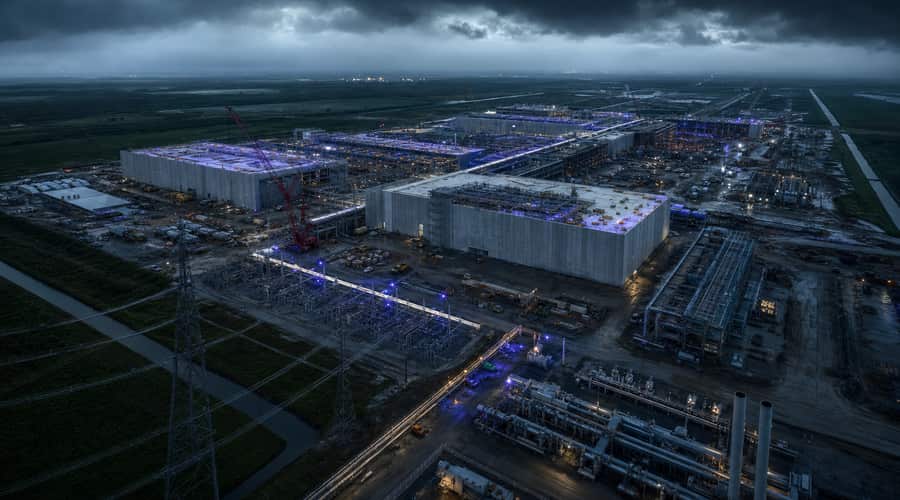
Louisiana regulators approved three new gas-fired power plants for Meta's Hyperion data center before the public had a clear view of the financing structure now sitting behind the project. That's the issue. Not whether Meta wants more compute, which it plainly does. Not whether Richland Parish wants jobs, which it plainly does. The hard question is who carries the risk if a $27 billion data center financing plan outlives Meta's appetite for the site.
On August 20, 2025, the Louisiana Public Service Commission approved Entergy Louisiana's plan for three 754-megawatt gas plants, about 2.26 gigawatts in total, along with transmission work for Meta's Richland Parish campus. S&P Global reported that the commission approved the settlement in a 4-1 vote, with Commissioner Davante Lewis voting against it. The scale was already large. Meta had first announced the project as a $10 billion data center. By July 13, 2026, Meta said it was expanding the campus to 5 gigawatts of compute capacity and more than $50 billion of investment in the region.
The ownership structure is where this stops looking like an ordinary utility growth story. In October 2025, Meta announced a joint venture with funds managed by Blue Owl Capital to develop and own Hyperion. Blue Owl-managed funds took 80% of the venture. Meta kept 20%. S&P Global Ratings said Beignet Investor LLC, a Blue Owl-backed holding company, was issuing $27.3 billion of senior secured debt due in May 2049 to fund its side of the project. The debt sits with Beignet, not directly on Meta's balance sheet.
Here's the part you should care about. Meta's lease agreements with the joint venture have a four-year initial term, according to Meta's own announcement, with options to extend. Meta also provided a residual value guarantee for the first 16 years of operations if certain conditions are met after a non-renewal or termination. That guarantee matters, but it doesn't erase the basic problem for ratepayers: the power plants are long-lived utility assets, while the customer arrangement is built with exit flexibility.
The Utility Deal Came First
The Louisiana PSC was asked to judge whether Entergy's power plan protected customers. According to S&P Global's August 2025 report, Entergy told regulators the settlement would mitigate cost-shift risk, and an Entergy executive said the monthly bill effect for customers would be around plus or minus one dollar over time. That's the utility-side argument. It depends on contracts, guarantees and demand forecasts doing exactly what they're supposed to do.
Consumer and environmental groups weren't satisfied. The Louisiana Illuminator reported in February 2026 that regulators rejected a request to investigate whether Meta's transfer of an 80% stake in the data center could leave Entergy customers exposed. Earthjustice, the Alliance for Affordable Energy and the Union of Concerned Scientists had pushed for that review. The commission said no.
Frankly, that is too thin for a project this large. A state utility commission doesn't need to become Morgan Stanley. But if a utility is building gas plants for one enormous technology customer, and that customer's project is later financed through a Delaware holding company and multibillion-dollar private debt, regulators need enough visibility to test the risk. Otherwise, the public is being asked to accept the downside on faith.
AI Infrastructure Is Moving Faster Than Regulators
The Wall Street Journal described the Hyperion structure as "Frankenstein financing," a phrase that stuck because it captures the mix: private equity, project finance and investment-grade bonds stitched into one AI infrastructure vehicle. S&P's October 2025 rating note put numbers under it: $28.79 billion in committed development costs, $23.03 billion from Blue Owl-affiliated funds for their 80% interest, and $5.76 billion from Meta's Iris Crossing LLC for the remaining 20%.
This is not just a Louisiana story. The New York Times reported in December 2025 that Meta used Beignet Investor LLC and Blue Owl to finance Hyperion while agreeing to rent the data center through a series of four-year leases. The same report said other tech companies were interested in similar structures. You can see why. Meta gets capacity for AI training without carrying the whole project as ordinary corporate debt. Blue Owl gets exposure to a huge data center asset tied to a strong tenant. Bond investors get a long-dated security with Meta-linked economics.
Everyone gets something.
The weak spot is public oversight. Microsoft, Google, Amazon and Meta are all chasing power at a scale that would have sounded extreme before the current AI race. Local regulators are being asked to approve generation and transmission projects on timelines that suit hyperscalers, not necessarily households. When the financing is simple, that is hard enough. When the customer risk runs through special-purpose entities, bond offerings and residual value guarantees, the old utility-review model starts to look badly outmatched.
Meta has said the Richland Parish expansion will support more than 7,500 jobs at peak construction, 1,000 operational roles, more than $1 billion in local infrastructure improvements and projected Entergy customer savings of $2.65 billion over 20 years. Those are real claims from the company, and Louisiana officials will understandably want the investment. But jobs and tax revenue don't answer the stranded-asset question by themselves.
The next version of this deal will not wait for Louisiana to sort out the last one. BlackRock is already leading a separate $12 billion financing for a Meta data center project in El Paso, Texas, according to the Wall Street Journal. The template is spreading. If you want the grid built around AI, you need regulators who can read the financing as closely as they read the power application.
Also read: Google backs Proxima Fusion in €411 million round as Big Tech bets on stellarators to solve the power crunch • Amazon and Microsoft are spending $400 billion on AI this year and investors want to know when it pays off • LG Electronics wins Korea's first Nvidia liquid cooling certification as AI data centers hit a heat wall