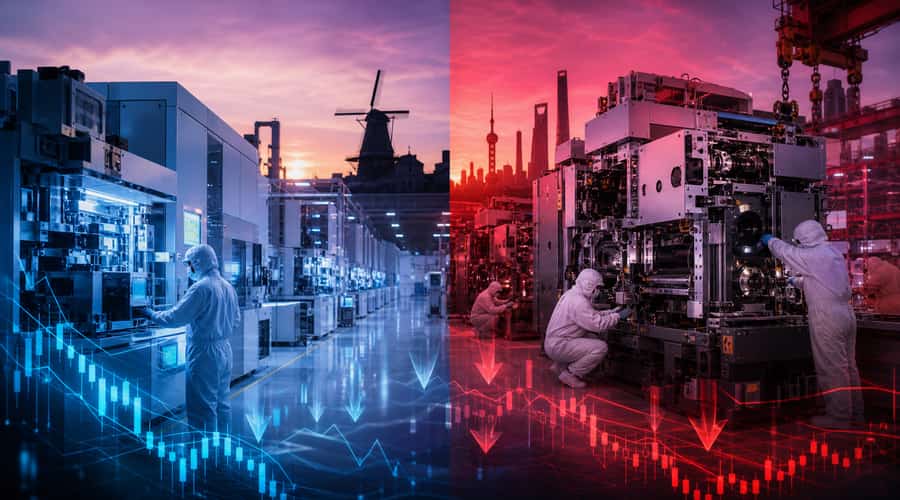
China has begun limited production of homegrown immersion DUV lithography tools, and ASML investors reacted hard. The sharper question is not whether China has caught ASML, but whether export controls have helped create the rival they were meant to delay.
The Information reported that an unnamed state-backed company in Shanghai has started making domestically developed immersion DUV lithography machines. These are the tools chipmakers use to print circuit patterns onto silicon wafers. Reuters carried the report Monday, and ASML shares fell about 4.6% after it landed, with Applied Materials, KLA, Lam Research, and the rest of the U.S. equipment names also dragged lower. That part checks out.
What needed fixing is the name. The report did not clearly say Shanghai Yuliangsheng Technology itself is the company now mass-producing the machines. It said the Shanghai company brought together development teams from other Chinese firms, including Yuliangsheng, and that people familiar with the situation asked for the company not to be identified. So you should not write this as a clean Yuliangsheng launch. That turns an anonymous-sourced report into a named-company claim the reporting doesn't support.
The numbers are small, but they are not trivial. The Information said the Shanghai firm plans to manufacture about five DUV machines this year and roughly 20 in 2027, with deliveries slated for Chinese chipmakers including SMIC, Hua Hong Semiconductor, and ChangXin Memory Technologies. ASML shipped 131 immersion DUV systems last year, according to the same report. Five machines won't dethrone Veldhoven. They do something else: they give China a domestic machine to test, break, improve, and send back onto the fab floor.
The claim is narrower than the selloff
SMIC began testing a Chinese-made immersion DUV tool from Yuliangsheng in 2025, according to Financial Times reporting later cited by China Daily, Electronics Weekly, and other industry outlets. That tool was described as targeting 28nm-class production, with multi-patterning offering a path to finer nodes at higher cost and lower efficiency. Don't overstate that. A 28nm-capable tool is not an EUV replacement, and it is not proof that China can suddenly manufacture leading-edge chips at competitive yield.
But mature-node capacity matters. Cars, appliances, industrial equipment, power-management chips, and parts of the AI server supply chain still depend on less advanced semiconductors. If Chinese fabs can use domestic immersion DUV machines for even a slice of that work, ASML's China business becomes less protected. It matters.
ASML's China exposure was already shrinking. Caixin reported in April that mainland China accounted for 19% of ASML's first-quarter sales, down from 33% for full-year 2025 and 36% in the fourth quarter. In January, Caixin also reported that ASML expected China to fall to about 20% of total 2026 revenue after a backlog-fueled surge. That was the floor investors thought they understood: EUV was banned, but DUV still had room to run.
The new report makes that floor look less solid. ASML can still lean on AI demand outside China. Reuters reported on July 15 that ASML raised its 2026 net revenue outlook to 43 billion to 45 billion euros after a stronger second quarter, with chief executive Christophe Fouquet pointing to very strong order intake tied to AI chip demand. TSMC, Samsung, SK Hynix, Micron, Intel, you name it, advanced chip capacity still runs through ASML in ways China cannot yet copy.
Yield is the hard part
Look at the operational problem. Moving a domestic DUV machine from early production into high-volume fab use can take months or years because accuracy, reliability, uptime, and a dozen other integration pressures all have to hold under real manufacturing conditions. The Information's own report said the Chinese machines still trail ASML's products in performance and build quality. That gap matters.
SMEE, China's longer-running lithography company, has also been working on the 28nm DUV problem. Tom's Hardware reported last year that SMEE had formally introduced its SSA/800-10W immersion ArF DUV machine, while also noting that its website still listed the older SSA600 dry scanners as its most advanced commercial tools. Chinese media later reported first-batch SSA800 deliveries, but even those reports have been contested inside China. The clean conclusion is modest: China has multiple domestic lithography efforts moving, but public evidence on volume, yield, and customer use is still thin.
That is the real story. The U.S. Commerce Department and allied governments restricted China's access to EUV and then tightened parts of the DUV channel. Those controls slowed China in the short term. They also gave Beijing a clear list of what it had to localize. Huawei-linked SiCarrier, Yuliangsheng teams, SMEE, and state-backed suppliers did not appear from nowhere.
Frankly, ASML is not in immediate danger of losing the lithography market. Its tools have decades of process knowledge behind them, plus a service network Chinese suppliers cannot replicate overnight. Investors sold the stock because monopoly assumptions are fragile once a credible domestic alternative gets onto a customer floor. Five machines are not a revolution. They are a start, and starts are exactly what export controls were supposed to prevent.
Also read: Washington threatens to sanction Chinese AI firms over distillation theft as Beijing fires back • Nvidia takes a stake in Safe Superintelligence and gets access to Ilya Sutskever's research in return • Brian Armstrong tells crypto founders who pivoted to AI they got it backwards