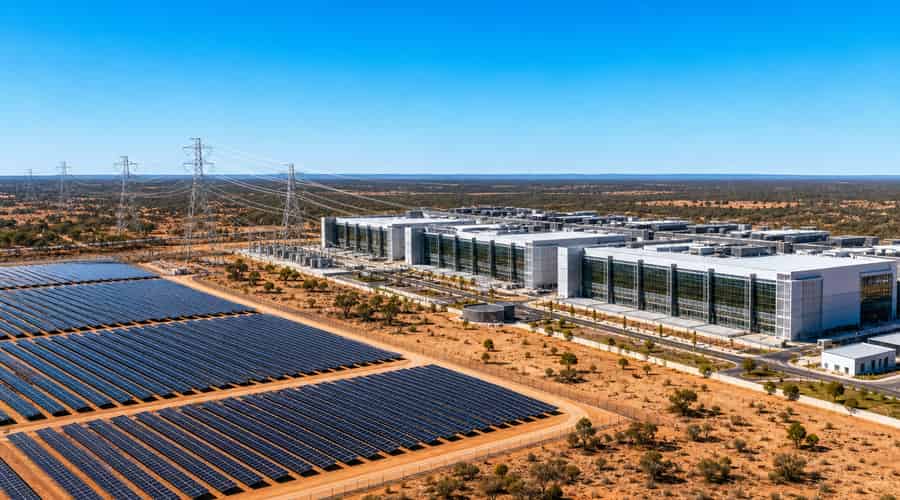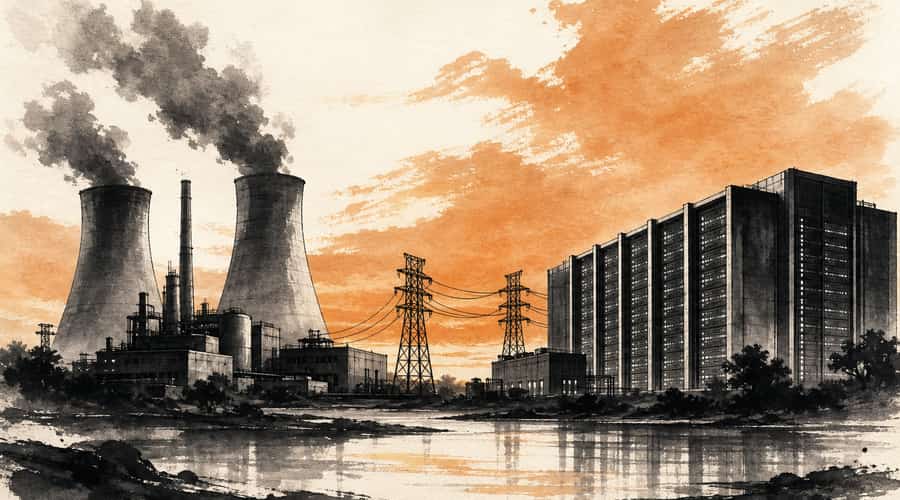
The EPA's July 16 interpretation gives data center owners a cleaner path to run private power plants outside the Acid Rain Program. You shouldn't treat it as settled law.
There's no polite way to say it: this is a very big deal, and it could also be a fragile one. Inside EPA reported that a July 16 memo from Aaron Szabo, the EPA's Assistant Administrator for Air and Radiation, says so-called islanded power generation, plants that serve a data center without connecting to the public grid, is not subject to the Clean Air Act's Acid Rain Program. If the plant isn't supplying the grid, the EPA's reading is that the acid rain rules don't attach.
That sounds technical. It isn't small. The Acid Rain Program, created under Title IV of the Clean Air Act, requires major reductions in sulfur dioxide and nitrogen oxides from the power sector. Those pollutants are not abstractions if you live near the smokestack. They shape the air people breathe, and the monitoring and allowance rules are part of how the federal government has controlled them for decades.
The timing tells you why the ruling matters. Data centers are chasing power faster than the grid can deliver it. A July 2026 analysis from the Center for Strategic and International Studies noted that developers in some regions can now wait as long as seven years to bring new data centers and other large loads online. The queue is that long. That is why private power is suddenly central to the AI buildout. If you can't wait for the grid, you build beside it, behind it, or away from it.
Microsoft's power strategy shows the pressure clearly. Constellation announced in September 2024 that Microsoft signed a 20-year power purchase agreement tied to restarting Three Mile Island Unit 1 in Londonderry, Pennsylvania, now renamed the Crane Clean Energy Center. That plant is expected to add about 835 megawatts of carbon-free power to the grid. Chevron went a different direction in June 2026, announcing a 20-year agreement to develop Project Kilby in West Texas, a co-located natural gas facility expected to deliver about 2.67 gigawatts of dedicated capacity for a Microsoft-operated data center, with first power targeted for 2028 if the project reaches a final investment decision by the end of 2026.
This is where the EPA interpretation becomes useful to hyperscalers. A natural gas or diesel plant built only for a data center campus may now avoid Acid Rain Program compliance: sulfur dioxide allowances, nitrogen oxide controls under that program, and the monitoring structure that comes with it. For a developer already fighting equipment delays, local opposition and power-market bottlenecks, that is real money and real time.
Don't mistake that for certainty.
The legal fight is already forming
The Sierra Club's response to the EPA's broader air-permitting push was blunt. In a July statement on the agency's minor-source permitting proposal, senior adviser Jeremy Fisher said the plan opened the door to silencing communities worried about air quality and health impacts from thousands of diesel generators and other pollution sources. The Environmental Defense Fund made the same fight from another angle, saying at a July 22 EPA hearing that public participation is a key safeguard in air permitting. Comments on that minor-source proposal are due August 21, 2026.
The islanded-power memo sits next to those fights, not apart from them. The EPA also proposed in May 2026 to let developers begin work on non-emitting components, such as cement pads, wiring, piping and support structures, before obtaining a major New Source Review permit. Put the pieces together and you can see the direction of travel: faster construction for power generation, looser public-participation rules for many smaller permits, and a narrower reading of the Acid Rain Program for private data center plants.
Frankly, companies would be foolish not to study the opening. They would be just as foolish to book it as permanent.
Szabo's memo is an agency interpretation, not a final rule that has gone through notice and comment. Courts can still test whether the EPA's reading fits the Clean Air Act. Since the Supreme Court's June 28, 2024 Loper Bright decision overturned Chevron deference, judges are no longer required to defer to an agency's interpretation simply because a statute is ambiguous. That matters here because the whole exemption depends on statutory reading, not on a new act of Congress. The statute hasn't changed.
There is already a live model for the litigation risk. Environmental groups recently threatened Clean Air Act litigation in San Antonio against Vantage Data Centers and VoltaGrid over alleged air pollution from gas and diesel generators at data center sites, according to the San Antonio Express-News. Separately, litigation over turbines powering xAI-linked data center operations in Mississippi has tested whether mobile gas turbines can be treated as unpermitted stationary sources. A June SEC filing for SpaceX-related offering materials disclosed a $399 million accrual for probable and reasonably estimable litigation losses across multiple matters, including a complaint tied to mobile gas turbines powering the COLOSSUS II data center.
For investors, that is the part to keep in view. The EPA has cleared a lane for islanded power, but it hasn't removed the roadblocks waiting in court, state permitting offices or local communities. Build the plant if the economics work. Just don't pretend an assistant administrator's memo is the same thing as settled law.
Also read: Ares Management has held talks to acquire Leonard Green and partners in a deal that would reshape mid-market private equity • OpenAI's first hardware product sold out in 12 hours and is now flipping on eBay for $1,850 • X Money goes live nationwide with 6% APY and a Visa card but Elon Musk still doesn't have a bank