SpaceX's acquisition of xAI in February 2026 has fused one of the most profitable satellite businesses ever built with an AI lab burning $1 billion a month, and Starlink's cash machine is what makes the math work.
The numbers are striking on their own. SpaceX generated roughly $8 billion in profit against $15 to $16 billion in revenue in 2025, with Starlink contributing between 50% and 80% of that total, according to Reuters. Quilty Space projects Starlink alone hitting $20 billion in revenue and $14 billion in EBITDA in 2026. Those are margins that most technology businesses would consider unreachable, and they are being generated by a satellite internet service that crossed 10 million subscribers globally in February 2026. What makes those figures newly consequential is where the money is going.
In February 2026, SpaceX acquired xAI, Elon Musk's artificial intelligence venture and developer of the Grok large language model, in a deal that valued the combined entity at roughly $1.25 trillion. xAI had closed a $20 billion Series E round in January 2026 at a $230 billion valuation, with backers including Nvidia, Cisco, the Qatar Investment Authority, and Tesla. Despite that capital, xAI was burning approximately $1 billion per month competing against OpenAI, Google DeepMind, and Anthropic. Starlink's steady cash generation is the financial engine that makes that burn rate sustainable without requiring constant external fundraising.
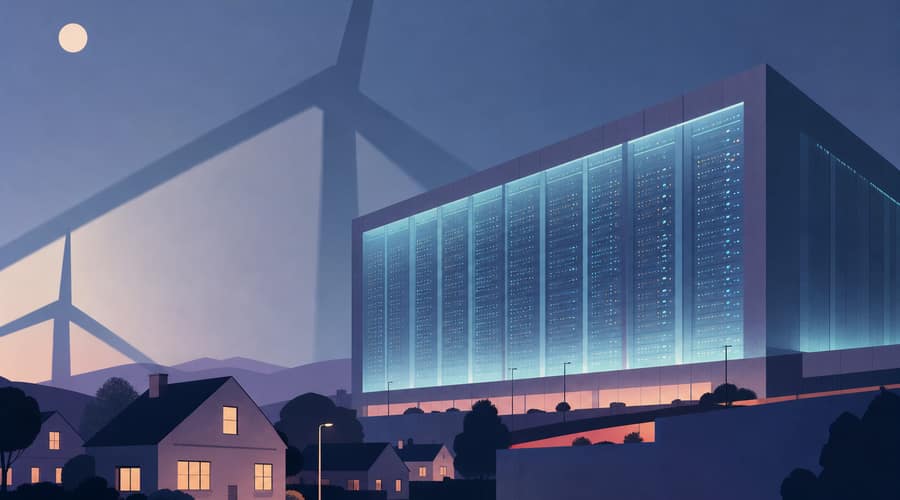
The merger's strategic logic extends well beyond plugging a funding gap. SpaceX has applied to US regulators for permission to deploy up to one million satellites in low Earth orbit, compared with roughly 27,000 currently authorized for Starlink. Alongside that application, Musk confirmed plans to place AI data centers directly in orbit, arguing it is the only viable path to the compute scale the next generation of AI models will require. Terrestrial data centers face hard constraints: power availability, water for cooling, land, and an increasingly difficult regulatory environment. Orbital infrastructure runs on continuous solar power, eliminates the cooling problem, and sits above most jurisdictional reach.
Next-generation Starlink V3 satellites are being designed with AI chips embedded for on-orbit compute, turning the constellation from a passive connectivity layer into an active inference platform. As Bloomberg's analysis of the merger noted, the combined entity now controls launch capability through Starship, global low-Earth-orbit bandwidth through Starlink, and AI model development through xAI. That vertical integration, from the rocket to the satellite to the model, has no direct parallel in the industry.
The IPO Question
SpaceX filed for a public offering targeting a valuation north of $1.75 trillion, what would be the largest IPO in history. The timing matters because it frames exactly what investors are being asked to buy. Starlink is profitable and growing rapidly. The launch business generates revenue but operates at thinner margins. xAI and X, the social platform Musk merged with xAI in 2025, are loss-making. As Heise's reporting ahead of the filing made clear, only Starlink is currently generating meaningful profit in the combined structure. The IPO, to the extent it succeeds, offloads some of the AI infrastructure burn onto public market investors while giving xAI's early backers an exit.
That tension is worth understanding clearly. The SpaceX-xAI entity is not a straightforward AI investment. It is a bet that Starlink's satellite economics, refined over a decade of launch cost reduction through reusable rockets, can subsidize the construction of an orbital AI compute layer before the terrestrial giants lock in the market. If Starlink's subscriber growth holds, Quilty Space's $20 billion revenue forecast for 2026 gives the combined entity more financial runway than xAI could ever have raised privately. If growth stalls or the orbital data center vision takes longer to build than the burn rate allows, the structure becomes fragile quickly. For anyone watching the AI infrastructure race, the SpaceX story is no longer a space story. It is one of the most consequential capital allocation experiments in the industry.
Also read: A 21-year-old cyberweapon called Fast16 just rewrote the history of state-sponsored sabotage • Tech giants unite behind Anthropic's Project Glasswing to secure AI-era software • Stanford's 2026 AI Index reveals China is matching US model performance on a fraction of the budget