Oracle just closed the largest single-facility technology debt package ever assembled, and the detail that matters most isn't the size of the deal. It's who had to anchor it.
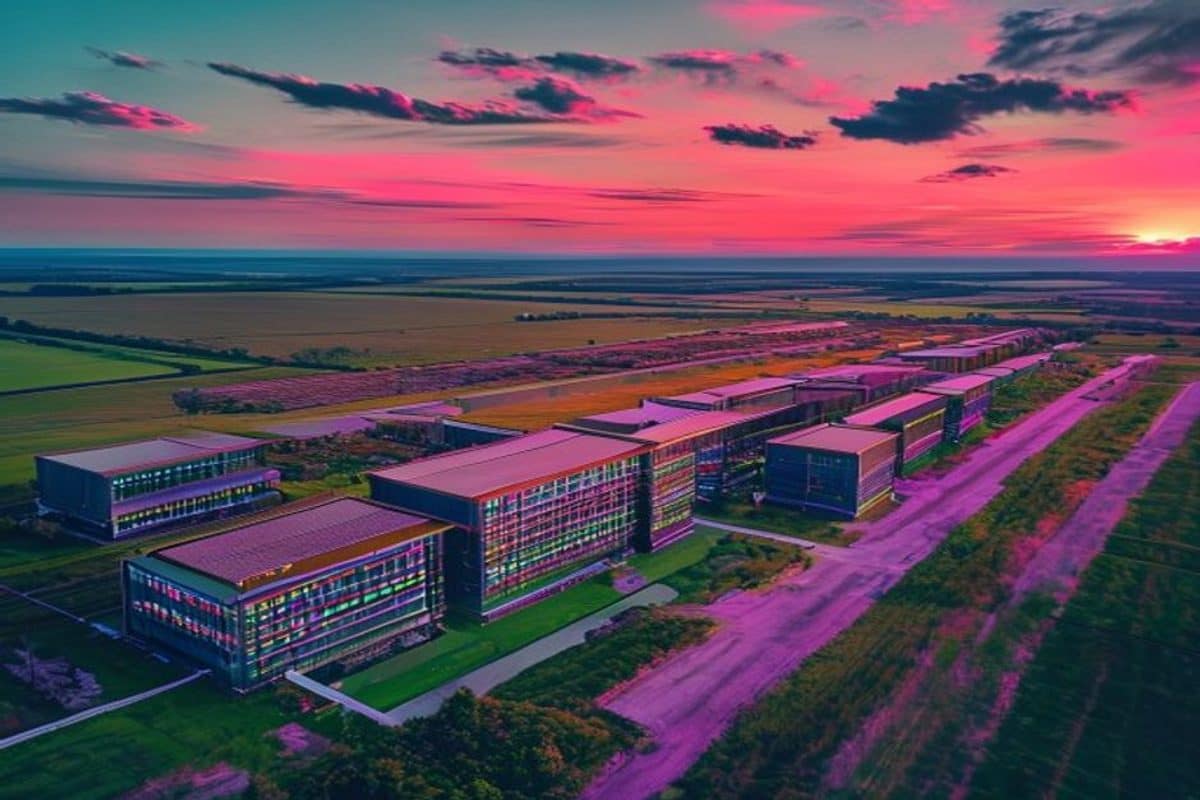
On April 24, Related Digital and Blackstone announced they had secured $16 billion to finance a data center campus in Saline Township, Michigan, purpose-built for Oracle. The project will deliver more than a gigawatt of compute capacity. It will be LEED certified, cooled by a closed-loop system, and is already under construction on a site that preserved a historic red barn at the entrance, which they have named, with some affection, "The Barn." Construction is on schedule. Oracle intends to use the campus to power applications for OpenAI. Everything, on its face, looks like routine infrastructure finance at scale.
But the story of how this deal actually got done is considerably more interesting than the press release suggests. Bank of America sold $14 billion in bonds tied to the project. Pimco, the world's largest active fixed-income manager, bought roughly $10 billion of them. The reason Pimco had to anchor the deal at that scale is that America's major banks largely stepped back, citing doubts about whether AI infrastructure demand is sustainable enough to underwrite nearly two decades of project-level debt. That hesitation, quiet as it was, is one of the most important signals in the current AI investment cycle.
The bonds carry a 7.5 percent coupon with a 19.5-year maturity, structured with six years of interest-only payments followed by 13 years of amortization. This is not cheap debt. Oracle's own corporate bonds trade at tighter spreads. The premium reflects the project finance structure: the bonds are secured against the Michigan campus itself, not against Oracle's broader balance sheet. Investors are lending against a single facility's projected cash flows rather than against the creditworthiness of a $400 billion enterprise. At 7.5 percent over nearly two decades, the total interest cost will exceed the principal. That math only works if the facility generates revenue from day one and maintains occupancy for the full duration of the loan.
The concentration risk underneath that assumption is significant. Oracle's $553 billion in remaining performance obligations, reported in its Q3 fiscal 2026 results, provides the demand signal underpinning the entire structure. But a meaningful share of those obligations traces to a single counterparty: OpenAI. The Michigan campus finances the relationship between Oracle and OpenAI. The bond investors finance Oracle's ability to build the campus. The chain is long, and every link in it depends on OpenAI's revenue trajectory holding up across a 19.5-year debt horizon. If you think that is a comfortable assumption, you have more confidence in the AI demand curve than the banks that passed on this deal.
The Scale of Oracle's Infrastructure Bet
The Michigan campus is not a standalone decision. Oracle's capital expenditure for fiscal 2026 is expected to reach approximately $50 billion, more than double the prior year, according to CFO Hilary Maxson. That level of investment has already strained the balance sheet enough that both S&P and Moody's have assigned negative outlooks to Oracle's credit ratings. In February 2026 alone, the company issued $25 billion in bonds. It has also issued $5 billion in preferred shares set to convert to equity after three years. Oracle has now become one of the largest issuers of high-grade corporate debt in the United States, with roughly $120 billion in notes in the primary U.S. corporate bond index.
Meanwhile, Oracle signed a six-year, $1.65 billion supply agreement with Australian modular data center firm Datapod for infrastructure deployments across the U.S. and Europe, and expanded its partnership with Bloom Energy to deploy up to 2.8 gigawatts of power capacity for its AI build-out. These are not hedge positions. They are the actions of a company that has made a single, enormous directional bet: that AI compute demand will grow faster than anyone currently models, and that Oracle is positioned to capture a disproportionate share of it through its existing cloud infrastructure and its deepening partnership with OpenAI.
The $290 Billion Infrastructure Financing Wave
Oracle is not alone in this. Since early 2025, at least $290 billion in debt financing has been secured for hyperscaler AI infrastructure initiatives across the industry. The Michigan deal is the largest single-facility slice of that total, but it is part of a wave that is restructuring the entire fixed-income landscape for institutional investors. Pimco's $10 billion anchor position is a significant commitment by any measure, and it reflects a calculation that the yield premium on AI infrastructure debt is worth the concentration risk.
The broader question this deal raises is one that the banks who declined to participate were quietly asking: at what point does the AI infrastructure buildout outpace the applications that justify it? The demand signal from hyperscalers is genuine. Revenue growth across Oracle's cloud segment, projected at 19 to 21 percent in Q4 fiscal 2026, supports the near-term thesis. Oracle raised its fiscal 2027 revenue forecast to $90 billion. These are not trivial numbers. But the debt matures in 2044. The applications that will generate the revenue to service it have not been invented yet.
What This Means for the Market
For entrepreneurs and technology investors watching from the sidelines, the Michigan deal illustrates something important about the current moment in AI infrastructure. The capital is real. The commitment is serious. The institutions financing this buildout are among the most sophisticated in the world, and they are pricing the debt at levels that reflect genuine uncertainty about the long-term demand curve. This is not irrational exuberance dressed up as infrastructure finance. It is calculated risk-taking at extraordinary scale, with appropriate pricing for the risk, from players who understand exactly what they are buying.
The deal also underscores a structural shift in how AI infrastructure gets financed. Traditional corporate balance sheets, even those as large as Oracle's, cannot absorb this level of investment alone. Project finance structures, anchored by institutional fixed-income investors rather than bank syndicates, are becoming the primary mechanism for funding the physical layer of the AI economy. That is a meaningful change in the plumbing of how the technology industry builds things. The firms that understand this financing architecture will have an advantage in the capital markets cycle that follows.
Also read: SpaceX is asking public investors to believe in something that isn't in the numbers yet • Toyota, Honda and Ford chiefs warn their companies may not survive China's automotive dominance • Xbox's new CEO has done more in two months than her predecessor managed in two years of damage control