
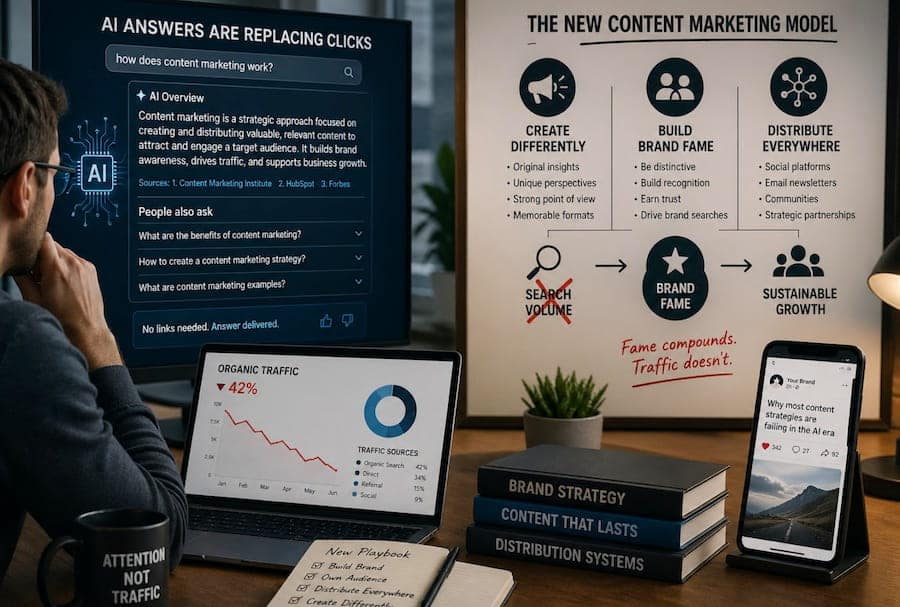
The old SEO playbook is breaking as AI answers replace clicks, forcing brands to compete for attention instead of rankings.
For years, content marketing ran on a predictable loop. Find a keyword, publish an article, rank on Google, capture traffic, and convert a small percentage. It scaled because search demand was visible and measurable. If you produced enough content, growth followed.
That system is now under pressure. Not because people stopped searching, but because they no longer need to click.
AI-generated answers are collapsing the value of informational queries. When a user asks a question, large language models increasingly deliver the answer directly. No need to visit ten blue links. No need to scroll through a blog post. The transaction ends at the answer.
This is not a marginal shift. It changes the economics of discoverability itself.
When answers replace traffic
Informational SEO used to be a volume game. More articles meant more surface area, more rankings, more traffic. It worked because search engines acted as distributors. They rewarded relevance with visibility.
AI breaks that distribution model. Instead of sending users to your content, it absorbs your content into its response layer. The value moves upstream.
That creates a simple but uncomfortable reality. You can still rank and receive less traffic. You can still publish and see diminishing returns. The compounding effect that defined content marketing starts to flatten.
In practical terms, discoverability becomes an economic problem rather than a publishing one. It is no longer enough to produce useful information. You need to be remembered.
This shift is already visible across industries. Brands that relied heavily on top-of-funnel content are seeing volatility in traffic performance. Meanwhile, companies investing in brand presence, community, and direct channels are less exposed to these changes.
From search demand to brand demand
The logical response is not to abandon content, but to rethink its role.
Content used to capture existing demand. Now it needs to create it.
That means moving away from purely informational output and toward distinctive narratives. The kind that people recognize, recall, and actively seek out. When someone searches for you by name, AI cannot disintermediate that intent.
Brand becomes the new distribution layer.
This is why we are seeing a renewed focus on formats that build familiarity rather than just answer questions. Opinionated essays. Founder-led content. Original data. Video series. Content that travels beyond search and into feeds, conversations, and communities.
It also explains the rise of personality-driven brands. When the voice is unique, it cannot be easily replicated or summarized away. The content carries identity, not just information.
As highlighted in internal editorial standards like those outlined in , strong writing is not about filling space. It is about delivering perspective with clarity and intent. That principle matters even more in an AI-saturated environment.
Distribution is no longer optional
If content creation was once the bottleneck, distribution is now the constraint.
Publishing alone does little. What matters is how content spreads. Through social platforms, newsletters, partnerships, and direct audiences. The brands that win are those that treat distribution as a core capability, not an afterthought.
This is where many traditional SEO strategies fall short. They optimize for ranking, not for reach beyond search. In an AI-driven landscape, that gap becomes costly.
Instead, leading teams are building systems that amplify every piece of content. Repurposing across channels. Designing for shareability. Creating feedback loops with their audience.
The goal is simple. Ensure the content exists in places AI cannot fully mediate.
What this means for marketers now
The immediate takeaway is not to panic, but to adjust priorities.
Informational SEO is not dead. It is just less reliable as a growth engine. It still has value, particularly for bottom-of-funnel and high-intent queries. But it can no longer carry the entire strategy.
The more durable approach combines three layers. First, targeted SEO for conversion-driven keywords. Second, brand-led content that builds recognition. Third, distribution systems that extend reach beyond search.
This is a harder model to execute. It requires creativity, consistency, and a clearer point of view. But it also creates a stronger moat.
The brands that adapt early will not just survive the shift. They will benefit from it. Because while AI makes information abundant, attention remains scarce.
And in that environment, the companies people remember are the ones that win.