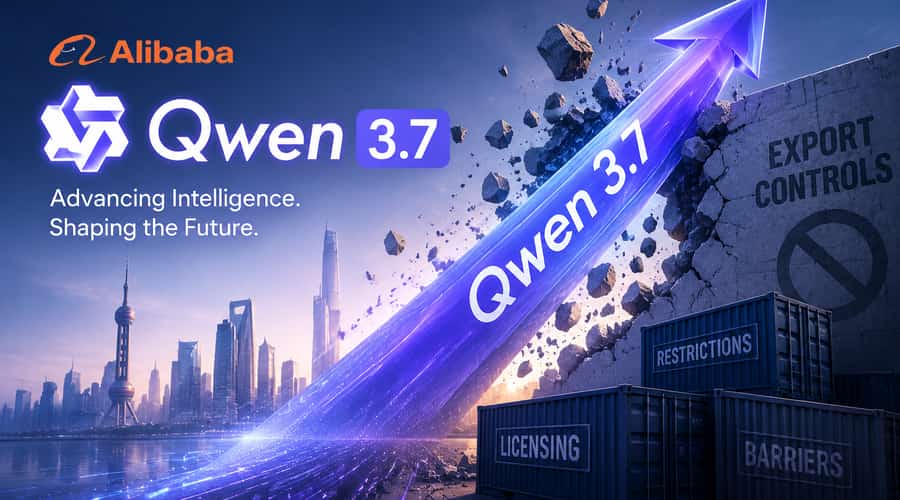
Alibaba's Qwen 3.7 appears to have surfaced inside Qwen Chat, but the stronger claim that open weights have been officially released is not yet supported by Alibaba's public model pages.
Alibaba's Qwen team has given developers something new to chase, but the story is more careful than the first wave of forum posts made it sound. Community users reported seeing Qwen 3.7 options appear in Qwen Chat on May 18, and early testing threads began circulating almost immediately. What has not appeared, at least in the public sources available now, is an official Alibaba release note or a confirmed open-weight package for Qwen 3.7.
That distinction matters. A model showing up in a hosted chat interface is not the same thing as a downloadable model release, and it is especially important in the Qwen ecosystem, where developers watch closely for weights, license terms, context limits, model sizes, and ModelScope or Hugging Face availability. Alibaba's public model listings still point to Qwen 3.5 and Qwen 3.6 as the latest documented families, including Qwen3.5 models added to Alibaba Cloud Model Studio in February and March and Qwen 3.6 models listed for April.
The current signal is still worth watching because Qwen has become one of the most important open and semi-open model families outside the U.S. frontier labs. Previous Qwen releases moved quickly from official announcements into developer testing, quantized builds, local inference guides, and benchmark tables. If Qwen 3.7 follows that path, the first serious signs will not be vague screenshots. They will be official model cards, repository updates, license language, and reproducible third-party evaluations.
Why the community is moving so quickly
Developers have learned to treat Qwen updates as practical events, not just branding moments. Earlier Qwen generations have been competitive on coding, reasoning, multilingual tasks, and long-context use, which makes even a hosted-model appearance enough to trigger testing. In the local AI community, the first questions are predictable: can it code better, does it handle tool use more reliably, will smaller variants arrive, and can it run efficiently on consumer or workstation GPUs?
That is why the early reaction has centered on hands-on checks rather than corporate positioning. Forum users are comparing outputs, probing reasoning behavior, and speculating about whether Alibaba will later publish open-weight variants. Those tests can be useful, but they are not a substitute for formal benchmark reporting. A handful of prompts can show where a model feels stronger, yet they cannot establish whether Qwen 3.7 is materially ahead of Qwen 3.6, Qwen 3.5, DeepSeek, Gemini, Claude, or Llama across production workloads.
As Reuters reported when Alibaba unveiled Qwen 3.5 in February, the company has been trying to make Qwen more relevant for agentic AI and consumer-facing products, while also competing in China's crowded chatbot market against ByteDance's Doubao and DeepSeek. That makes a Qwen Chat appearance commercially meaningful even before open weights arrive. Alibaba can use the hosted product to test demand, gather usage signals, and keep the brand visible while deciding what to release publicly.
The export-control backdrop is real, but it needs precision
The pressure around advanced chips is part of the Qwen story, but it should not be used as a shortcut explanation for every release. U.S. export controls have limited Chinese firms' access to the most advanced Nvidia accelerators, and that has changed how Chinese AI labs plan training, deployment, and cloud capacity. Alibaba has also reorganized around AI this year, with Reuters reporting in March that CEO Eddie Wu and senior technical leaders would coordinate a new task force after the departure of Qwen division head Lin Junyang.
Still, the better reading is not that export controls somehow make each Qwen release surprising. It is that Alibaba is trying to keep a rapid product and model cadence under tougher constraints than U.S. rivals face. Frequent Qwen updates help the company maintain developer attention, support Alibaba Cloud, and feed AI features across its consumer and commerce ecosystem. For founders and engineering teams, the practical question is whether those updates produce models that are reliable enough to build on.
The next checkpoint is simple. Watch Alibaba's official Qwen site, ModelScope, Hugging Face, and Alibaba Cloud Model Studio for a real Qwen 3.7 listing, not just chat-menu sightings. If open weights appear with clear licensing and documented variants, developers will move quickly. Until then, Qwen 3.7 should be treated as an emerging hosted-model signal rather than a confirmed open-weight release.
Also read: Anthropic's cyber warning is moving into financial regulation • Newsom's software tax would turn California into a national test case for SaaS • MiniPlasma shows how one Windows patch can fail for years