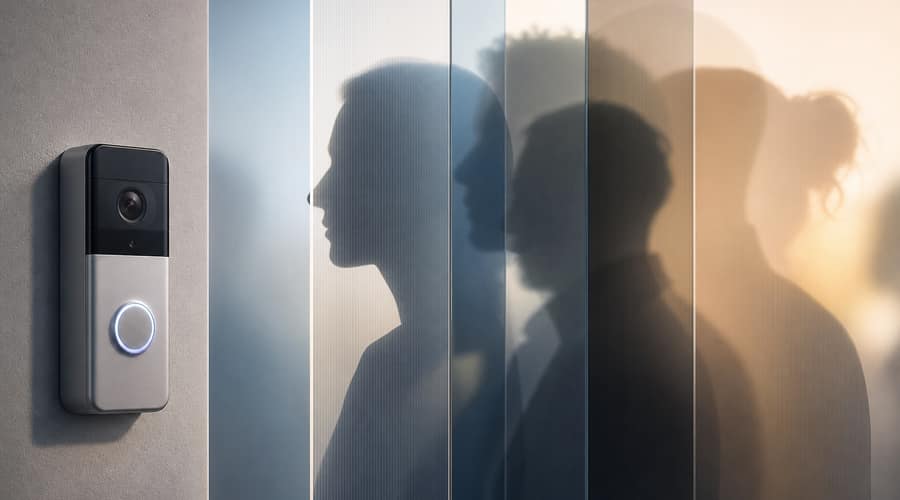
Amazon’s Ring lawsuit turns a simple smart home promise into a harder AI question: who gets to consent when the camera is not theirs?
Amazon’s Ring is back in the privacy spotlight, this time over a facial recognition feature built for convenience but now being tested as a question of consent. A proposed class action filed in federal court in Seattle says Ring cameras at other people’s homes collected and stored a Virginia man’s facial data without his permission.
The plaintiff, Charles Sigwalt, says he was captured by Ring doorbell cameras while visiting friends and family. The lawsuit targets Familiar Faces, an optional Ring feature that uses artificial intelligence to recognize people and label future alerts with their names. Sigwalt is seeking class action status and at least $5 million in damages for the proposed class.
As Reuters reported, Amazon was sued on Monday, June 1, and declined to comment on the case. That matters because the complaint is not only about whether Ring owners clicked yes to a new feature. It is about everyone else who walks past a camera they do not own and may not even notice.
Ring’s argument will likely start with the feature design. Familiar Faces is optional. The customer chooses whether to use it. Ring’s support material says facial recognition profiles and related information are encrypted and stored in the cloud, unnamed profiles are automatically removed after 30 days without recognition, and profiles are deleted after 180 days of no recognition.
That may sound careful from a product standpoint. But the lawsuit points to a different gap. A homeowner can opt in for the camera, but a delivery worker, neighbor, relative, child, tenant, or passerby has not made the same choice. The AI system still has to decide whether a face is familiar, and that is where a consumer feature begins to look like biometric infrastructure.
This is the difficult part for every company pushing AI into everyday hardware. The user experience is built around one paying customer, while the data environment often includes many people who never agreed to participate. A smart doorbell is not just watching the owner’s front step. It is also watching a slice of the public and semi-public world around it.
For Amazon, the business logic is clear. If Ring can tell the difference between a family member, a cleaner, a recurring visitor and an unknown person, the product feels more useful. Alerts get smarter. False alarms feel less annoying. The camera becomes less like a motion sensor and more like a household assistant.
But biometric data is not ordinary product telemetry. A face is difficult to change, easy to capture, and useful across contexts. That is why privacy battles around facial recognition rarely stay confined to one app setting. Once the technology is present, the next question is always who controls the match, the retention period, the access rights, and the audit trail.
Ring’s history makes this harder for Amazon
The new lawsuit lands against an uncomfortable background. In 2023, the Federal Trade Commission said Ring compromised customer privacy by allowing employees and contractors to access private videos and by failing to implement basic safeguards, including protections that could have stopped hackers from taking control of accounts, cameras and videos. Ring agreed to pay $5.8 million, which the FTC said would be used for consumer refunds.
The FTC also alleged that Ring used customer videos to train algorithms without consent before changing some practices. That detail is important here, because the Familiar Faces case is not happening in a vacuum. It asks whether Amazon has learned how to build trust around AI surveillance, not simply whether one product page disclosed enough to the person who bought the camera.
There is also the law enforcement issue. Ring drew years of criticism for partnerships that made it easier for police and public safety agencies to request footage from users through the Neighbors app. The company said in January 2024 that it would sunset its Request for Assistance tool, while still allowing public agencies to post safety updates and community notices.
Those steps may have reduced one visible source of criticism, but they did not erase the broader optics. Ring remains a network of privately owned cameras placed across neighborhoods, apartment entrances and small businesses. Add face recognition to that network and the public concern changes from video capture to identity recognition.
That distinction is why this case could matter beyond Ring. Consumer AI is moving from screens into homes, cars, wearables, locks, cameras and appliances. Companies want these systems to feel ambient and helpful. Regulators and courts may increasingly ask whether ambient AI is just another way of saying people are being processed before they know it.
Amazon can still argue that Ring customers control the feature, that the system includes deletion rules, and that the lawsuit overstates what the product does. The court will decide whether those defenses are enough. But even before the case moves forward, the market lesson is obvious: opt-in is weaker when the person opting in is not the only person being scanned.
The next phase of consumer AI will not be judged only by how clever the model is. It will be judged by whether companies can prove that convenience does not quietly outrun consent. For Amazon, Familiar Faces may become less of a smart camera feature and more of a test of how much biometric trust consumers are still willing to extend.
Also read: Microsoft gives AI agents a safer way to work on Windows • OpenAI is chasing finance and legal work as Anthropic gains speed • Trump narrows AI oversight after industry pushback.