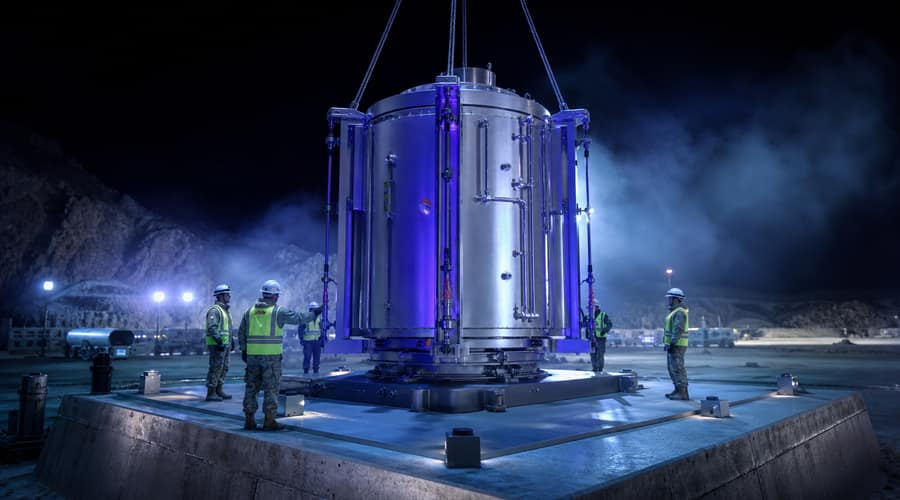
Antares has raised $470 million because the Pentagon no longer treats nuclear microreactors as a science project. The hard part now is turning a June criticality test into electricity on a military timeline.
Seven weeks ago, Antares Nuclear's Mark-0 reactor went critical at Idaho National Laboratory. That was the real news under today's funding announcement. According to the Department of Energy, the June 4 test was a zero-power fueled criticality demonstration under its Reactor Pilot Program, meaning the reactor sustained a controlled nuclear chain reaction but did not produce electricity. Still, for a company founded in 2023, it was a serious milestone.
Now Antares has raised $470 million in a Series C round. Dow Jones reported this morning that the financing was co-led by Paradigm and Caffeinated Capital and included $370 million in equity and $100 million in debt, with Point72 Ventures, Shine Capital, Industrious Ventures and others participating. Total funding is now past $600 million.
Sit with the speed of that. Antares was founded in 2023. It reached criticality in June 2026. It now has contracts or programs touching the Air Force, Space Force, Defense Innovation Unit and NASA. This isn't a normal hardware timeline, and you shouldn't read the round as another climate-tech financing headline. It is defense procurement, presidential orders and private nuclear money all moving at once.
Executive Order 14299, signed on May 23, 2025, directed the Defense Department, through the Army, to begin operating an Army-regulated nuclear reactor at a domestic military base or installation by September 30, 2028. The Army's Janus Program is one answer to that order. In November 2025, the Army named nine installations for consideration, including Fort Benning, Fort Bragg, Fort Campbell, Fort Drum, Fort Hood, Fort Wainwright, Holston Army Ammunition Plant, Joint Base Lewis-McChord and Redstone Arsenal.
The base list matters because this isn't really about shaving a few dollars off the electricity bill. The Pentagon wants power that can keep running when the civilian grid is hit by a storm, a cyberattack or a physical disruption. Diesel generators help, but diesel depends on fuel convoys and supply chains. A microreactor, once fueled and operating, creates a different problem for an adversary.
That is the point.
The Department of the Air Force and the Defense Innovation Unit selected Joint Base San Antonio in April 2026 as a potential site under the Advanced Nuclear Power for Installations initiative and paired it with Antares. JBSA's own public information page says the next steps include siting and environmental review under the National Environmental Policy Act. Antares says its R1 microreactor is designed for 100 kilowatts to 1 megawatt of electricity for more than six years, with sodium heat pipes, TRISO fuel and a nitrogen Brayton cycle.
The money follows the reactor test
A $470 million Series C is large for any startup. For a three-year-old nuclear company, it is the sort of number you only get after investors believe the risk has changed. Antares raised $96 million in a Series B in December 2025, and the new round came less than eight months later. The Mark-0 test explains the jump. A design on paper is one thing. A reactor that has sustained a controlled chain reaction at Idaho National Laboratory is another.
Paradigm and Caffeinated Capital are not classic defense contractors. Paradigm is better known for crypto infrastructure investing, and Caffeinated Capital has backed a wide range of software and hardware companies. Frankly, that makes the deal more telling, not less. Venture investors are looking at microreactors because the government customer has a hard deadline, named sites and a need that won't disappear when the next budget cycle gets awkward.
Antares also has a physical footprint that many young nuclear companies don't. The company lists operations in Torrance, California; Idaho Falls, Idaho; and Aiken, South Carolina. Its website says it opened Antares Prime, a 322,000-square-foot research and development facility, in 2025. The unglamorous factory detail is important here. You don't ship reactors from a slide deck.
The schedule is tight
The next milestone is electricity. Antares says it plans to operate a full-power, electricity-producing advanced reactor on American soil in 2027 and prepare for customer deployments beginning in 2028. Dow Jones reported that the company's next system, Mark-1, is intended to produce electricity and that initial deployments in 2028 are expected to go to the U.S. Air Force.
That timeline leaves little room for comfort. Antares still has to finish design and safety work, clear site and environmental review at Joint Base San Antonio, prove electricity production, and then move from demonstration to customer deployment. None of that is automatic. Nuclear timelines have a way of punishing optimism, even when the technology is small enough to be moved by truck.
The space angle can wait. Antares talks about power from Earth to the asteroid belt, and its NASA and Space Force work may become meaningful later. For now, the nearer test is simpler and harder: can the company put an electricity-producing reactor into a real defense setting fast enough to matter?
The Mark-0 going critical proved the physics at zero power. The $470 million funds the next part, which is manufacturing, licensing, deployment and repetition. If Antares hits that sequence, defense microreactors stop being a procurement experiment and start becoming infrastructure. If it misses, today's round will look less like a breakthrough and more like a very expensive clock.
Also read: How to cold email an investor and actually get a reply • Google backs Proxima Fusion in €411 million round as Big Tech bets on stellarators to solve the power crunch • Congress wants to freeze state AI laws for three years and state lawmakers are refusing to go quietly