Applied Aerospace & Defense has priced a $650 million IPO into a market that is suddenly willing to fund the harder parts of defense technology.
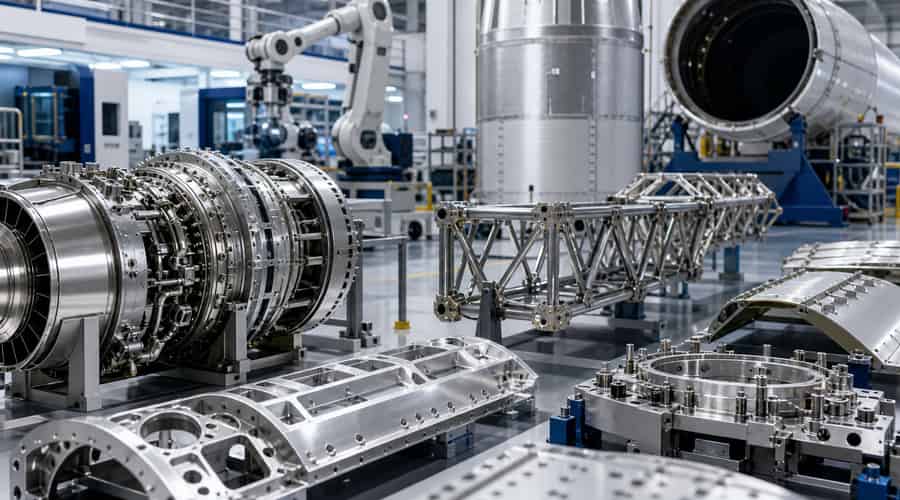
Applied Aerospace & Defense is not selling investors a sleek software story. It is selling them fuselages, flight control surfaces, solid rocket motor cases, engine shafts and the industrial patience needed to make those parts reliably. That is what makes its IPO interesting.
Bloomberg, in a report relayed by Reuters, said the Huntsville, Alabama-based company raised $650 million by selling 32.5 million shares at $20 each. The price landed inside the marketed range of $18 to $21, and the company is expected to list on the New York Stock Exchange under the ticker AADX. At that price, Bloomberg reported that Applied Aerospace would carry a market value of about $3.4 billion, based on shares outstanding in its filings.
This is not just another defense listing. Public markets have spent the past few years getting comfortable with defense software, autonomy and intelligence platforms, from Palantir to the wider group of companies that have tried to make military modernization feel more like enterprise technology. Applied Aerospace is a different sort of test. It asks whether investors are ready to back the physical supply chain behind missiles, launch vehicles, aircraft and satellites.
The modern defense trade has often been described through drones, data and artificial intelligence, and for good reason. Those tools are changing how governments fight and prepare. But none of them removes the need for specialized parts that can survive heat, stress, vibration and years of use in unforgiving environments.
Applied Aerospace sits in that less glamorous but essential layer. Its SEC filings describe a company that provides design, engineering, fabrication, assembly, inspection and testing for specialized aerospace and defense components. That matters because the bottleneck in defense is not always the idea. Increasingly, it is the capacity to make qualified hardware at scale, with the right certifications, materials knowledge and customer trust.
The company was formed when Greenbriar Equity Group combined Applied Aerospace, founded in 1954, with PCX Aerosystems, whose roots date back to 1900. That deal gave the platform history, facilities and broader customer relationships rather than a clean startup narrative. Applied Aerospace then added Consolidated Boring, Vestigo Aerospace and Rainwater Holdings, now Ultracor, to deepen its position in precision strike, space disposal systems and advanced materials.
That roll-up strategy is easy to understand. Defense customers do not usually want a long list of fragile suppliers. They want fewer vendors with more capability, more capacity and a record of delivering on programs that can last for decades. Applied Aerospace says sole or single-source positions represented about 87% of its 2025 revenue, with average customer relationships spanning 39 years. That is not a small detail. In defense manufacturing, incumbency can be a real moat.
Why Investors Accepted A Debt-Paydown IPO
The most important tension in this IPO is also the most obvious one. Applied Aerospace is raising public money largely to reduce debt, not to fund a dramatic new product launch. Its filing said it expected to use roughly $56.1 million of net proceeds to repay its revolving credit facility and about $532.8 million to repay term loan borrowings, based on the midpoint of the offering range.
That would normally make investors pause. Debt-paydown IPOs are not always the cleanest pitch, especially when the market wants growth capital going straight into expansion. But Applied Aerospace is arriving with a story that fits the moment. Its contract backlog stood at $1.06 billion as of March 31, 2026, up from $871.3 million at the end of 2025, helped by the Consolidated Boring acquisition. Its 2025 revenue rose 24.8% to $498.8 million, and pro forma 2025 revenue was $604.3 million.
The company is still not a simple profitability story. It reported a 2025 net loss of $17 million, and interest expense was a heavy burden. That is exactly why paying down debt matters. If the public offering lowers interest costs and gives the company more flexibility, investors may view the IPO less as a rescue and more as a balance sheet reset for a business sitting in a high-demand corner of the defense industrial base.
The timing helps. Reuters noted last week that companies such as Arxis, AEVEX and Hawkeye 360 have also reached New York public markets in recent weeks, as investors look for exposure to rising defense budgets and geopolitical instability. That does not mean every defense listing deserves a premium. It does mean the market is widening its definition of defense tech beyond software and sensors.
For startups and investors, the lesson is practical. The next phase of defense innovation will not be funded only through code. It will need factories, machinists, engineers, materials specialists and balance sheets strong enough to carry long program cycles. Applied Aerospace is testing whether Wall Street is ready to value that infrastructure directly.
What comes next will matter more than the first-day print. If AADX trades well and delivers against backlog, it could make the public market more welcoming for other defense supply chain companies. If it struggles, investors may decide that hardware risk still belongs mostly in private equity. Either way, the IPO shows where attention is moving: from the software layer of defense technology to the industrial base that has to make it real.
Also read: MIT's ChartNet turns chart reading into a serious AI test • PaXini is testing Hong Kong's appetite for China's robotics boom • Bilt faces a harder test as regulators review payment failures