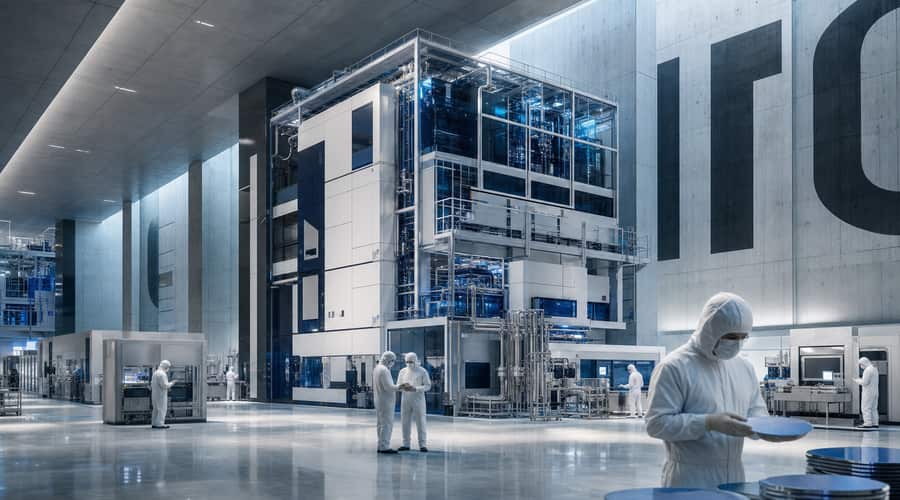
ASML has become Europe's $700 billion test case for the AI boom, and the question now is whether the chip machine monopoly can grow without becoming the bottleneck.
ASML Holding crossed the $700 billion market value line in June, according to Seeking Alpha, making it the first publicly traded European company to clear that mark. By mid-July, market data put the Dutch company just below that level again, around $682 billion after its second quarter results. That movement tells you the real story. ASML is no longer a hidden supplier sitting behind the semiconductor trade. It is one of the main trades.
The reason is blunt. Every advanced AI chip needs lithography, and ASML is the only company making extreme ultraviolet lithography systems at commercial scale. TSMC, Samsung, Intel, SK Hynix and Micron can argue over foundry share, memory pricing and packaging capacity. They still need ASML's EUV scanners to print the smallest circuit patterns on wafers. No scanner, no leading-edge chip.
Nobody else gets a vote.
Canon and Nikon still sell lithography tools for older process nodes, but EUV is a different machine. ASML spent roughly two decades getting the technology from lab problem to factory tool, with Zeiss supplying critical optics and Cymer building the light-source technology ASML later bought in a deal that closed in 2013. ASML's own history of EUV development describes the source problem plainly: generating enough usable EUV light was the hard part. That is why this moat has held.
The Quarter Made The Monopoly Visible
Reuters reported that ASML raised its 2026 outlook on July 15 after second quarter revenue reached 9.33 billion euros and net income came in at 2.92 billion euros, both ahead of LSEG estimates. The company now expects full year net revenue of 43 billion to 45 billion euros, up from a prior range of 36 billion to 40 billion euros. Its gross margin guidance also moved higher, to 54% to 56%, according to the company's results.
That is not a company chasing demand. It is rationing capacity.
Chief executive Christophe Fouquet told investors on ASML's earnings call that the company is close to receiving all the EUV orders it needs for 2027 while adding about 30% more EUV capacity versus 2026. He also said ASML has already received a large number of 2028 EUV orders and is studying another 30% capacity increase for that year. If you run a chipmaker, that matters more than a neat forecast. It means your place in line is part of your strategy.
High NA EUV is the expensive next step. Reuters reported that Intel has started using ASML's High NA EUV machine for some Panther Lake processor layers after experiments that began in 2024. The tool costs around $400 million, roughly twice the price of a standard EUV system, and Intel declined to comment on the Reuters report. TSMC has been more cautious. Reuters and TrendForce have reported that TSMC plans to skip High NA EUV for its A13 process around 2029, with cost still the obvious sticking point.
Here's the thing: even that hesitation does not break ASML's position. It shows how expensive the next step has become.
The Trillion Dollar Question Is Not Cute
Reuters reported on July 20 that analysts and investors are now asking whether ASML could become Europe's first trillion-dollar company after its shares rose about 60% this year and pushed the group close to a $700 billion valuation. Bernstein analyst David Dai raised his ASML price target to 2,500 euros after the results, according to Investing.com, citing capacity, pricing and margin upside. Barclays had already raised its target to 2,000 euros in late June, according to Price-Target.com.
That is the market's bet in plain language: AI spending keeps flowing through Nvidia and the cloud companies, then through TSMC and Samsung, then into ASML's order book. You don't have to love the valuation to understand the chain.
The main risk is not that a rival suddenly appears with a better EUV machine. That would be too neat. The real risks are slower hyperscaler spending, delays at chipmakers trying to absorb all this equipment, and export controls. The Netherlands and the U.S. have barred ASML from selling EUV systems to China for years, and TechCrunch recently noted that China still accounts for older deep ultraviolet demand that could face tighter restrictions under new U.S. proposals.
China is the hard political edge of this story.
ASML has already overtaken Roche, LVMH, Novo Nordisk, AstraZeneca and SAP as Europe's most valuable listed company. If it reaches $1 trillion, it will not be because it found a new market. It will be because the AI market kept discovering that the most important supplier in the chain rarely puts its logo on the chip.
Also read: Boxabl Shares Jump 20 Percent as Tiny Home Startup Debuts on Nasdaq • Oracle Sues Wisconsin Over A $7 Billion Data Center Collateral Bill • A Judge Just Capped Sony's Copyright Case Against Udio at 333 Songs