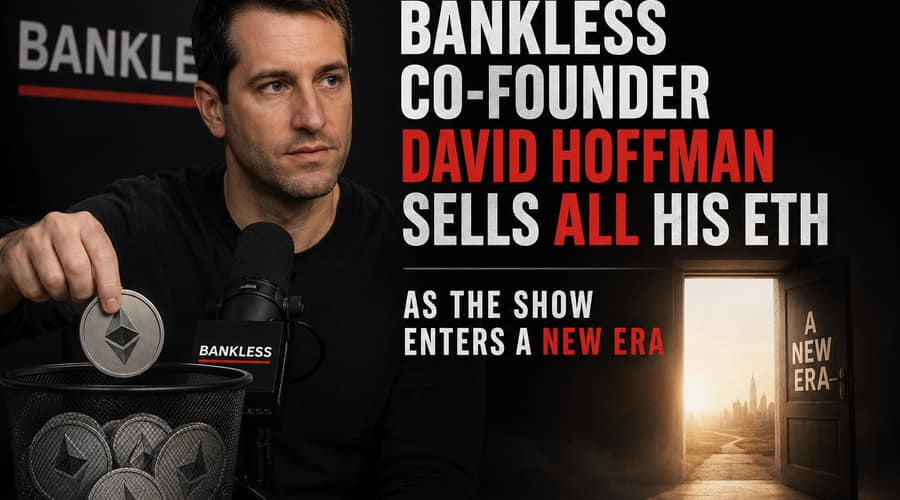
David Hoffman says he has sold his entire Ethereum position, turning a personal portfolio decision into a wider test of what Bankless represents now.
One of Ethereum's most visible advocates has made a very public break with the asset he helped champion. Hoffman, the co-founder of Bankless, said he has sold all of his ETH, a move that landed while the token was trading near the low $2,000s and while Ethereum sentiment was already under pressure.
The timing matters because Bankless has never been just another crypto media brand. Since launching around the last major DeFi expansion, the newsletter and podcast became a consistent case for self-custody, decentralized finance, and Ethereum as the center of the onchain economy. Hoffman's exit from ETH therefore reads less like a routine portfolio adjustment and more like a symbolic crack in a thesis that shaped a large part of the last crypto cycle.
Ryan Sean Adams framed the moment in similar terms. In a post on X cited by CoinNess and other crypto outlets, Adams said the first era of Bankless had concluded, describing the past six years as a collaboration focused on crypto, DeFi, and maximizing Ethereum. He also said he remains bullish on ETH and on Bankless itself, which is an important distinction. Adams is not walking away from Ethereum. He is marking a change in how the brand moves forward.
The role shift inside Bankless is easier to miss than the headline sale, but it may matter more over time. According to TechFlow and PANews, Adams said he will step back from content direction and guest interviews while still appearing on the weekly Rollup podcast, with Hoffman taking fuller control of editorial direction. In plain terms, Bankless is not disappearing. The balance of voices that built its identity is changing.
That is significant because Bankless became influential by pushing a coherent ETH-first worldview with unusual energy. During DeFi summer and the bull market that followed, the brand helped introduce a large audience to Ethereum-native products, tokenized communities, staking, layer 2 networks, and the broader idea that finance could move onchain. When a founder associated with that conviction says he no longer owns ETH personally, the market naturally reads it as more than a private allocation choice.
Hoffman appears to understand the weight of that signal. Reports say he has promised a fuller explanation, which leaves room for several possibilities. It could be personal risk management. It could be a broader rethink of where the strongest crypto opportunities now sit. It could also reflect a desire to separate his editorial work from a portfolio that made every Ethereum discussion feel financially loaded. Until he explains it directly, traders and longtime listeners will fill the gap themselves.
Why the reaction is so loud
The reaction has been amplified by Ethereum's backdrop. ETH has lagged the enthusiasm around some newer chains and faster-moving narratives, while recent price action has made holders more sensitive to any sign of fatigue from public believers. In crypto, a high-profile sale is rarely treated as a quiet financial decision. It becomes a mood board for the market.
That debate has been building for months. Parts of Crypto Twitter have shifted toward higher-throughput chains, application-specific networks, crypto AI themes, and assets that promise faster growth or fresher positioning. Bankless itself has widened its scope in recent years, which has helped keep the publication relevant but also made its original mission feel less singular than it once did.
There is another layer here, too. Bankless has already been through reputational stress, including earlier scrutiny around its venture arm and token activity. That history does not prove anything about Hoffman's ETH sale, but it explains why the audience is quick to look for a larger pattern. Crypto communities remember incentives, especially when media brands also sit close to investing, sponsorships, and token markets.
That is why the story has traveled so fast. Crypto markets are full of people who talk about conviction, but conviction gets tested when a founder starts acting differently from the thesis he spent years explaining. Bankless built its reputation on confidence, framing Ethereum as a serious financial substrate and DeFi as the path into it. Now it is entering a second chapter with a different internal balance, and that alone is enough to make the market lean in.
For ETH holders, the immediate takeaway is not that Ethereum has lost Bankless. Adams still says he is bullish, and the publication remains active. The real change is subtler: one of the movement's most recognizable voices has decided that his personal exposure no longer needs to match the public story. In crypto, that kind of separation gets noticed quickly, and the next thing to watch is whether Hoffman's explanation narrows the story or turns it into a broader debate about Ethereum's next phase.
Also read: SpaceX's S‑1 Reveals 18,712 Bitcoin, Quietly Turning the IPO Into a Crypto Moment • Pocatello's data center rejection shows local AI backlash turning into law • SpaceX's IPO filing could reset private tech pricing