
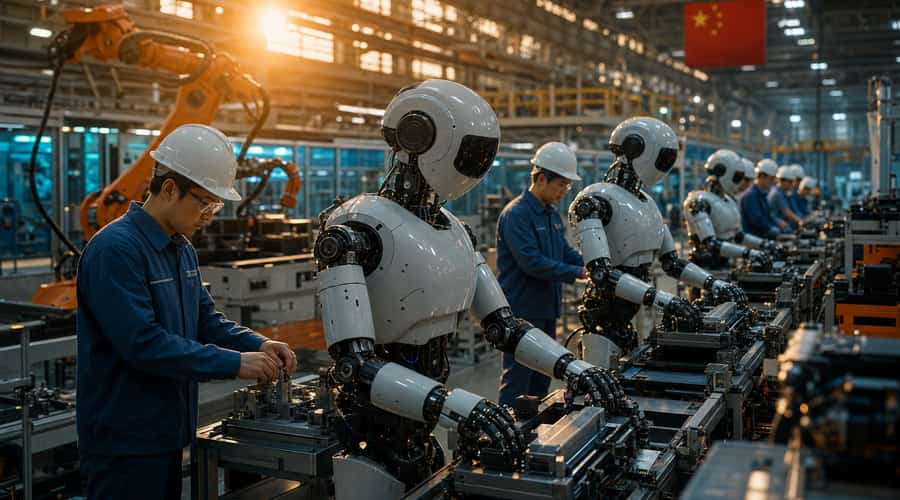
China's humanoid robot story is no longer just a demo reel. The companies worth watching are the ones getting machines into factories, exhibitions, IPO queues, and showroom plans while the US is still arguing over strategy.
If you want to understand why humanoid robotics has become a serious industrial contest, don't start with a backflip video. Start with Hangzhou, Shenzhen and Shanghai, where companies such as Unitree Robotics, UBTech and AgiBot are trying to turn humanoids from stage props into repeatable products.
The old article had the right instinct, but too many of its sharpest numbers could not be verified in live search. Robotera's reported $200 million May 2026 round, Unitree's alleged $610 million Star Market IPO filing, the claimed 90% global humanoid shipment share and several shipment forecasts did not show up in reliable current reporting. That's a problem. A strong view still needs facts under it.
The verified story is strong enough without padding. The Associated Press reported in April that more than 100 humanoid robots were shown at a Hong Kong exhibition, including AgiBot's X2 Ultra, and described AgiBot, Unitree and UBTech as three of China's top humanoid robot makers, each shipping more than 1,000 units in 2025. That is the useful line for readers: China is not only showing robots on state television. It is building enough of them for early industrial and public-facing deployment.
Unitree is the cleanest example of how fast this market is moving. The company was founded in 2016 by Wang Xingxing in Hangzhou and made its name first with quadruped robots. It later moved into humanoids with the H1 and G1, with the G1 introduced as a mass-production model at about $16,000. South China Morning Post reporting, summarized in current company references, says Unitree filed in March 2026 for a Shanghai Stock Exchange listing after beginning IPO tutoring with CITIC Securities in July 2025.
That matters to you because a listing is not a laboratory milestone. It forces a company to put its business in front of public-market scrutiny: revenue quality, supply chain depth, customer concentration, margins, warranty risk, all the unglamorous things that separate a robotics manufacturer from a robotics clip account.
China has turned demos into deployment pressure
Reuters reported in 2025 that Shanghai authorities supported an AgiBot data-collection site where hundreds of robots were tele-operated to generate training data for embodied AI models. AgiBot also said it had moved toward mass-production preparation at a Shanghai factory in 2024, and media reports said it had produced 962 units by December 15, 2024. These are not magic numbers, but they show the mechanism. More robots in more controlled environments produce more motion data, and that data feeds the next model and hardware cycle.
The Guardian's March 2026 reporting made the same point from the factory floor, with companies such as Guchi Robotics and Galbot working on automation for car assembly and pick-and-place tasks. The piece also noted that roughly 140 companies were working on humanoid robots in China. Some will fail. Many should. But a crowded domestic market gives the serious companies customers, component suppliers and rivals close enough to learn from.
Frankly, that is the part Western coverage often misses. China's advantage is not that every humanoid it makes is better than every American one. It is that policy, factories, investors and showcase customers are pulling in the same direction. When a robot can be tested in a logistics center, an auto plant or a public exhibition without a two-year enterprise sales cycle, the company learns faster.
The US still has real contenders. Agility Robotics, the Oregon company behind Digit, announced this month that it plans to go public through a SPAC deal valuing it at $2.5 billion, according to Business Insider. The deal is expected to bring in more than $600 million in gross proceeds, including a private investment led by Foxconn. Agility also has pilots with Amazon and Toyota. That is not trivial, and you shouldn't pretend it is.
But one American robotics company going public does not erase China's manufacturing lead. BYD executive Stella Li told Business Insider in June that the company wants humanoid robots in every car showroom and is also investing in industrial robotics and dark factories. When an automaker with BYD's production scale talks that way, it is not a science fair comment. It is a signal that humanoids are being pulled into the same industrial system that made China dominant in electric vehicles and batteries.
There are risks here. Unitree has drawn scrutiny in the US over security and military-use concerns, and some researchers have raised questions about data collection in connected robots. Those concerns are real, especially if humanoids move from trade-show floors into warehouses, hospitals, schools or government buildings. A robot is a moving sensor platform with legs. Treating it like a normal appliance would be foolish.
The better test for this sector is simple. Watch which companies can ship in volume, place robots in real work settings, lower unit costs and keep improving reliability after the sale. Unitree, UBTech, AgiBot, Agility and Figure AI all want to tell that story. The winners will be the ones whose customers keep the robots after the demonstration ends.
Also read: Blackstone is using a Singapore REIT to cash in on its $16 billion AirTrunk bet before the AI infrastructure wave peaks • Hexaware's Anthropic reseller deal reveals how frontier AI will actually reach enterprise clients • Washington's chip export controls handed Huawei the Chinese AI market Nvidia once dominated