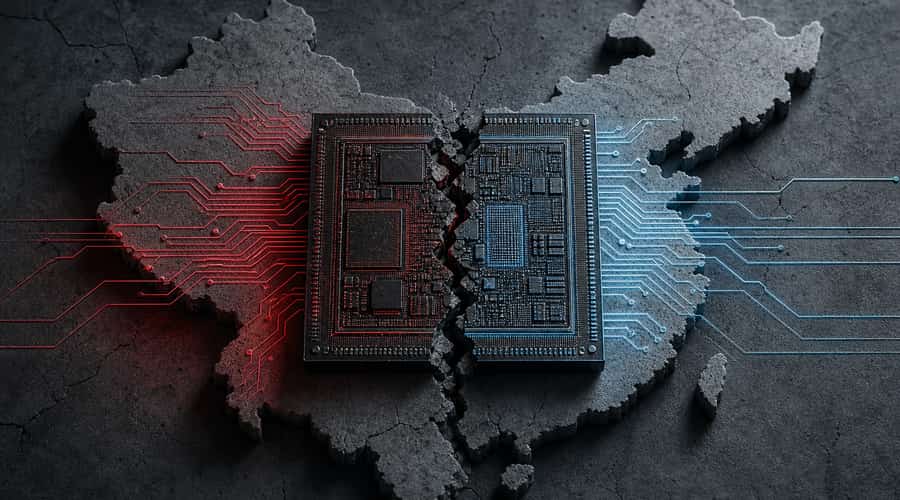
Nvidia didn't just lose share in China. Washington's export controls helped turn Huawei from a fallback supplier into the company Chinese AI buyers were told to take seriously.
Jensen Huang has been saying the quiet part loudly. Nvidia had about 95% of China's advanced AI accelerator market before US export controls pushed it out, the Nvidia CEO told the Associated Press in a recent interview. Tom's Hardware reported that Huang put the current figure even more bluntly at a Citadel Securities event in October 2025: Nvidia went from 95% to 0%.
That is not a normal competitive stumble. It is what happens when policy gives your customers a reason to rebuild around someone else's chips.
The chain of events is clear enough. Washington first blocked Nvidia's top data center GPUs from China, including the A100 and H100. Nvidia then designed China-compliant parts such as the A800, H800 and later the H20, only to see the rules tighten again. The H20, built specifically to stay inside earlier limits, was hit with new licensing requirements in April 2025. Nvidia later disclosed a $4.5 billion charge tied to H20 inventory and purchase obligations in its first quarter of fiscal 2026. You don't need a theory of geopolitics to understand that number. It is policy showing up on an income statement.
Huawei was ready enough to benefit. According to the Associated Press, Bernstein estimated Nvidia's China AI chip share at about 40% in 2025, roughly level with Huawei, and predicted Nvidia would fall to around 8% this year while Huawei would rise to about 50%. That is the market Washington helped create. Chinese buyers still want Nvidia hardware where they can get it, especially for frontier model training, but the center of gravity has moved toward domestic supply.
Huang's argument is self-serving. Of course it is. Nvidia wants to sell chips into the world's largest AI hardware market, and its CEO has every reason to say export controls have backfired. But self-interest doesn't make the point wrong. The original logic was to slow China's access to advanced compute. The result has been more complicated: Beijing leaned harder into self-sufficiency, Huawei gained a protected runway, and Chinese AI companies had months to adapt their software and procurement plans around non-Nvidia hardware.
The H200 reversal proves the timing problem. President Donald Trump approved H200 sales to approved Chinese customers in December 2025, with a 25% cut of those sales going to the US government. Reuters reported in January that Chinese technology companies had ordered more than 2 million H200 processors, each priced at roughly $27,000, even as Nvidia demanded full upfront payment because Chinese import approval remained uncertain. Axios later reported that Huang said at GTC in March 2026 that Nvidia had received purchase orders and was restarting H200 manufacturing for China.
Demand never disappeared. Trust did.
You can see that in the strange split now running through the market. Chinese universities and big technology companies still want H200 chips for research and development, the Associated Press noted, and analysts say cutting-edge Chinese model training still relies on Nvidia hardware when it is available. At the same time, DeepSeek said its V4 model, rolled out in April, was adapted for Huawei's Ascend chips. That doesn't mean Huawei has caught Nvidia's best Blackwell or Rubin products. It means Chinese developers are doing the work needed to make domestic chips usable at scale.
That is the part policymakers should care about. A temporary supply block is one thing. A forced migration path is another. Once Alibaba, ByteDance, Tencent and others spend real engineering time on a domestic stack, the next Nvidia license approval is no longer a clean reset. Procurement teams have new suppliers. Engineers have new constraints. Government buyers have new instructions. The switching cost has already been paid.
The Associated Press reported that Huawei's most advanced commercial Ascend 950 series chips are viewed by some industry analysts as roughly comparable to Nvidia's H200. That comparison needs care, because Nvidia still leads at the high end and Huawei faces production limits. But the direction is not ambiguous. A rival that was supposed to be contained is now being pulled forward by guaranteed demand inside China.
For Nvidia investors, the China hole is no small line item. Tom's Hardware noted that China had previously represented 20% to 25% of Nvidia's data center revenue. Nvidia's global business is still enormous, and the AI buildout in the US, Europe and the Gulf gives it plenty of demand. But near-total dominance in China was a special position. Once lost, it won't simply return because Washington decides the H200 is acceptable after all.
Export controls exist for real national security reasons. Nobody serious should pretend the US has no interest in limiting China's access to the most advanced AI systems. But controls have to be judged by outcomes, not slogans. If the practical effect is to hand Huawei a captive market, accelerate Chinese chip software, and leave Nvidia asking permission to re-enter a market it once owned, then the policy has done more than restrict sales. It has changed the competitive map.
Frankly, that is the lesson for Intel, AMD, Qualcomm and every other American chip company with China exposure. Qualcomm is already planning China-compliant data center chips, according to Tom's Hardware, because it can read the Nvidia case as well as anyone. If Washington wants American firms to keep setting technical standards abroad, it can't keep treating market exit as a free national security win. Sometimes you deny a rival the best product and still give them the one thing they needed most: time.
Also read: Germany is betting €300 billion on AI to solve a labor crisis that AI cannot fully fix; Sovereign wealth funds are betting that AI's real money is in the wires and the watts, not the models; The AI buildout has turned America's power utilities into the most contested assets on Wall Street