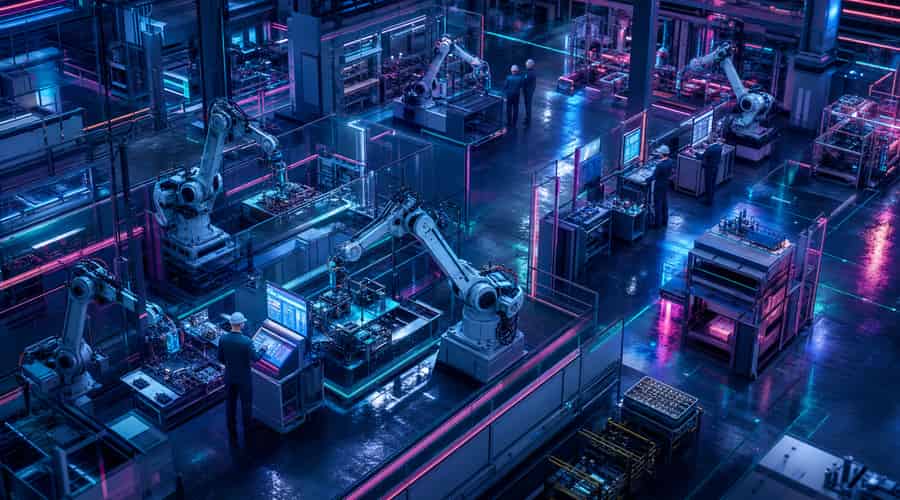
Germany is using a huge public infrastructure fund to soften a labor shortage that AI can help with, but can't solve. The hard truth is simple: software can speed up an office, but it won't staff a hospital ward.
Germany's AI bet is large, but you shouldn't mistake it for a magic labor policy. The country's €500 billion infrastructure and climate fund, approved in March 2025, gives Berlin room to spend on transport, hospitals, energy, education, research and digital systems. Roughly €300 billion sits with the federal government after allocations to the states and the climate fund. That is not a €300 billion cheque written to AI startups, and pretending otherwise makes the story too neat.
The pressure behind it is real enough. Germany is losing output because work is not getting done. According to the Cologne Institute for Economic Research, unfilled jobs already cost the country about €49 billion a year, and the German Chambers of Commerce and Industry has warned that the cost could rise toward €74 billion by 2027. Bloomberg reported this month that the new fund has started slowly, with only €11 billion of €40 billion earmarked for 2026 deployed so far. Slow starts are common in German public spending. The labor gap is less patient.
The case for AI is strongest where the shortage already looks like a spreadsheet problem. Bitkom has put Germany's shortage of IT specialists at about 109,000. In software, finance, administration and sales operations, AI tools can take work out of the queue: code suggestions, document search, onboarding material, internal reports, customer records. Berlin-based Blockbrain, which raised €17.5 million in February, is selling that exact promise to German companies that want their own knowledge systems to answer questions instead of sending workers hunting through files.
You can see why ministers like the argument. A country short of workers can either bring in more people, train the people it has, or raise output per worker. AI offers the third option, and it sounds cleaner than the first two.
But Germany's shortage isn't only in white-collar work. DIHK has put total vacancies across the economy at about 1.8 million. A model can draft a memo, summarize a procurement document, or help a developer finish a test suite faster. It can't rewire a building, care for an elderly patient through a night shift, or drive across a district to fix a heating system. Any serious labor plan has to sit with that uncomfortable split.
The German Institute for Employment Research, with partner institutes, projected in November that AI could reshape about 1.6 million jobs over the next 15 years while leaving the total number of jobs broadly stable. That finding is more useful than the usual AI panic. It says the work changes. It does not say the missing worker appears. The same study pointed to gains for IT and information services, with demand there rising by about 110,000 workers, while other business services lose ground. If Germany gets the transition right, AI lifts output. If it gets it wrong, it moves pain from one part of the labor market to another.
The Public Sector Is The Buyer Now
What makes Germany's approach different from the American model is not just the amount of money. It is who writes the cheque. In the US, Microsoft, Google and Amazon have driven the AI buildout through data centers, cloud contracts and enterprise software. In Germany, the state is pushing demand through a federal infrastructure vehicle that includes digitalization alongside hospitals, transport, energy, education and research.
For founders, that changes the sales motion. You are not only pitching a chief technology officer who wants a cheaper subscription. You may be selling to a ministry, a public hospital group, a rail operator, a regulated manufacturer, or a Mittelstand company that wants proof before it changes a workflow it has trusted for twenty years. Frankly, that is harder than a Silicon Valley demo day. It is also more durable if you win it.
NEURA Robotics shows the other side of the same bet. The German robotics company said this month that it secured up to $1.4 billion in funding from backers including Nvidia, Amazon, Bosch, Schaeffler and the European Investment Bank, according to The Wall Street Journal. The company says it has an order backlog above $1 billion and wants to scale production to several million robots by 2030. That is not chatbot optimism. It is capital chasing physical automation in manufacturing, logistics and health care, exactly the places where labor shortages bite hardest.
Still, even robots do not remove the policy question. They need factories, standards, maintenance workers, buyers and time. Germany has spent years underinvesting in public digital systems, and anyone who has dealt with slow paperwork there knows the problem is not only a lack of clever software. It is procurement, fragmented responsibility and political caution. AI can expose those weaknesses as quickly as it improves them.
The danger is not that Germany's AI push produces nothing. It will produce useful tools, stronger startups and some real productivity gains. The danger is that politicians treat those gains as permission to avoid harder choices on immigration, retraining, care work and vocational education. A €49 billion annual output loss is a crisis. Solving the easiest half and renaming the rest as modernization would be a very German way to stay stuck.
Also read: Sovereign wealth funds are betting that AI's real money is in the wires and the watts, not the models • The AI buildout has turned America's power utilities into the most contested assets on Wall Street • xAI deploys Grok 4.5 at Tesla and SpaceX as Elon Musk bets his own companies on a 1.5 trillion-parameter challenger