Sovereign wealth funds are moving away from the most crowded public AI trade and toward the physical layer that AI can't run without: data centers, power and private credit.
The AI trade has stopped being only a story about who builds the best model. If you're watching where the largest state-backed investors are putting new money, the answer is much duller and much more important: racks, leases, substations, fiber routes and electricity contracts.
That is the point behind the shift the Financial Times reported this week from Invesco's annual survey of 90 sovereign wealth funds managing $17.2 trillion. A net 17% of those funds plan to cut listed equity exposure, while 28% to 35% expect to raise allocations to private assets. Infrastructure allocations have nearly doubled to 9% between 2022 and 2025. This isn't a mood change. It's a portfolio decision.
You can see why. Public AI exposure has become brutally concentrated. A passive S&P 500 investor now owns a market where a small group of technology companies carries an outsized share of the index's return. Nvidia, Microsoft, Amazon, Alphabet and Broadcom have become the shorthand for the whole AI boom, which is convenient until it isn't. When the same companies dominate the index, the benchmark stops feeling broad.
Sovereign funds don't get to be casual about that risk. They manage national savings, pension promises and strategic capital, not a trading account you can close on a bad Thursday. If a fund has already made money from listed AI stocks, the sensible next dollar doesn't have to chase the same crowded trade. It can buy the pipes beneath it.
The clearest example remains Aligned Data Centers. CNBC reported in October 2025 that a consortium including BlackRock's Global Infrastructure Partners, MGX, Microsoft, Nvidia and xAI agreed to buy Aligned in a roughly $40 billion deal. The group behind the purchase, the Artificial Intelligence Infrastructure Partnership, has also counted Singapore's Temasek and the Kuwait Investment Authority among its backers. The price made it one of the biggest data center transactions on record.
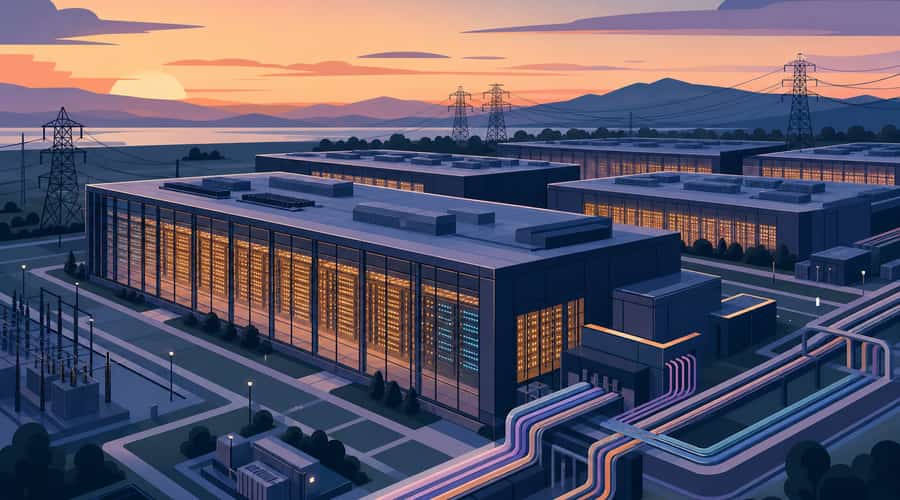
Aligned is not a model lab. It doesn't have a consumer chatbot with a name you can put on a billboard. It owns and develops data center capacity across the Americas, which is exactly why the asset matters. AI needs chips, but chips need buildings, cooling, power and grid connections before they produce a single token. Frankly, the building is starting to look less like a support function and more like the scarce asset.
The crowded trade is not the only trade
There is nothing foolish about owning Nvidia or Microsoft if you understand what you own. The mistake is pretending those stocks are the whole opportunity. Public markets have already rewarded the obvious winners. Private infrastructure gives large investors a different kind of exposure: long leases, contracted cash flows and assets that don't reprice every minute because one analyst changed a multiple.
That doesn't make the trade risk-free. Data centers can be overbuilt. Power interconnection queues can stretch for years. Local opposition can slow projects when electricity prices rise or water use becomes political. A lease with a hyperscaler is only as good as the assumptions behind demand, utilization and renewal pricing. You should be suspicious of anyone who makes infrastructure sound like free money.
But the sovereign fund logic is still clear. A data center with power secured in Northern Virginia, Texas or parts of Latin America can be more valuable than a pitch deck from the next model company. The model company may win or lose on talent, inference costs and distribution. The data center owner gets paid because all of those companies need somewhere to run.
Export controls add another push. Chips, frontier models and sensitive software sit closer to national security review than ordinary real assets. Gulf and Asian sovereign funds can run into political scrutiny when they try to buy strategic technology stakes in the United States. A fiber route, a power agreement or a data center campus is not free of regulation, but it sits in a different category from model weights or advanced semiconductors.
This is why the move into private credit matters as much as the headline acquisitions. Building AI infrastructure takes debt as well as equity. Someone has to finance substations, backup generation, land, cooling systems and construction before the customer turns on the servers. Sovereign funds like that profile because it can give them exposure to the AI buildout without asking them to guess which chatbot wins the enterprise account.
Retail investors mostly don't get this menu. You can buy shares in the public winners, or in some listed data center and power names, but you can't usually join the private vehicles financing a specific campus at negotiated terms. The Aligned deal was not waiting for small investors on an exchange. That gap matters because the institutions with the longest time horizons are buying access to the less visible part of the AI economy.
The better way to read this rotation is not as a vote against AI. It is a vote against paying any price for the most obvious AI stocks after the easy money has already been made. Sovereign funds are still betting on AI demand. They're just betting that, over the next phase, the owner of the wires and watts may have a cleaner claim on the cash than the company with the loudest demo.
Also read: Momenta's Hong Kong IPO prices at HK$295.60 as Chinese autonomous driving bets on software margins over profits • Micron Technology briefly overtook Meta and Tesla in market value after revenue quadrupled on AI memory demand • Baidu's Kunlunxin is chasing a $50 billion Hong Kong IPO with a condition investors have rarely seen