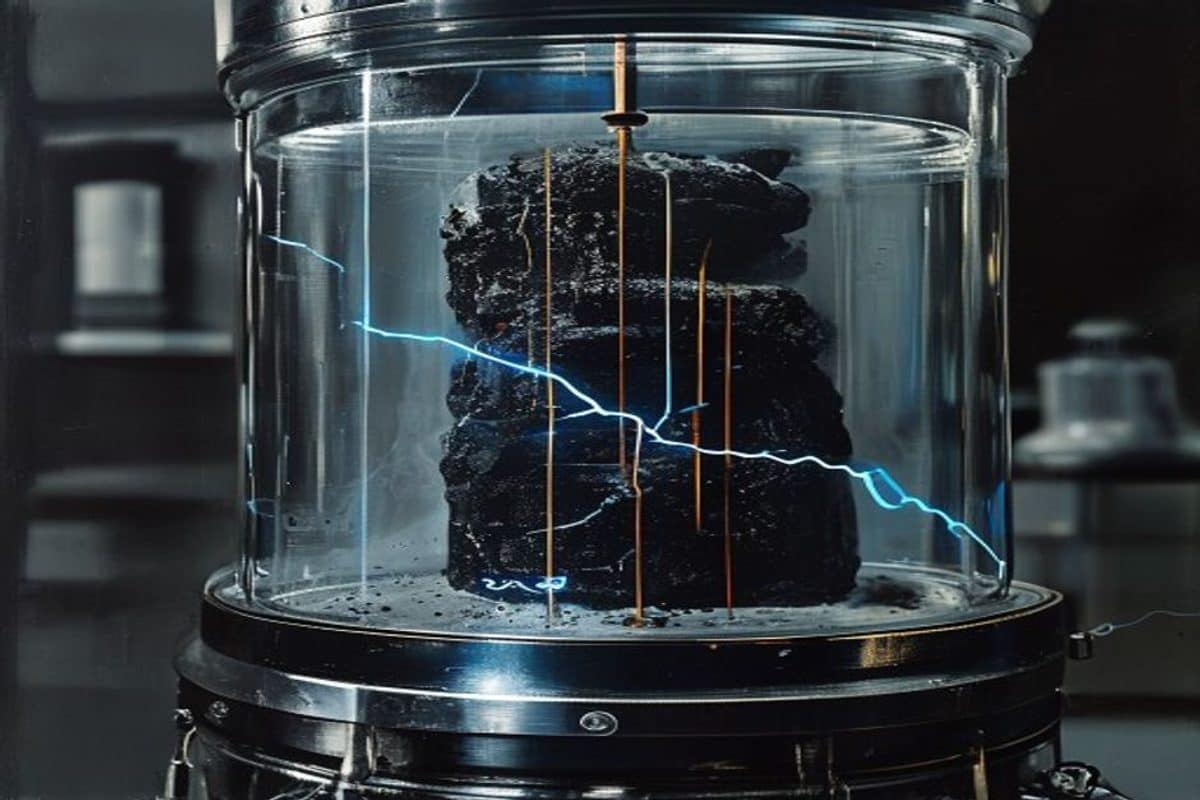
A team at Shenzhen University led by Chinese Academy of Sciences member Xie Heping has developed the world's first zero-carbon-emission direct coal fuel cell, generating electricity from coal without combustion and without producing carbon dioxide.
Coal and zero emissions are not two phrases that belong in the same sentence. Until now. A research team in China has built a device that places coal inside what is functionally a battery, extracts electricity from it electrochemically rather than by burning it, and produces no carbon dioxide in the process. If that sounds like it should be impossible, that reaction is precisely why the result is worth paying close attention to.
The device is called a zero-carbon-emission direct coal fuel cell, or ZC-DCFC, and it was developed by a team led by Xie Heping at Shenzhen University. The core distinction from conventional coal power is the elimination of combustion entirely. Traditional coal-fired generation burns coal to produce heat, uses that heat to boil water, drives a steam turbine, and converts mechanical energy into electricity, a chain of energy conversions that is inherently inefficient and produces CO2 at the combustion stage as a fundamental byproduct. The ZC-DCFC bypasses that entire chain by converting the chemical energy in coal directly into electrical energy through an electrochemical process, the same principle that governs a standard battery or hydrogen fuel cell.
In a conventional fuel cell, a fuel such as hydrogen is oxidized at an anode to release electrons, which flow through an external circuit as usable electricity before recombining with oxygen at the cathode. The ZC-DCFC applies this architecture to coal, using the carbon in coal as the fuel that undergoes electrochemical oxidation. The critical engineering achievement is doing this in a way that prevents carbon from combining with oxygen to form CO2. Instead, the carbon is converted through a different reaction pathway, and the resulting output is electricity at efficiency levels the team reports as higher than conventional coal combustion, alongside an absence of the carbon dioxide that combustion makes unavoidable.
The efficiency claim is significant independent of the emissions story. Coal power plants typically convert around 33 to 40 percent of coal's energy content into usable electricity, with the remainder lost as heat. Electrochemical conversion can theoretically achieve much higher efficiencies because it is not subject to the thermodynamic ceiling that limits heat engine performance. If the ZC-DCFC can deliver on its efficiency claims at meaningful scale, it would represent an improvement in coal utilization that has economic value even before accounting for the environmental implications.
What This Means and What It Does Not
The temptation with a result like this is to immediately project it onto global energy infrastructure, and that projection needs to be made carefully. This is a laboratory demonstration. The gap between a working proof of concept and a technology that can be manufactured at the scale required to replace existing coal capacity is vast, involving materials cost, durability under continuous operation, manufacturing processes, and grid integration challenges that do not appear in a lab paper. Xie Heping's team has demonstrated that the underlying chemistry is real and that the device works. That is genuinely important. It does not mean coal plants are about to be retrofitted with fuel cells.
What it does mean is that one of the most persistent assumptions in energy policy, that coal use is inseparable from CO2 emissions, has been given a credible scientific challenge. That matters for countries that have large coal reserves and the political and economic reality of continuing to use them, China being the most prominent but far from the only example. If a technology pathway exists that allows coal to be used for electricity generation without the emissions that make it incompatible with climate commitments, the strategic calculus around coal transitions changes substantially.
The research also arrives in a context where China is simultaneously the world's largest coal consumer and one of the most aggressive investors in clean energy technology. The ZC-DCFC fits a pattern of Chinese scientific institutions pursuing energy innovations that address domestic resource realities while engaging seriously with decarbonization goals. Whether this particular technology scales is an open question, but the institutional commitment to finding that answer is clearly present.
For energy investors and policymakers tracking the long-term outlook for fossil fuels, the ZC-DCFC is a development worth monitoring with genuine seriousness rather than dismissing as laboratory curiosity. Technologies that appear to reconcile coal with climate targets have a commercial and geopolitical value that will attract significant follow-on investment if the early results hold under scrutiny. The next stage of validation, extended operation, independent replication, and preliminary scaling studies, will determine whether this remains a fascinating result or becomes a consequential one.
Also read: Prediction.Express wants to be the Bloomberg terminal for the prediction market economy • Proton maps out an ambitious 2026 roadmap as privacy demand hits new highs • Xiaomi's MiMo V2.5 Pro matches the best open-weights models in the world and costs half as much to run