
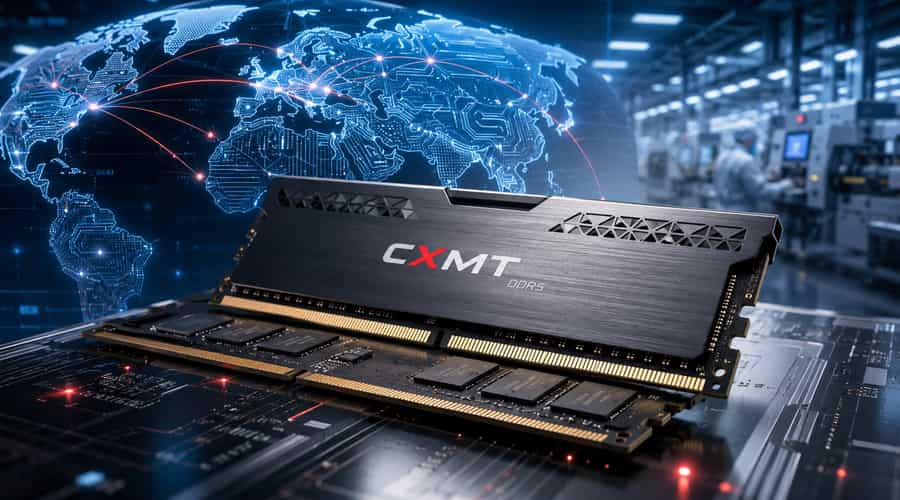
Corsair’s use of CXMT DDR5 is not just a parts-bin story. It shows Chinese DRAM is moving from domestic alternatives into products that mainstream buyers already trust.
The memory shortage has created an opening that would have looked unlikely a year ago: a major Western consumer hardware brand shipping DDR5 with chips from ChangXin Memory Technologies, China’s leading domestic DRAM producer. The module spotted this week is a Corsair Vengeance DDR5 kit, the kind of product bought by gamers, PC builders and small workstation users who usually never think about where the individual memory dies come from.
That is precisely why it matters. Startups watching AI infrastructure costs tend to focus on GPUs, cloud contracts and data center power. But memory has become part of the same pressure system. When Samsung, SK Hynix and Micron are pulled toward higher-margin AI servers and hyperscale contracts, the ordinary DDR5 market gets squeezed. A supplier like CXMT does not need to beat the industry leaders at the high end to change the market. It only needs to prove it can serve the middle reliably.
As Tom’s Hardware reported, screenshots posted by hardware leaker @wxnod showed a Corsair Vengeance DDR5 16GB stick bought in China using CXMT DRAM, running at 6,000 MT/s with CL36 speeds. The label reportedly points to a China-market part number, CMK5X16G3E60C36A2-CN, with Intel XMP and AMD EXPO support. HotHardware separately noted timings of 36-44-44-96 at 1.35V for the 32GB kit configuration.
This is not a formal Corsair announcement. It is a supply-chain signal. Corsair has historically leaned on Micron, Samsung and SK Hynix for DRAM supply, so a CXMT-powered Vengeance kit suggests the company is comfortable enough with the chips to put its brand on the module. That does not make CXMT an equal to the big three. It does make CXMT harder to dismiss as a domestic-only player.
For early-stage companies, the memory problem shows up quietly. A founder building AI tools may not buy raw DRAM directly, but the cost still filters through workstation builds, inference boxes, cloud GPU instances and hosted infrastructure. If memory pricing stays inflated, every layer of the stack becomes less forgiving. Training experiments get rationed. Local development machines become more expensive. Small teams wait longer before buying capacity they know they will eventually need.
That is why a mainstream CXMT entry has more meaning than a new budget RAM brand on a Chinese marketplace. Corsair is a trust layer. Buyers may not know CXMT, but they know Corsair’s Vengeance line. If CXMT chips can pass validation for a recognizable branded kit, they can help expand supply without asking buyers to take a leap into unknown white-label hardware.
The specs are also telling. DDR5-6000 CL36 is not exotic, but it is useful. It sits in the practical range for mainstream gaming PCs and creator workstations. For many business users, stable availability at a lower price matters more than record latency. That is the opening CXMT appears to be walking into: not the most glamorous corner of memory, but the corner with volume.
China’s domestic memory push has been building for months. South China Morning Post recently noted that Chinese module makers have been accelerating DDR5 products based on CXMT dies, including consumer modules from Gloway and KingBank and enterprise products from Powev’s Sinker line. CXMT has also disclosed DDR5 products supporting up to 8,000 Mbps and 16Gb and 24Gb die densities. That still leaves it behind the most advanced 32Gb DDR5 chips from Samsung, SK Hynix and Micron, but the gap is no longer wide enough to keep CXMT out of ordinary products.
The political risk has not gone away
The harder question is whether this becomes a commercial breakthrough or a regulatory trigger. Chinese memory is arriving at the same moment Western governments are trying to reduce exposure to China in strategic technology supply chains. CXMT has avoided some Commerce Department entity-list controls that hit other Chinese semiconductor firms, but the direction is not risk-free: a May 2026 U.S. procurement rule adds CXMT to covered semiconductor restrictions for federal contractors from August 1, 2026.
For Corsair and other module makers, the business logic is simple. If the market is short and customers are angry about price, a qualified alternative supplier is valuable. For regulators, the logic may look different. Memory sits close to AI, cloud computing and defense-sensitive systems. Even if a consumer DDR5 kit is not an advanced AI component, the supplier behind it will attract more attention as its market share grows.
CXMT’s own numbers explain why this story will not stay small. Recent Shanghai Stock Exchange disclosures tied to its planned STAR Market listing showed first-quarter revenue of 50.8 billion yuan, up more than 700% year over year, with net profit above 33 billion yuan. Those figures reflect a memory market distorted by shortage and AI demand, but they also give CXMT the capital story it needs to expand capacity.
The next thing to watch is pricing. If Corsair sells CXMT-based kits at the same shortage-driven prices as modules using Samsung, SK Hynix or Micron chips, the benefit goes mostly to margins. If the supply translates into lower street prices, startups and smaller builders finally get some relief. Either way, the signal is clear: Chinese DRAM has crossed from alternative supply into branded consumer hardware, and the old memory hierarchy is starting to feel less permanent.
Also read: Grok is struggling to turn Musk's reach into enterprise trust • Brain implants are pushing artificial vision closer to practical use • A $4,000 bounty shows DeFi still prices security too cheaply.