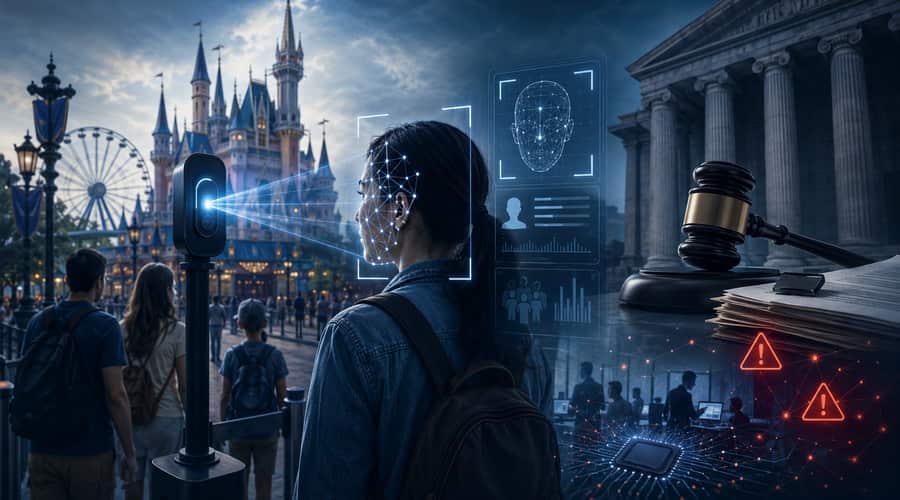
Disney's lawsuit is not just a theme park privacy fight. It is a warning to every company treating biometric AI as a faster checkout lane instead of a regulated identity system.
Disneyland's new face-scanning entrance system has moved from convenience feature to courtroom test in less than a month, and that is exactly why founders should pay attention. A proposed $5 million class action accuses The Walt Disney Co. of using facial recognition at Disneyland Park and Disney California Adventure without giving guests a meaningful chance to understand or avoid the collection of biometric data.
The lawsuit was filed in the U.S. District Court for the Southern District of New York after Riverside County resident Summer Christine Duffield visited the Anaheim parks with her children on May 10. The complaint alleges Disney collected facial data from adults and minors without adequate consent, notice, and transparency. Disney has not been found liable, and the case is still at the allegation stage, but the claim is already useful because it shows where the next wave of AI risk is likely to land.
As the Los Angeles Times reported this week, Disney rolled out the technology across Disneyland Resort in late April to help verify tickets and prevent fraud. Disney's own privacy notice says the system uses a camera image taken at the entrance, compares it with an image saved when a guest first used a ticket or pass, converts those images into numerical values, and deletes those values within 30 days unless they are needed for legal or fraud-prevention purposes. The company also says participation is optional and that non-facial-recognition lanes are available.
That sounds like a compliance framework. The lawsuit argues it is not enough. That difference matters because most biometric disputes are not really about whether a company can make the technology work. They are about whether the user clearly knew what was happening, whether consent was freely given, how long the data stayed in the system, and whether the company could prove all of that later.
Facial recognition is attractive because it removes friction. A guest walks up, the system checks the face against a ticket or pass, and entry becomes faster. Retailers, hotels, stadiums, casinos, airports, and office landlords are all interested in the same promise. Fewer bottlenecks. Less fraud. Better security. More data tied to real-world identity.
But the very feature that makes biometric AI valuable also makes it legally sensitive. A password can be changed. A face cannot. Once a company collects biometric identifiers, it is no longer handling ordinary customer data. It is handling a permanent identity marker that can become more valuable, and more dangerous, as systems become connected across locations and vendors.
This is where startups often misread the market. They sell speed, accuracy, and fraud reduction, then treat privacy language as something legal can add before launch. That approach is getting weaker by the month. In biometric deployments, the product is the policy. The placement of signs, the default lane, the opt-out flow, the retention schedule, the child consent process, and the vendor audit trail are all part of the experience.
Illinois' Biometric Information Privacy Act has already taught companies that biometric laws can create serious exposure when consent and retention practices are loose. BIPA is not the only model in play, and this Disney case is centered on California parks and a New York federal filing, but the lesson is similar. Regulators and plaintiffs are looking closely at whether consumers are being nudged into biometric systems without a real choice.
The vendor contract is now part of the product
For entrepreneurs building identity, security, or venue-management software, the legal risk will not stop with the brand using the system. Enterprise buyers are going to push harder on indemnification, data ownership, deletion rights, model performance, breach response, and whether biometric templates can ever be used to improve a vendor's broader product.
That changes the sales conversation. A facial recognition vendor that can show clear consent logs, configurable retention limits, child-specific workflows, and jurisdiction-aware notices will have an advantage over a cheaper tool that simply recognizes faces well. Accuracy gets a company into the room. Compliance keeps it there.
There is also a practical operating point here. If a company says participation is optional, the alternative has to feel real. A hidden lane, a slower lane, a confusing sign, or staff who cannot explain the difference can turn an opt-out into a weak defense. The law may decide those details later, but customers decide them immediately.
Disney has the resources to fight, settle, or redesign around a lawsuit like this. Most startups do not. That is why the case should be read less as a Disney story and more as a deployment warning. Biometric AI is moving into ordinary consumer spaces, and the companies that win will be the ones that treat consent, retention, and auditability as core infrastructure rather than paperwork after the launch.
The next thing to watch is whether courts accept opt-out facial recognition as enough in crowded public-facing environments. If they do not, the cost of rolling out biometric AI will rise quickly. For founders, that may feel like friction. In reality, it may become the moat.
Also read: Palantir's USDA contract puts federal worker monitoring on the AI map • Berkshire's cash pile shows Greg Abel is not rushing the Buffett playbook • Meituan puts avatar video startups under new pressure