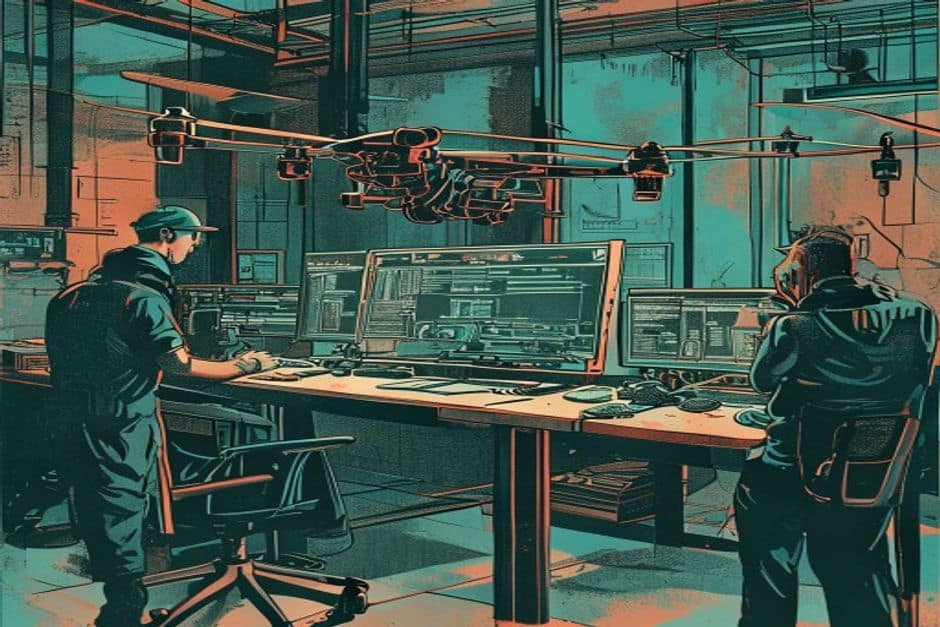
Europe's next defence contest is not only about bigger budgets. It is about whether startups can build cheap autonomous systems faster than legacy procurement can slow them down.
Ukraine has changed the maths of modern warfare, and Europe is now trying to catch up before the next shock arrives. The lesson is brutally simple: a cheap drone can force an army to spend money like a superpower, especially when the interceptor costs far more than the target.
That imbalance is pulling a new class of defence startups into the centre of European security policy. Skycutter in the UK, Tekever in Portugal and Frankenburg in Estonia are not trying to look like old prime contractors with decades-long programmes and glossy procurement decks. They are building around speed, modularity and the expectation that many systems will be used once and replaced quickly.
As The Guardian reported, Skycutter is working on interceptor drones and missiles for Ukraine, including systems that use 3D-printed fuselages and lower-cost electronics. That detail matters because it points to a different industrial model. The winning product is not necessarily the most exquisite weapon. It may be the one that can be redesigned, printed, assembled and shipped while battlefield conditions are still changing.
The clearest example is the Shahed drone, which has been widely reported to cost about $30,000. Against that, a Patriot interceptor can cost millions. No defence ministry can comfortably win a long war by firing luxury ammunition at disposable threats, however capable the system may be. The economics eventually become strategy.
This is where autonomy and AI move from buzzwords into hard market demand. Interceptor drones need guidance, target recognition, resistance to jamming and the ability to operate in messy airspace where signals are contested. The software does not replace the hardware, but it decides whether a low-cost platform can perform a task once reserved for far more expensive systems.
For startups, that creates a venture-shaped opening. The market is large, urgent and painfully underserved. Ukraine has shown that demand can move faster than traditional suppliers, and European governments are now under pressure to prove they can support domestic companies rather than depend on US primes. Defence sovereignty sounds abstract until the ammunition runs low and the spare parts sit outside your political control.
Still, this is not a clean software story. Cheap and expendable does not mean easy to scale. A company making autonomous weapons has to navigate export controls, classified requirements, field testing, military procurement rules and supply chains for motors, batteries, sensors and explosives. Venture capital likes fast iteration, but defence customers still buy through systems designed to avoid failure more than to reward speed.
Procurement is the real bottleneck
The UK shows the tension clearly. Its delayed defence investment plan has left industry waiting for firm signals on what the government will actually buy. Reports of a £28bn gap in defence funding have sharpened the problem, because startups cannot hire engineers, build factories or commit to suppliers on speeches alone.
That uncertainty creates relocation risk. If a young defence company sees faster procurement, clearer contracts and deeper capital in the US, Germany or elsewhere, patriotism will not cover the payroll. Governments that want sovereign capability have to behave like serious customers. That means smaller contracts issued faster, clearer testing pathways and procurement teams able to buy from companies that do not yet have a 30-year relationship with the ministry.
The European Union is also moving in this direction, with sovereignty rules and defence funding designed to keep more production inside Europe. That could reshape supply chains in favour of local components, domestic assembly and allied manufacturing networks. It could also make life harder for startups if rules become another compliance maze instead of a route to faster adoption.
The most interesting companies will be the ones that can balance both worlds. They need the low-cost mindset of consumer hardware, the software cadence of AI startups and the reliability expectations of the military. Tekever's drone experience, Skycutter's interceptor focus and Frankenburg's anti-drone missile work all sit inside that wider shift from prestige platforms toward mass, adaptability and attrition economics.
Investors will need a different yardstick too. Defence tech is not SaaS with uniforms. Revenue can arrive in bursts, procurement can stall for political reasons and customers may demand sovereign production that limits easy global scaling. But the upside is equally clear: governments are being forced to spend, and the old industrial base cannot meet every new requirement alone.
Europe's defence sovereignty push will be judged by whether it turns urgency into companies that can actually produce at scale. The next phase is not about proving that cheap autonomous weapons matter. Ukraine has already done that. The question now is whether Europe can build the market, supply chains and procurement habits needed to keep those weapons coming when the pressure is highest.
Also read: Google is preparing Gemini users for stricter AI pricing. • AI's giant spending spree is making investors ask harder questions • Tech managers are losing ground as AI rewards leaner teams