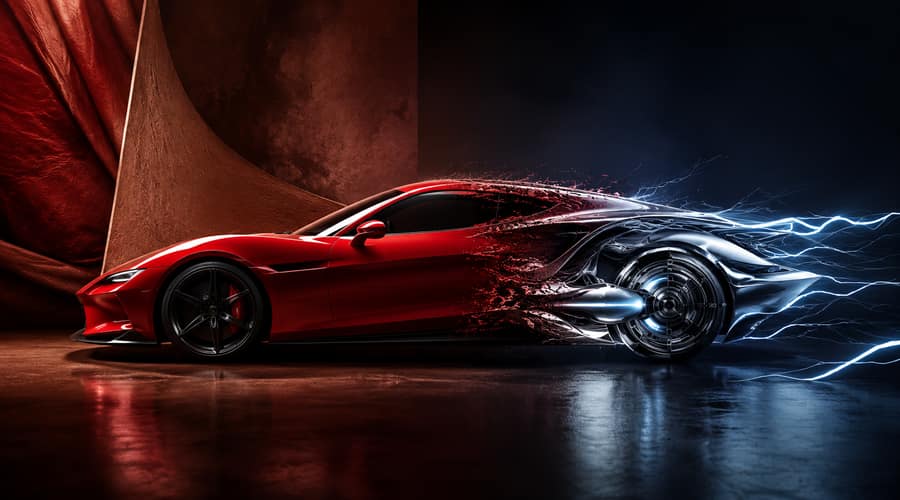
Ferrari’s first full electric car is not just a product launch. It is a public test of whether one of the world’s strongest performance brands can change its technology without changing what people think they are buying.
Ferrari has put the Luce in front of the market, and the market did not applaud. Shares in the Italian luxury carmaker fell as much as 7.8% in Milan trading after the company unveiled its first fully electric vehicle, a four-door, five-seat model priced from about €550,000, or roughly $640,000.
That reaction matters because Ferrari is not valued like a normal car company. Investors have long treated it more like a luxury house with engines, protected by scarcity, pricing power and a customer base that accepts long waits because the badge does most of the talking. The Luce asks a harder question: can Ferrari add batteries, silence and five seats without making the brand feel more ordinary?
According to Reuters, Ferrari presented the Luce in Rome on Monday, with deliveries expected to begin in the fourth quarter of 2026. The car was developed with LoveFrom, the design collective associated with former Apple design chief Jony Ive and Marc Newson, which is why the design has become part of the story. Ferrari did not simply electrify a familiar silhouette. It chose a smoother, cleaner form that sits away from the muscular language many buyers associate with Maranello.
On paper, Ferrari has not built a timid EV. The Luce uses four electric motors, one for each wheel, and a 122 kWh battery pack. Reports from the launch put output at just over 1,000 horsepower, with 0 to 100 kilometers per hour arriving in about 2.5 seconds and a top speed above 310 kilometers per hour. The expected range is more than 530 kilometers on Europe’s WLTP cycle.
Those numbers are serious. They also may not be enough. Ferrari’s problem was never whether it could build a fast electric car. The problem is whether speed still feels special when electric performance has already become familiar to anyone who has driven a Tesla Plaid, watched a Rimac video or seen Porsche make the Taycan a credible road car years ago.
This is where Ferrari’s challenge becomes more emotional than technical. The company has spent decades teaching customers that sound, vibration, gear changes and combustion theatre are part of the product. With the Luce, Ferrari says it has worked to create an electric sound by capturing and amplifying real drivetrain vibrations instead of playing a fake engine note. That is a smart compromise. But it also shows how difficult the transition is. Ferrari has to replace not only an engine, but a memory.
The five-seat layout adds another layer. Ferrari already crossed a line with the Purosangue, its four-door, four-seat high-riding model, but that car kept a V12 engine at the center of the experience. The Luce is more practical and more radical at once. A 600-liter trunk and room for five people may bring Ferrari into a new use case, but practicality is a dangerous word for a company built on desire.
Why Investors Pushed Back
The selloff was not only about the car’s looks. It reflected a concern that Ferrari’s strongest financial asset, its ability to sell fewer cars at higher prices, could be weakened if the company chases a category where even wealthy customers are becoming more selective. Luxury EV demand has cooled across parts of Europe and the United States, and residual values have become a real concern for buyers who expect rare cars to hold value.
Porsche’s Taycan offers the closest comparison, but it is imperfect. The Taycan gave Porsche a credible electric performance flagship and helped prove that an EV could still feel premium. Yet Porsche sells at a different scale, at lower price points, and with a broader product identity that already includes everyday usability. Ferrari’s Luce starts at a price that puts it closer to a collector’s decision than a normal luxury car purchase.
That is why the design reaction landed so hard. If the Luce looked unmistakably like a Ferrari, investors might have treated the launch as a cleaner extension of the brand. Instead, the Ive influence appears to have divided the audience. Minimalism works beautifully when the product is a phone, a watch or a laptop. In a Ferrari, restraint can easily be read as absence.
The timing also matters. Ferrari has already moderated its long-term electric ambitions. Its 2030 plan now points to fully electric models making up about 20% of the lineup, while combustion and hybrid cars continue to carry much of the range. Lamborghini has also slowed its first EV plans, a reminder that even the most powerful luxury badges are not immune to customer hesitation.
For other high-end manufacturers, the Luce is now a live case study. Electrification is no longer an automatic signal of progress. In the mass market, an EV can be judged on efficiency, price and software. In the luxury performance market, it has to protect myth, scarcity and resale value at the same time.
Ferrari may still prove the skeptics wrong. Its client list is deep, its allocation power is formidable, and a first electric Ferrari will attract buyers simply because it is a first. But the stock reaction is a useful warning. The next phase of luxury EVs will not be won by adding batteries to famous badges. It will be won by companies that can make the new technology feel inevitable without making the brand feel diluted.
Also read: Britain could rejoin Europe's startup capital pipeline this year • Private credit losses are starting to test startup financing. • Palantir turns a London police setback into a public test of AI procurement