Firmus no longer looks like a simple data center float. The Nvidia deal has turned its delayed ASX listing into a harder question: can it build enough AI factory capacity to justify the story it is now selling?
Firmus has pushed its expected ASX listing into the background after landing a new Nvidia partnership anchored by a 360 megawatt AI factory in Batam, Indonesia. The Australian reported on June 28 that the agreement runs to 2034, covers up to 170,000 Nvidia AI accelerators across Grace-Blackwell, Vera-Rubin and Vera platforms, and could support $US25 billion to $US30 billion in revenue from committed offtake deals over its first six years.
That is the story now. Not just an Australian IPO. Not another AI infrastructure pitch deck. Firmus is trying to show investors that it can sell compute before it has to sell shares, and Nvidia is giving it a structure that makes GPU access look less like procurement and more like financial muscle.
According to The Australian, Firmus co-chief executive Tim Rosenfield said the company had been open about wanting to list, but was not tied to someone else's timetable. Investors had previously been told the IPO was on track for June or July with a possible $12 billion valuation. The company was valued at about $7 billion after a $US505 million April raise and recent private share transactions, including James Packer buying stock.
Frankly, the delay makes sense. If you can tell public-market investors that contracted revenue has increased tenfold, you don't rush into a listing window just to satisfy an old calendar.
The important detail is the structure. The Australian reported that Firmus will sell Nvidia-powered cloud services, while Nvidia earns its usual product revenue and also shares in cloud revenue on supported capacity. Rosenfield declined to give the exact economics, including Nvidia's income share or Firmus's expected margin. Keep that caveat in view, because the missing number is the number every serious investor will want.
Nvidia gets something useful too. It can help smaller AI cloud providers offer what Rosenfield called hyperscale-level economics to native AI companies, then share in the upside when the capacity is used. You don't need to be Meta, Microsoft or Amazon to get into the room, at least in theory. You need demand, offtake contracts and a partner with access to the hardware stack.
This fits Nvidia's wider cloud move. The Wall Street Journal reported last year that DGX Cloud Lepton was built to connect AI developers with GPU cloud providers such as CoreWeave, Lambda and Crusoe. DataRoom later noted that Firmus was one of 17 named partners in that Lepton ecosystem, alongside Mistral AI, Nebius, Nscale, Together AI and others. That earlier list made the Firmus relationship real, but not unique. The Batam deal gives it a sharper edge.
You should still be careful with the hype. Nvidia has every reason to seed multiple cloud partners and keep optionality. It doesn't need every one of them to become a champion. Firmus needs this project to work much more than Nvidia does.
The hard part is execution
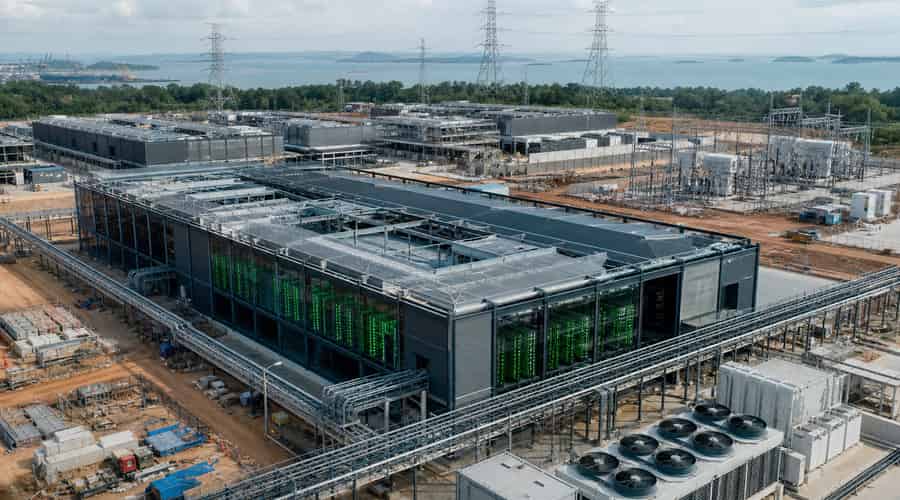
Batam gives Firmus a bigger stage than anything it has built so far. The Australian said the Indonesia project would be about 10 times the size of Firmus's Melbourne factory and about five times bigger than its Tasmania facility. A 360 megawatt AI factory is not a branding exercise. It is land, grid access, cooling, financing, customers, delivery dates and the plain work of keeping utilization high enough to justify the hardware.
Firmus has also been selling investors a specific cost story. DataRoom reported in April that the company claimed it could build data centers at less than $US6 million per megawatt, roughly half the benchmark it cited for operators such as NextDC. The company put that down to standardized design, regional sites and single-storey construction. Critics questioned whether that gap can survive contact with real infrastructure costs, especially when power and electrical systems are the expensive part.
The company is trying to prove itself at home at the same time. The Herald Sun reported this month that Firmus lodged plans for Project South Gate George Town at the former Gunns pulp mill site in Bell Bay, Tasmania, with two AI data halls, an office building and a maintenance workshop. The proposal would draw 288 megawatts from a grid fed largely by hydro, wind and solar, and public feedback runs until June 29. Its earlier Launceston site was approved in July 2025, is expected to use 104 megawatts and is still due to be completed by the end of 2026, with full operation expected in 2027.
Those details matter because public investors are less forgiving than private buyers chasing scarce GPU exposure. Firmus has backers with recognizable names, including Nvidia, UniSuper and James Packer's Ellerston-linked investment, and The Australian has reported a $US10 billion financing package led by Blackstone. The market will still ask the plain question: can this company build and run AI factories at the scale it is now promising?
For founders watching this, the lesson isn't that every AI infrastructure company should chase giant GPU commitments. Most shouldn't. The useful point is narrower: in AI compute, financing and distribution are becoming part of the product. If Nvidia's revenue-share model works for Firmus, GPU supply becomes a weapon that smaller clouds can use against hyperscalers, not just a bill they have to pay before they earn a dollar.
The Batam project now carries that argument. Firmus has bought itself time on the IPO, but it has also raised the burden of proof. A delayed float is easy to explain when the contract book is growing. It is harder to explain if the factories, the margins or the customers arrive late.
Also read: Pimco is turning AI data centers into a private debt power play • NPCI is betting AI can take UPI to a billion daily payments • GM wants Cruise's failure to pay off in your driveway