Europe’s AI gigafactory race has moved from political ambition to active procurement, and France is still in the hunt, even if the contest is now broader and more complicated than a single national pitch.
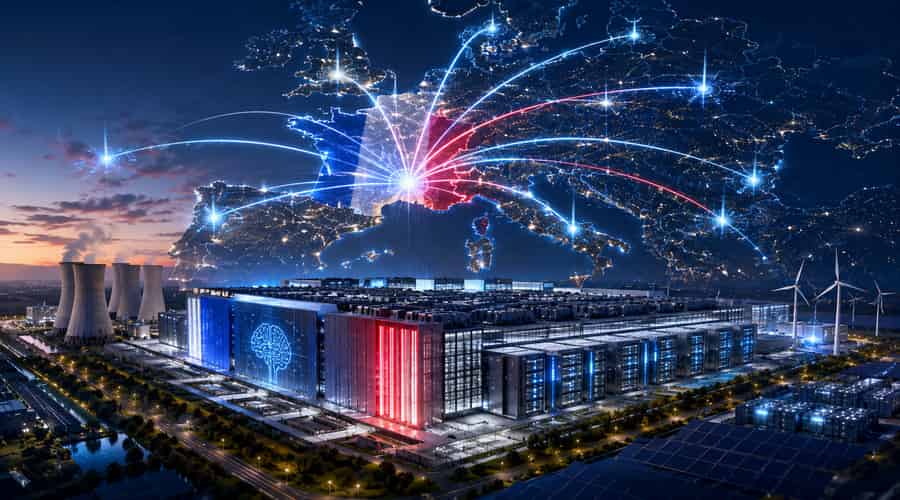
France wants to turn its energy base, industrial policy and growing AI ecosystem into a claim on one of Europe’s most important compute projects. The prize is not just another data centre. It is a chance to host the infrastructure that could decide whether European startups train frontier models at home or keep renting capacity from U.S. and Chinese hyperscalers.
The European Commission and the EuroHPC Joint Undertaking have now pushed the process into a more concrete phase. EuroHPC launched a call for proposals on April 28, 2026, with submissions due by June 23, 2026, after earlier consultations drew 76 expressions of interest across 16 EU member states and 60 potential sites. That keeps the story current and turns what was once a policy slogan into a live contest among governments, industrial groups, cloud operators and investors.
The EU’s gigafactory concept is designed around very large computing hubs that can train and run advanced AI models. The political logic is clear. Europe has strong universities, a deep industrial base and active AI startups, but it still depends heavily on foreign cloud and chip supply chains. If Brussels wants European companies to build larger models without exporting sensitive data or paying premium prices for scarce compute, it needs capacity on the continent.
There is serious money attached. The Commission’s InvestAI plan includes a €20 billion facility to support up to five AI gigafactories, while existing AI factory investments and EuroHPC programs already form part of the wider public financing base. As the European Commission has laid out in its recent AI continent materials, the goal is to blend EU backing, national commitments and private capital rather than have Brussels pay for the whole buildout itself.
France has strengths, but the field is crowded
France’s case rests on a few practical advantages. It has nuclear-heavy electricity, a state accustomed to large industrial projects, and a government that has made AI infrastructure a visible part of its economic strategy. Those strengths matter because gigafactories will need reliable power, grid access, cooling, land, financing and long-term political support. In this race, an attractive site is not enough. The operators also need a credible plan for running an energy-hungry facility for years.
French bids are understood to involve combinations of industrial companies, data-centre operators, cloud players and equipment suppliers. But France is not competing in a vacuum. Germany, Italy, Spain, the Nordics and other member states can all make their own cases, whether through industrial demand, renewable power, existing supercomputing assets or national funding. The earlier expression-of-interest numbers show how much appetite there is across the bloc.
There is also a cautionary note. Bloomberg reported in March 2026 that Fluidstack had pulled out of a proposed €10 billion, one-gigawatt AI infrastructure project in Bosquel, northern France, after shifting focus toward larger U.S. contracts. That does not remove France from the EU gigafactory race, but it does show the difficulty of turning political announcements into bankable projects. AI infrastructure is expensive, power-intensive and brutally competitive. Operators will go where customers, financing and execution risk make sense.
Energy is now part of AI strategy
The site selection debate will be as much about electrons as algorithms. AI gigafactories are expected to use tens of thousands, and potentially far more, specialised processors. That means constant demand for power, resilient grid connections and cooling systems that can withstand both technical pressure and public scrutiny. Local communities will ask what they get in return for hosting such infrastructure. Governments will have to answer with jobs, investment and credible environmental planning.
France’s nuclear fleet gives it a strong talking point, especially as AI companies look for cleaner and more predictable energy sources. But low-carbon power alone will not settle the issue. A winning bid will need to show how the site connects to the grid, how it handles water and cooling, how it secures hardware supply, and how European researchers and startups will actually gain access to the machines once they are built.
That last point matters for founders. A European gigafactory only changes the startup landscape if it lowers the practical barriers to training and testing serious models. Lower latency is useful. Lower cloud costs matter more. So does keeping proprietary data within European legal and regulatory structures. For a health AI company in Paris, a robotics startup in Munich or a language-model developer in Barcelona, compute access can be the difference between building an ambitious product and scaling back the roadmap.
The next test is execution
The policy backdrop has also changed. The Council adopted the EuroHPC regulation amendment on January 16, 2026, expanding the joint undertaking’s mandate to support AI gigafactories and quantum technologies. That gives the program a clearer legal base just as companies prepare formal bids. It also raises the stakes, because Brussels is no longer only talking about AI sovereignty. It is creating a mechanism to fund and select the infrastructure behind it.
The competition will now turn on details that rarely fit neatly into political speeches: consortium structure, energy contracts, chip procurement, financing terms, governance and guaranteed European access. France can still be a leading contender, but the winners will be the bids that make the strongest operational case, not simply the loudest national claim.
For startups and investors, the takeaway is straightforward. Europe’s AI ambitions will be judged by where the compute lands, how quickly it comes online, and whether smaller companies can use it without being crowded out by national champions and well-funded incumbents.