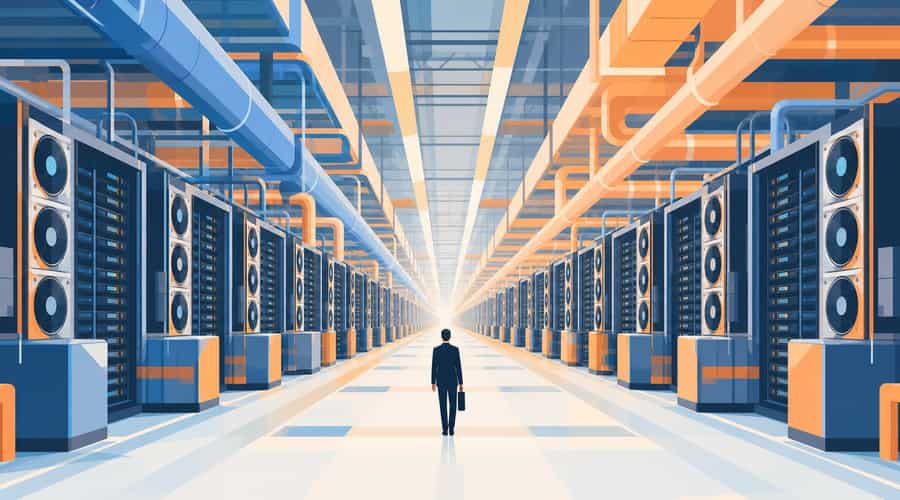
Oracle's AI data center bet is no longer just a growth story. It's a financing story, and Wall Street is finally treating those as two different things.
Oracle closed its fiscal year on May 31 with $55.7 billion in capital expenditures, up from $21.7 billion a year earlier, and the stock still sold off after earnings. You can see why. Revenue for the fiscal fourth quarter rose 21 percent to $19.2 billion, Oracle Cloud Infrastructure revenue jumped 93 percent to $5.8 billion, and adjusted earnings beat Wall Street's estimate. Those are not weak numbers. They just aren't big enough to make $55.7 billion look easy.
Oracle's own pitch rests on the backlog. The company reported $638 billion in remaining performance obligations, the contracted revenue it hasn't yet recognized, with $85 billion in net new additions during the quarter, according to MarketWatch. The Wall Street Journal has reported that one of the contracts behind that backlog is OpenAI's roughly $300 billion commitment to buy computing power over about five years. That's the bet in plain English: build the capacity now, recognize the revenue later, and trust that OpenAI and the rest of the AI market keep moving fast enough to fill the racks.
Paying for it is the hard part. CFO Hilary Maxson said Oracle expects a net cash outlay of about $70 billion for capital expenditures in fiscal 2027, with another $20 billion to $25 billion paid directly by customers, according to the Journal. The company also expects to raise $40 billion in debt and equity financing this fiscal year, including a $20 billion equity issuance it has already announced. If you're an investor, you don't have to hate AI to ask a simple question: when does this start throwing off cash instead of consuming it?
That's why Oracle has become such a useful case for the skeptics. The company is not talking about a pilot project or a vague cloud refresh. It had negative free cash flow of $23.7 billion in fiscal 2026, according to Investor's Business Daily, after spending tens of billions on data centers and related infrastructure. The money is real today. The payoff is still scheduled for later.
The lease obligations make the picture heavier. In a recent regulatory filing, Oracle disclosed $248 billion of data center and cloud lease commitments with terms running 15 to 19 years, a number D.A. Davidson analyst Gil Luria flagged as another sign that the company could be strapped for capital. Lease commitments don't always sit in the headline capex figure readers see first, but they still have to be paid. Frankly, that's the point Wall Street is pressing now. The AI buildout is being sold as demand-led, but the balance sheet has to survive the wait.
Oracle also faces litigation around how it financed part of the push. Reuters reported in January that bondholders led by the Ohio Carpenters' Pension Plan sued Oracle, several executives and underwriters, alleging the company misled investors about whether it would need to borrow more after selling $18 billion of debt in September 2025 and later issuing another $38 billion. Oracle has not lost that case, and allegations are not findings. Still, the lawsuit belongs in the story because it shows where the pressure has moved: from whether AI demand exists to who carries the financing risk until that demand becomes revenue.
Here's the thing: Oracle isn't the whole AI market. It's the sharper version of the market's worry.
Microsoft, Alphabet, Meta and Amazon are still spending hard on AI infrastructure, and Amazon has guided to more than $200 billion of capital expenditures for 2026. The Financial Times reported that the Magnificent Seven lost more than $2.2 trillion in market value in June as investors rotated away from the companies writing the biggest AI checks and toward some of the chip and component suppliers getting paid by them. That split tells you a lot. The market still believes someone will make money from the buildout. It is less sure the biggest spenders will keep the best share of it.
Regulators have started to sound the same alarm in plainer language. The Bank of England warned last year that stretched AI valuations could face a sharp correction if adoption disappoints, competition rises or infrastructure costs prove too high. The IMF has also warned that advanced AI models could create systemic risks in finance. Those warnings are not a verdict on Oracle. They are a reminder that infrastructure booms can be real and still be overfinanced.
Oracle's leadership change adds one more wrinkle. Safra Catz moved to executive vice chair in September 2025, while Clay Magouyrk and Mike Sicilia became co-CEOs, according to Oracle's announcement and Reuters. Larry Ellison remains executive chairman and chief technology officer, and the company still looks like a Larry Ellison company in the moments that matter. He has put Oracle in the middle of the AI infrastructure race, with OpenAI as the customer everyone is watching.
If the contracts convert on schedule, Oracle can argue that Wall Street mistook upfront construction pain for weakness. If capacity is delayed, if OpenAI slows its commitments, or if financing costs stay high while lease bills keep arriving, Oracle will have handed investors the clearest example yet of the AI boom's central problem: enormous demand does not automatically make an enormous balance sheet easy to carry.
Also read: Goldman Sachs says Europe's grid and factory suppliers are cashing in on AI • Abu Dhabi's MGX Closes Nearly $50 Billion to Bankroll the AI Buildout • ITG Priced Its Nasdaq IPO Below Range Even as the AI Infrastructure Boom Rages On