Gold miners have been hit harder than bullion in July, and Alamos Gold and Equinox Gold show why the trade cuts both ways when rates, mine problems and deal risk arrive together.
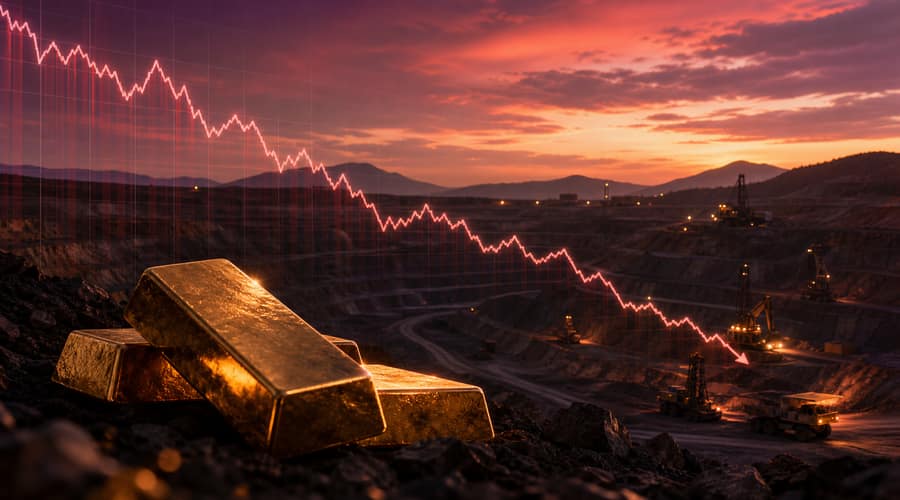
You can own gold for the metal. Or you can own miners for the upside. July has been a quick reminder that those are not the same thing. Gold futures were still around $4,046 an ounce on July 23, according to The Wall Street Journal, but that was nearly 24% below the 2026 high of $5,318.40. Alamos Gold and Equinox Gold were taking the fall differently, with Alamos trading near $29 in mid-July and Equinox touching $8.485 on July 17, according to Metals Channel. The metal fell hard. The stocks carried extra baggage.
That is the trade. Mining equities don't simply track bullion. They add operating costs, production guidance, mine access, financing decisions and investor mood to the gold price. When the metal rises, that extra exposure can make shareholders look clever. When it falls, it can make the same position look reckless.
The macro setup was already rough. Reuters reported that Federal Reserve Chair Kevin Warsh told a European Central Bank panel in Sintra, Portugal, that anyone expecting the central bank to accept inflation above 2% would be disappointed. The Fed's own June projections showed nine of 19 policymakers expected at least one rate increase in 2026, up from none three months earlier. Higher rates make non-yielding gold less attractive, especially when the 10-year Treasury yield has been grinding higher and the dollar has had support.
You don't need a theory here. The price did the talking. J.P. Morgan Global Research said in June that gold peaked in late January before cooling, and The Wall Street Journal put the recent front-month futures price at $4,046.50 on July 23. A market that had been paying for fear, central bank buying and lower-rate hopes suddenly had to price a Fed that sounded less forgiving.
Alamos had a mine problem on top of a gold problem
Alamos was not only punished for the gold selloff. The company gave investors a specific reason to sell. On June 18, Alamos said two seismic events at its Young-Davidson mine in Ontario damaged infrastructure and limited access to two higher-grade stopes planned for the second quarter. No injuries were reported. That matters, but the market cared about the ounces.
The same update said storm damage to a regional power line caused three days of unplanned downtime in late May. Alamos cut second-quarter production guidance to 130,000 to 135,000 ounces, about 12% below the prior midpoint, and said 2026 consolidated production would come in below the low end of full-year guidance while costs would run above plan. That is a blunt update. Bank of America later lowered its Alamos target to $39 from $50, according to MarketBeat and TipRanks, after an earlier June cut from $57 to $50.
Frankly, this is why treating miners as quiet gold proxies is lazy. A bar of gold doesn't have seismic events. It doesn't lose access to higher-grade stopes. It doesn't wait for a utility crew after a storm. Alamos did have one offset: the company said Island Gold was tracking well, with the ramp-up and mill expansion still expected to drive growth. Investors saw the nearer problem first.
Equinox is selling a bigger company to a nervous market
Equinox's July problem was different. On July 22, the company said shareholders approved the issuance of up to 421,770,377 common shares tied to its proposed business combination with Orla Mining. Equinox said 99.83% of votes cast backed the share issuance resolution, and Orla securityholders approved the arrangement the same day. The deal is expected to close on July 31 if the remaining conditions are met.
That approval may make strategic sense. But shareholders still have to live through the arithmetic. Under the terms disclosed by Equinox, each Orla share would be exchanged for one Equinox share and $0.0001 in cash, leaving Equinox holders with about 67% of the combined company and former Orla holders with about 33%. In a strong gold tape, investors might focus on scale. In a falling tape, they focus on dilution and timing.
Metals Channel said Equinox traded as low as $8.485 on July 17 and its relative strength index hit 29.0. That is oversold territory by the usual technical definition, but don't confuse oversold with safe. It only tells you selling has been heavy. It doesn't tell you the selling has to stop.
None of this says miners are finished. J.P. Morgan still expects gold to average $6,000 an ounce in the fourth quarter of 2026 and says $6,300 is possible by the end of 2027. If that forecast is right, the same operating exposure that hurt shareholders this summer can work in reverse. But you should be honest about what you own. Alamos brings mine execution. Equinox brings acquisition and share-count risk. Both bring gold exposure, but neither gives you gold alone.
Mining stocks can make a bull market feel bigger. They can make a correction feel personal.
Also read: Why $100 oil is dragging gold down instead of pushing it higher • Scott Bessent confirmed America has $1 trillion in gold and then explained why it doesn't back your dollar • Abu Dhabi just gave tokenized gold the regulatory stamp it needed to go mainstream