
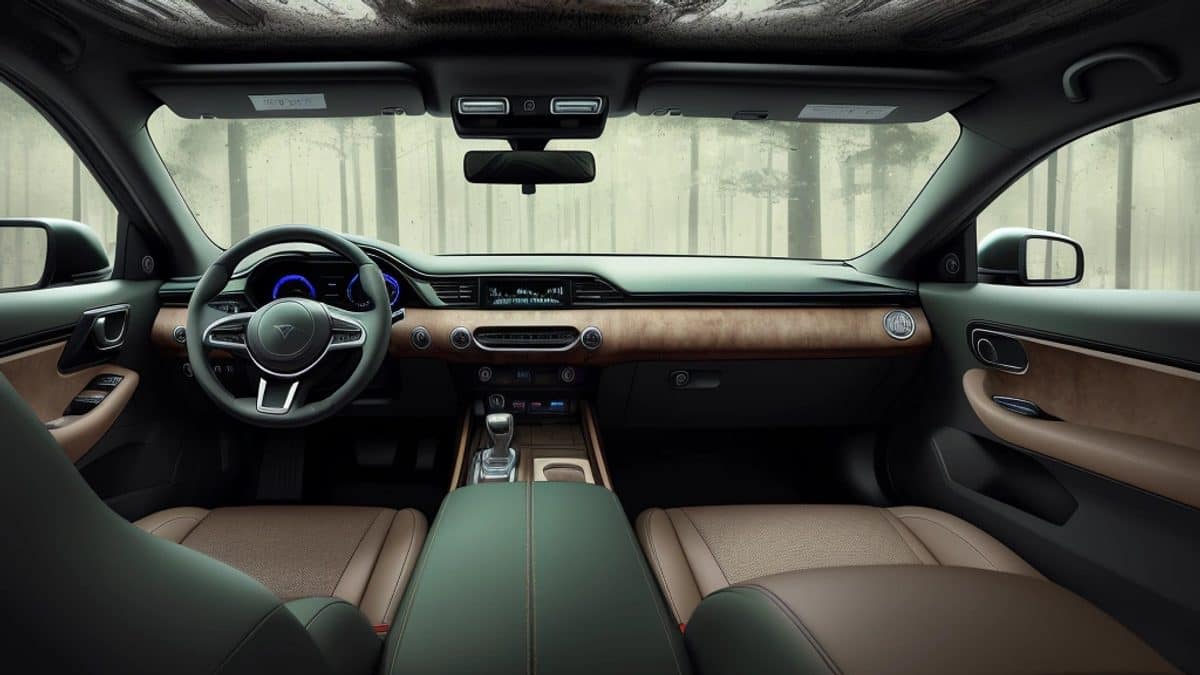
General Motors is rolling Google Gemini out to roughly four million US vehicles through an over-the-air update, one of the largest deployments of generative AI into consumer hardware ever attempted, and the race it signals is about far more than smarter voice commands.
The car has been waiting for this moment for a long time. For years, the in-vehicle voice assistant was a frustrating product, capable of answering specific commands if you phrased them exactly right, and useless if you deviated from the script. GM's announcement this week changes that dynamic in a meaningful way. Gemini is replacing Google Assistant in 2022 and newer Cadillac, Chevrolet, Buick, and GMC vehicles with Google built-in, arriving as a free over-the-air update to approximately four million US cars. That is not a test deployment. It is a mass rollout of a generative AI assistant into one of the most personal, frequently used, and already-connected devices most people own.
The practical difference is not subtle. Google Assistant in a car required drivers to phrase requests in a specific format. Gemini is designed for natural language, which means you can ask it something the way you would ask a person, without memorizing command structures or knowing in advance whether the system can handle the question. GM says Gemini will also be able to access vehicle data, alert drivers to maintenance concerns, help plan routes, explain features, and control climate functions, even remotely before the driver gets in. That last detail is easy to underestimate. Remote pre-conditioning through a conversational interface is not a small step. It is the beginning of a vehicle that knows what you need before you ask explicitly.
The sharper angle here is not what Gemini can do inside the car. It is what this deployment reveals about where the battle for AI distribution is heading. For the last two years, the fight over AI interfaces has been mostly fought in browsers and apps. Perplexity versus Google Search. ChatGPT versus Microsoft Copilot. Every major platform racing to become the conversational layer on top of the internet. But the car is a different kind of surface. It is not a device people choose to pick up. It is a space people spend 30 to 60 minutes in every day, often with divided attention, a genuine need for hands-free help, and no obvious alternative for real-time information.
That makes the dashboard one of the most valuable AI interfaces that has not yet been decisively owned. Apple and Google have both tried, CarPlay and Android Auto are the most widespread solutions, but neither has moved fully into a generative AI model that can handle complex natural language queries, vehicle-specific data, and third-party services all at once. GM's move is a direct attempt to make Gemini the default AI layer inside a car for millions of drivers, not as an optional app but as the built-in assistant that responds every time someone talks to their vehicle.
Google's strategic interest here is obvious. Its broader rollout of Gemini across Android, Search, and Chrome is about replacing Assistant wherever it currently lives, and the automotive channel is one of the biggest remaining surfaces where Assistant still has significant reach. By converting four million GM vehicles to Gemini in one move, Google accelerates a distribution strategy that would otherwise take years of incremental app-level updates to accomplish. For GM, the calculation is different but equally clear. A car that feels intelligent is a car that retains brand loyalty. If Chevrolet and Cadillac vehicles become associated with a genuinely useful AI assistant, that perception matters at the point of sale, at lease renewal, and in every conversation a driver has about whether their car is worth recommending.
The Bigger Competitive Picture
GM is also doing something more strategically layered than the headline suggests. This is explicitly described as a near-term step while the company develops its own AI platform. That means Gemini is a bridge product, useful now, valuable for locking in the Google partnership, but also a placeholder while GM builds proprietary intelligence that can connect directly to OnStar, its vehicle systems, and its customer data. That is an ambitious plan with a long runway, and it is not guaranteed to succeed. Building an in-house AI platform that can match what Google has already deployed is a significant technical and capital commitment. But the intent is important. GM does not want to outsource its data and its customer relationship to a third-party AI permanently. It wants to use the Gemini deployment to buy time and learn what drivers actually want from a car assistant.
The competitive dynamic with Tesla is worth noting too. Tesla's Full Self-Driving system has logged close to 10 billion miles of driver data and remains at SAE Level 2. GM's Super Cruise recently crossed one billion hands-free miles. Both companies are accumulating real-world driving experience, but the AI assistant layer is a different kind of battleground. It does not require full autonomy. It requires a model that can understand a driver's context, preferences, and intent well enough to be genuinely useful, without being distracting or annoying. That bar is lower than autonomous driving but still surprisingly hard to meet. Gemini's track record in phones and search suggests it can handle that task. Whether it translates cleanly to the vehicle context, with noisy cabins, variable connectivity, and real-time demand for accurate local information, is something millions of GM drivers are about to find out.
The Dashboard As A Platform
What the GM announcement clarifies is that the in-vehicle AI market is entering a serious phase. It is no longer a feature discussion. It is a platform discussion. The question is not whether cars will have AI assistants. They already do. The question is which AI assistant becomes default, trusted, and deeply integrated before a different platform locks in. Apple is not standing still. Amazon has had its Alexa automotive ambitions for years. And as vehicles become more software-defined, the assistant layer becomes more strategic, not less, because it is the interface point between the driver and everything the vehicle can do.
Four million vehicles updated over the air is a real signal about where that race now stands. Gemini is in the lead on the Google-connected automotive stack, and the scale GM is bringing to this rollout means that lead has just grown considerably. The next move will come from whichever platform decides the car is too important to leave to the competition, which is a decision that is now harder to defer than it was last week.
Also read: Scout AI just turned defense robotics into a frontier lab bet and investors are buying in fast • The AI companies said to kill office demand are now signing London's biggest leases • TIME's new AI A-list shows the race is now global even if the money is still American