Noam Shazeer left Google for OpenAI on June 18. John Jumper left DeepMind for Anthropic the next day. Alphabet then lost about $225 billion in market value on June 22, which tells you exactly how nervous investors are about Google's hold on AI talent.
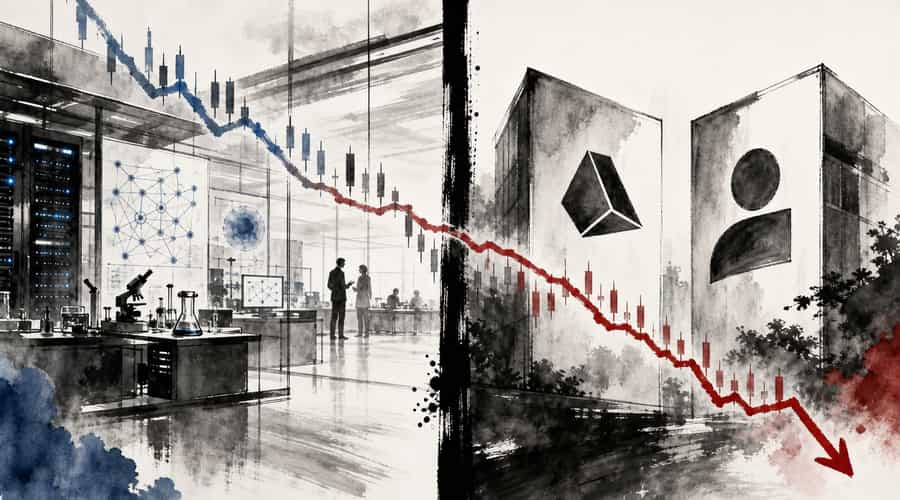
Two departures in two days should not be enough to shake a company worth more than $4 trillion. Yet Alphabet shares fell about 5% on June 22, and the market wiped out roughly $225 billion in value, according to Dow Jones Market Data cited by The Wall Street Journal and Barron's. That is the point. Investors are no longer treating elite AI researchers as replaceable staff inside large companies. They are treating them as strategic assets.
Noam Shazeer announced on June 18, 2026, that he was joining OpenAI. His departure carries a particular sting because Shazeer was one of the authors of the 2017 paper 'Attention Is All You Need', the work that introduced the Transformer architecture behind the current generation of large language models. Google had already lost him once, when he and Daniel De Freitas left in 2021 to start Character.AI. Then Google brought him back in 2024 through a $2.7 billion licensing and hiring deal tied to Character.AI, as Axios and other outlets reported at the time.
Google paid a staggering price to get him back. It held him for less than two years.
John Jumper's announcement came on June 19. Business Insider reported that Jumper, who had worked at Google DeepMind for nearly a decade, is leaving for Anthropic after helping build AlphaFold, the protein structure prediction system that made him a co-winner of the 2024 Nobel Prize in Chemistry with Demis Hassabis. AlphaFold's database has offered more than 200 million protein structure predictions, turning a once-slow biological problem into something researchers could search at scale. You don't need to romanticize that work. The achievement is plain enough.
Jumper has not said what his Anthropic role will be. In his own post, he said he would take time to recharge first. That detail matters because it keeps the story honest: Anthropic has hired one of Google's most important AI-for-science figures, but the exact job is not yet public.
Alphabet's stock move was not only about two resignations. MarketWatch reported that the June 22 fall was the company's biggest one-day percentage decline in more than a year and its largest one-day market-cap loss on record. The Wall Street Journal cited D.A. Davidson's Gil Luria saying the exits raised a blunt question: if researchers who don't need the money think they have a better chance at the frontier outside Google DeepMind, what does that say about Google's position?
Frankly, that is the right question. Google still has thousands of AI researchers, enormous distribution through Search, YouTube, Android and Cloud, and a model business that no serious competitor can ignore. But frontier AI is not only a balance-sheet contest. The people who can change model architecture, scientific AI systems, and training strategy now have choices that did not exist before ChatGPT turned research labs into the center of the technology market.
The spending backdrop makes the departures look worse. MarketWatch recently noted that Alphabet's first-quarter free cash flow fell 47% to $10.1 billion while the company continued pouring money into AI infrastructure. Separate reports have put Alphabet's planned 2026 AI-related spending as high as $180 billion to $190 billion. If you're an investor, the fear is simple: the company is spending like an AI winner, while some of its most visible AI people are choosing rivals.
Shazeer's exit is the harder one for Google to explain. Jumper leaving after a Nobel Prize and nearly a decade at DeepMind can be read as a scientist taking a new chapter. Shazeer's move is more pointed. Google bought its way back into his orbit through the Character.AI deal, gave him a central role on Gemini, and then watched him leave for OpenAI, the company Gemini most directly needs to beat in consumer chat, developer tooling and enterprise adoption.
This is not a collapse story. Don't bother with that version. Google DeepMind remains one of the deepest AI labs in the world, and Gemini is a real deployed product, not a slide deck. Alphabet also has something OpenAI and Anthropic still envy: profitable businesses that can fund years of infrastructure buildout without depending entirely on new capital rounds.
But the talent story is now part of the valuation story. That wasn't always true at this scale. A decade ago, a senior researcher leaving Google would have been a recruiting win for the next employer. In 2026, two exits in the same week can feed a quarter-trillion-dollar market reaction because investors understand that the scarce resource in AI is not only chips, data centers or cash. It is judgment at the frontier.
Google can afford the money. The harder question is whether it can still offer the place where the most ambitious AI researchers believe their best work will happen. Shazeer and Jumper have just given the market an uncomfortable answer.
Also read: A federal judge's ruling against Workday puts every AI hiring vendor on notice for discrimination liability • Baseten raises $1.5 billion at a $13 billion valuation as inference becomes AI's most contested infrastructure layer • Insilico Medicine signs a $2.5 billion AI drug discovery deal with SK Biopharmaceuticals for neuroimmune disorders