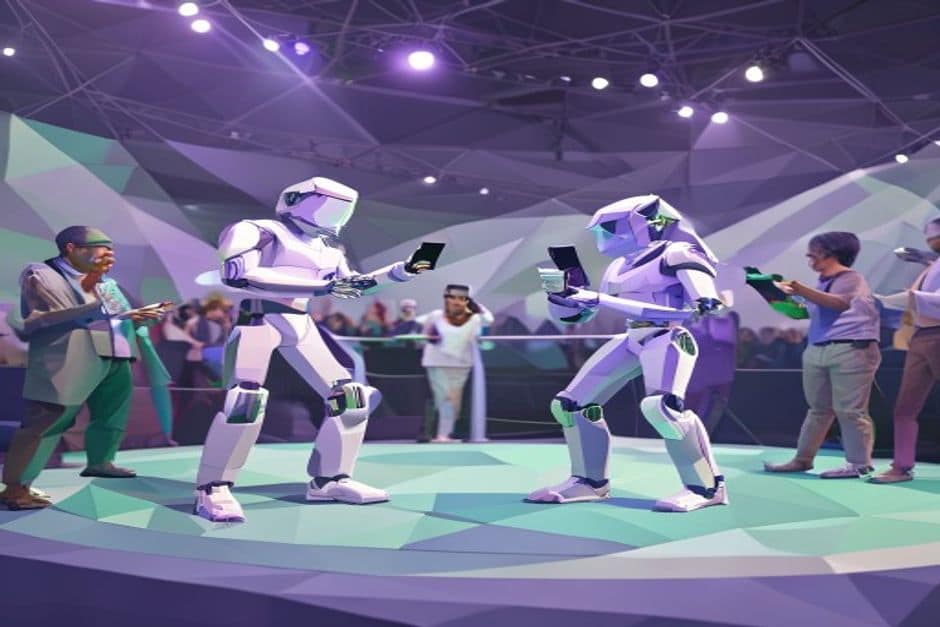
A viral Unitree G1 and EngineAI PM01 fight is not proof that robots can brawl on their own, but it does show where humanoid robotics marketing is heading next.
The most useful thing about the Unitree G1 and EngineAI PM01 fight clip is not that two small humanoids swung at each other until both ended up on the floor. It is that the scene looked commercially legible in a way many walking demos no longer do. Balance, recovery, impact, crowd reaction and durability were all on display at once, even if the fighting itself still looked clumsy.
That distinction matters. The Reddit post drawing attention today shows viewers arguing in real time over whether the robots are autonomous, remotely controlled or simply performing a staged promotional routine. Several commenters point to visible human operators and remote controls in the clip, which means the prudent read is that this was a teleoperated or heavily controlled demonstration, not a clean example of two humanoids perceiving, planning and fighting independently.
For investors and founders, that does not make the demo meaningless. It just changes what it proves. A teleoperated robot that can absorb contact, regain posture and keep moving still says something about hardware quality, actuator control and the maturity of the development platform. It says much less about artificial intelligence.
Unitree and EngineAI are operating in a market where attention has become part of the go-to-market machinery. Unitree's G1 is widely known as one of the lower-cost Chinese humanoid platforms, with public pricing around $16,000. EngineAI's PM01 has been positioned in a similar affordable research and developer tier, with reports placing it near the low five figures. Those numbers are the hook. The videos are the proof surface.
Until recently, the standard humanoid clip showed a robot walking, waving, dancing or lifting an object in a clean environment. That still matters, but it no longer separates one company from the next. A fight demo gives the audience a rougher benchmark. Can the machine stay upright when force arrives from an unexpected angle? Can it fall without becoming useless? Can it recover quickly enough to make the failure look like part of the show?
As Asia Times reported after China's first humanoid robot kickboxing event in Hangzhou in May 2025, the format was not just entertainment. It was a public stress test for full-body coordination, battery endurance and material durability. That is why these clips travel so well. They compress a technical question into something anyone can understand: did the robot take the hit and get back up?
The danger is that spectacle can outrun substance. A robot fight is easy to share and hard to evaluate. Camera angle, editing, floor surface, operator skill and safety limits all shape what the viewer thinks they saw. A founder watching the same clip should ask boring questions before getting excited. How much autonomy was involved? How many takes were needed? What parts failed afterward? Was the robot using onboard perception, a scripted routine, motion capture, a game controller or some mix of all four?
Robustness is becoming the next benchmark
Locomotion was the first great public benchmark because walking is brutally difficult and visually obvious. Once a humanoid can walk, jog, climb stairs and perform a controlled fall, the next question becomes whether it can handle contact. Real workplaces are not empty labs. Warehouses, factories, hotels and homes are full of bumps, slips, dropped objects, moving people and awkward surfaces.
This is where a ridiculous-looking robot fight becomes more serious. The commercial future of humanoids depends less on whether they can throw a clean kick and more on whether the same control systems can keep a machine useful after disturbance. A humanoid that falls over during a routine task is not a platform. It is a liability with legs.
Unitree has been effective at making that progress feel accessible. Its robots are not framed like rare research artifacts locked inside a corporate lab. They look like developer hardware moving toward mass availability. EngineAI is chasing a similar signal from another angle, using acrobatics, public appearances and combat-themed demonstrations to show energy, speed and mechanical confidence.
The market should still keep its skepticism. Low-cost humanoids are becoming real platforms for research, education, entertainment and early commercial pilots, but they are not yet general-purpose workers. Many demos remain supervised, constrained and optimized for camera-friendly moments. The hard part is not making a humanoid look impressive for 30 seconds. It is making it reliable for 30,000 uneventful minutes.
That is the real story behind the G1 and PM01 clip. The fight is a marketing object, but the market signal is broader. Chinese humanoid startups are moving from polished mobility demos toward rougher scenes that make durability visible. The next useful benchmark will not be who wins the robot fight. It will be which company can turn those falls, hits and recoveries into machines that survive ordinary work.
Also read: AI startups are learning that fluent models still fail at logic • Data centers are turning power into the next AI bottleneck • Trump Media's Bitcoin bet is turning Truth Social into a crypto proxy