HyperLight's $80 million Series C is not just another photonics funding round. The useful fact is who wrote the checks: MediaTek, UMC Capital, Jabil, Foxconn, EDBI, and the Qatar Investment Authority are supply-chain names, not tourist investors.
If you're trying to understand where AI data-center hardware is heading, don't start with the largest number in HyperLight's announcement. Start with the cap table. According to the company's June 18 announcement carried by Business Wire, MediaTek led the $80 million Series C for the Cambridge, Massachusetts startup, with UMC Capital, Jabil, Foxconn, CDIB-TEN Capital, EDBI, and the Qatar Investment Authority joining the round. Existing backers Summit Partners, The Engine, and Foothill Ventures also came back in.
That mix tells you more than the usual funding language does. HyperLight was spun out of Harvard in 2018 to commercialize thin-film lithium niobate photonics, and it is now trying to move from the lab bench into the hardware chain that feeds AI clusters. You can be interested in the science. The investors are interested in whether it can be made, packaged, qualified, and shipped.
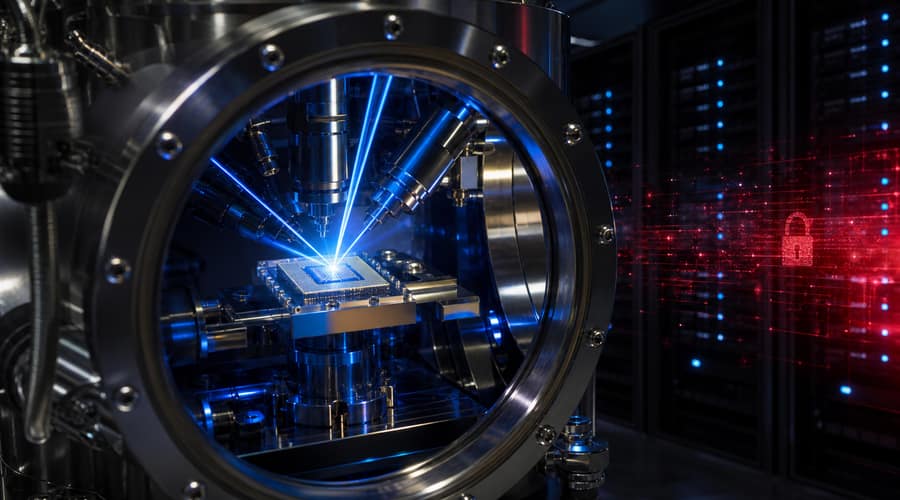
The company's argument is plain enough. Copper interconnects inside AI infrastructure are under pressure as GPU clusters demand more bandwidth and lower power per bit. HyperLight says its thin-film lithium niobate, or TFLN, chips move data optically with high modulation bandwidth, CMOS-level drive voltage, and low optical loss. Its current platform supports 200G-per-lane operation, and the company says 400G-per-lane solutions are now sampling.
Those are not decorative numbers. In March 2026, HyperLight said its work with UMC and Jabil was aimed at 1.6T data-center bandwidth. If that qualification work holds up, the company is not selling an abstract alternative to copper. It is trying to win a place in the next layer of AI plumbing, the part most people never see but every model depends on.
Silicon photonics still has the incumbent advantage. It is mature, it fits more naturally into existing semiconductor manufacturing, and companies including Intel and Cisco have already pushed optical networking hardware into real deployments. HyperLight's bet is that TFLN can do things silicon struggles to do at the same power and bandwidth levels, especially when the electronics around it are already operating at CMOS voltages.
Here's the thing: better physics doesn't automatically become better infrastructure. Photonics startups have been caught in that gap for years. A device can work beautifully in a research setting and still fail the duller tests that decide commercial life: wafer yield, packaging repeatability, customer qualification, and whether a system maker trusts the supply chain enough to design around it.
HyperLight knows that, which is why the manufacturing details matter. The company says it is already producing on 6-inch and 8-inch wafers through its partnership with UMC and Wavetek, while Jabil brings the assembly and manufacturing work needed to turn chips into deployed hardware. UMC, Jabil, and Foxconn are not passive names in this story. They are the sort of companies you need in the room before a new component has a serious chance of reaching volume.
Mian Zhang, HyperLight's CEO, has been building toward that test since the company's Harvard spinout days. The academic origin helps explain the technology, but it does not sell the part into a data center. Customer qualification does. HyperLight says the new money will expand manufacturing capacity, accelerate that qualification process, scale its TFLN Chiplet Platform, and deepen partnerships across foundry, semiconductor, networking, and systems integration.
Frankly, that is the only version of this story worth taking seriously. A photonics company raising money from generalist venture investors would be interesting. A photonics company raising money from MediaTek, UMC Capital, Jabil, Foxconn, EDBI, and QIA is different. It means the people who sit closer to production are willing to make a supply-chain bet before the market has fully settled on the winner.
The sovereign fund participation is part of the same signal. EDBI is tied to Singapore's economic development strategy, and the Qatar Investment Authority has been active in global infrastructure and technology investment. Their presence does not prove HyperLight wins, but it does show that optical interconnects are being treated as more than a niche component story. AI infrastructure is now national industrial policy, and bandwidth sits inside that policy whether politicians talk about it or not.
You should still be careful with the hype. HyperLight has announced capital, partners, sampling milestones, and manufacturing plans. It has not announced that its TFLN chiplets are already running through AI data centers at mass scale. That difference matters. The hard part is not making light move data in a convincing demo. The hard part is making customers believe the component will be available, reliable, and worth designing into expensive systems.
Still, this round narrows the question. HyperLight no longer has to prove only that thin-film lithium niobate is promising. It has to prove that a Harvard-born photonics platform can survive the factory, the qualification cycle, and the purchasing discipline of AI infrastructure buyers. That is a tougher test than a funding announcement. It is also the one that counts.
Also read: Microsoft shareholders are suing over AI promises that the numbers couldn't keep, Gallup data shows tech workers who skip AI face triple the odds of being laid off, NASA's bet on Relativity Space for a 2028 Mars mission is either visionary or a warning sign about SpaceX dependency