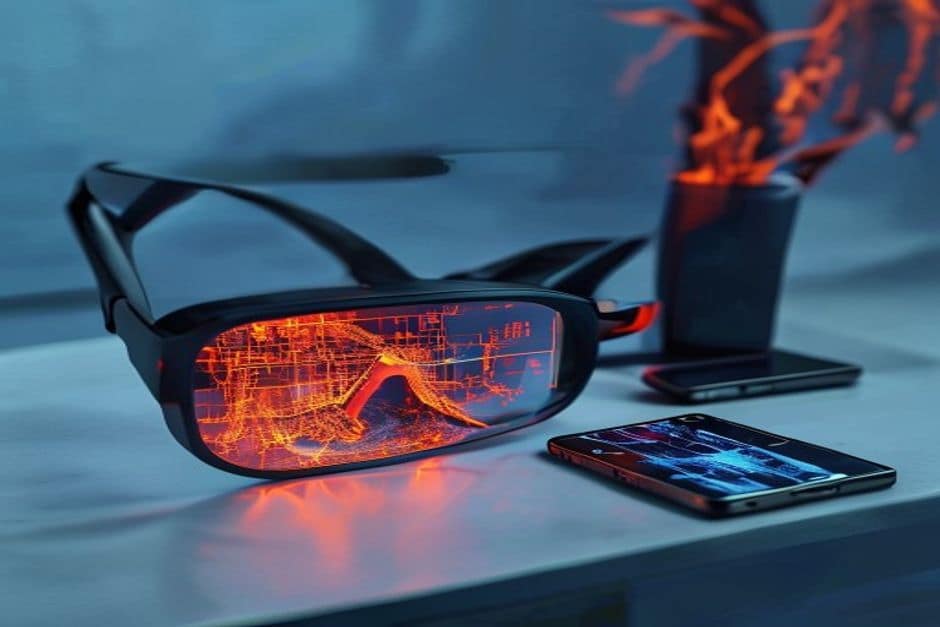
ICE's reported smart glasses plan shows how wearable AI could move from consumer curiosity to government enforcement tool before the public has settled the rules.
The next important customer for smart glasses may not be a commuter asking an AI assistant for directions. It may be a federal agent trying to identify someone in the field without pulling out a phone.
That is the sharper meaning behind ICE's reported plan to develop its own smart glasses to supplement Mobile Fortify, the facial recognition app already used by immigration officers. According to 404 Media reporting circulated through a Reddit post on Saturday, a DHS official and another person who attended a recent conference described plans for a device that would extend biometric identification into a hands-free format.
The details still matter. There is a difference between a concept discussed at a conference, a prototype in procurement, and equipment deployed at scale. But the direction is clear enough to take seriously. ICE already has a mobile app that can use a phone camera for facial recognition in the field. Smart glasses would make that same workflow more ambient, quicker to trigger, and harder for bystanders to notice.
For the wearable AI market, that is a meaningful signal. Consumer smart glasses are still trying to prove they can be more than a camera, speaker and chatbot wrapped around a familiar frame. Government buyers have a simpler test. Does the device give personnel faster access to identity, location, records or alerts while keeping their hands free?
Startups tend to imagine smart glasses through the consumer lens first. Meta has Ray-Ban smart glasses. Apple keeps pushing spatial computing. Hardware founders talk about ambient assistants, live translation, workplace training and real-time navigation. Those are attractive markets, but they are also slow markets. Consumers care about price, battery life, social awkwardness, fashion and whether other people feel comfortable being recorded.
Institutional buyers weigh the calculation differently. Police departments, border agencies, logistics operators, defense contractors and emergency responders can justify devices that ordinary people would reject as too intrusive or too expensive. If a wearable system saves time during an enforcement stop or reduces the need to handle a separate device, procurement teams may see value long before consumers do.
This is where startups should pay attention. Government demand can shape product road maps before the broader market catches up. Cameras get better. Battery packs move from awkward to acceptable. Edge AI improves. Identity systems become tighter. A feature that begins as a field enforcement tool can later appear in enterprise security, venue access, retail loss prevention or corporate facilities management.
That does not mean every wearable AI company should chase public-sector contracts. It does mean founders need to understand how procurement can pull a young market toward surveillance use cases. Once facial recognition becomes a core selling point, the company is no longer just selling hardware. It is selling judgment, risk management and compliance, whether it admits that or not.
ICE's reported plan also lands against a wider backdrop. Mobile Fortify has already drawn scrutiny because it pushes facial recognition away from ports of entry and into domestic field encounters. Prior reporting has described the app as drawing on large image databases and returning identity and immigration-status information to officers. If glasses are added to that workflow, the interface changes from active scanning on a phone to something closer to continuous field awareness.
The accountability problem gets harder
Smart glasses revive old questions in a more difficult package. Facial recognition has long raised concerns about accuracy, consent, racial bias, data retention and whether a match becomes treated as proof. Body cameras raised a different set of questions: when they record, who controls the footage, and what happens when the device is pointed at the public rather than the officer.
Face-recognition glasses combine those concerns. The wearer may be recording, identifying or querying a database without a clear outward signal. The person being scanned may not know it is happening. If the system returns a wrong match, the error can move quickly from software output to real-world consequence.
That risk is not theoretical for the broader category. Clearview AI became controversial because it showed how powerful facial recognition becomes when linked to huge image collections. Police body cameras became controversial because recording policies often left too much discretion to agencies. Smart glasses could make both problems feel more ordinary by putting the camera and the database at eye level.
For businesses, the lesson is not simply that this technology is dangerous. The lesson is that trust will become a product requirement. A company building wearable AI for workplaces, campuses, public venues or government agencies will need clear limits on capture, retention, matching thresholds, audit trails and human review. Those safeguards cannot be bolted on after the first scandal.
Investors should also separate technical capability from market permission. A device may work well enough to attract an agency buyer and still create reputational risk for the company behind it. The most valuable wearable AI businesses may be the ones that can say no to certain deployments, or at least define strict boundaries before regulators define them later.
ICE's smart glasses plan is still reported, not fully public policy. But it points to a market reality that founders cannot ignore. Wearable AI will not mature only through consumer adoption curves and glossy product launches. It will also be shaped by institutions that want faster identification, more data in the field and fewer visible steps between seeing a person and checking a system.
That is the next watch point. If smart glasses become enforcement infrastructure before they become everyday consumer devices, the public debate over wearable AI will start with surveillance rather than convenience. For startups, that changes the pitch, the risk and the responsibility.
Also read: HiDream-O1-Image puts pixel space back in the image model race • ChatGPT on Android may put Codex sessions in your pocket • Europe's age checks are putting VPNs in the regulatory spotlight