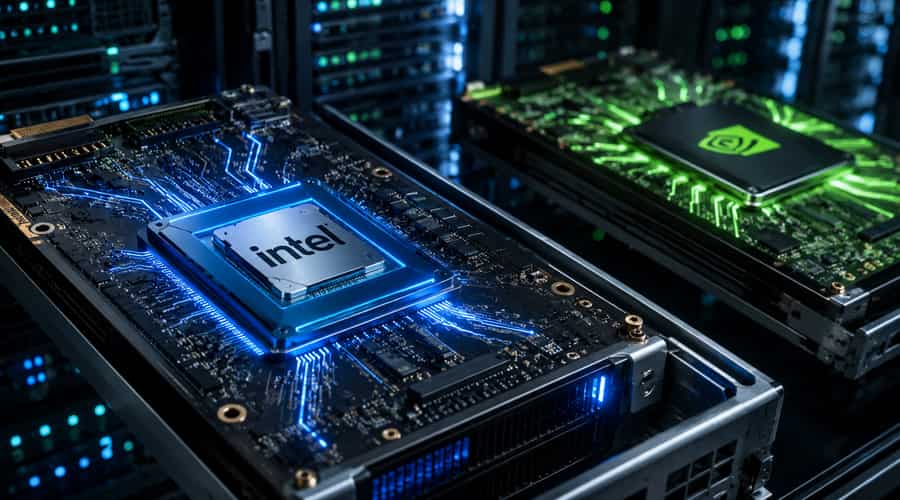
Intel is trying to turn its AI chip story from a long-running catch-up effort into a real procurement option. The question is whether customers will believe the timeline.
Intel’s plan to bring Crescent Island to customers in 2026 is not just another roadmap item. It is a direct attempt to get back into a market Nvidia has made almost its own, and it comes as AI infrastructure buyers are starting to care as much about cost and availability as raw speed.
Intel has disclosed Crescent Island as a data center GPU built for AI inference, with customer sampling planned for the second half of 2026. That timing matters. Nvidia’s latest quarterly results show how far ahead the leader remains, with data center revenue reaching $75.2 billion, up 92% from a year earlier. But the same customers feeding that growth are also looking for leverage, because no serious AI buyer wants one supplier to control performance, software, delivery schedules and price.
Intel has been here before, which is why the new push deserves both attention and caution. The company’s Gaudi 3 accelerator was pitched as a lower-cost alternative for AI training and inference, but it never changed the shape of the market. Intel’s own filings show Gaudi inventory-related charges in 2024 and 2025, a blunt sign that demand did not match expectations. That history will follow Intel into every sales conversation around Crescent Island.
The most interesting part of Intel’s approach is not that it wants to beat Nvidia at Nvidia’s own game. It is that Intel appears to be choosing a narrower fight. Crescent Island is designed around inference rather than frontier model training, using Intel’s Xe3P architecture and LPDDR5X memory instead of the high-bandwidth memory that dominates top-tier AI accelerators.
That tells us something important about where Intel sees the opening. Training the largest models remains the prestige end of AI computing, but inference is where the daily cost of AI shows up. Every chatbot response, coding assistant request, enterprise search query and agent workflow has to run somewhere. As more companies move from pilots to actual deployments, the question becomes less glamorous and more practical: how many useful tokens can a server deliver per dollar, per watt and per rack?
Recent Computex coverage from Tom’s Hardware added a useful detail to that picture: Intel’s reference design includes 160GB of LPDDR5X memory, while partners could have room to build cards with as much as 480GB. That does not make Crescent Island a direct substitute for Nvidia’s highest-end systems. It does suggest Intel is trying to make memory capacity and deployment simplicity part of the pitch, especially for enterprise inference workloads that do not require the most expensive accelerator in the rack.
Nvidia’s strength is that it sells the whole machine. GPUs, networking, software libraries, developer tools and cloud relationships all reinforce each other. Intel’s opportunity is different. If it can offer a chip that fits into air-cooled enterprise servers, avoids some of the supply pressure around high-bandwidth memory and handles common inference workloads at a compelling cost, it does not need to replace the top Nvidia systems on day one. It needs to win workloads that customers can move without too much pain.
That is a smaller target, but it is a real one. Many enterprises do not need the most expensive accelerator in the world for every AI task. They need predictable performance, available supply and a software stack that does not punish their engineering teams. This is where Intel has to prove that it has learned from Gaudi. Hardware specifications can start the conversation, but software maturity and customer trust will decide whether the chip leaves the lab and enters real clusters.
The timing is both bold and unforgiving
A 2026 sampling window puts Intel into a fast-moving race. Nvidia is already pushing Blackwell systems deeper into cloud and enterprise infrastructure, and it has laid out a broader platform strategy around AI factories, networking and inference software. The company is also moving into AI PCs and workstation-class systems, which presses on areas where Intel has historically been stronger.
That makes Intel’s challenge unusually complicated. It is not only trying to compete in data center accelerators. It is defending its old territory while trying to enter Nvidia’s strongest one. Nvidia wants to make AI computing feel like a platform that stretches from cloud clusters to PCs. Intel wants to remind the market that it still owns deep relationships with server makers, enterprise buyers and the x86 ecosystem.
For buyers, this competition could be useful even before Intel takes meaningful share. A credible alternative can change negotiations. It can push suppliers to sharpen pricing, improve availability or support more flexible system designs. If Intel can show real benchmarks, real customer sampling and a credible production path, procurement teams will have a reason to keep the conversation open.
The risk is execution. Intel has spent the past several years trying to regain confidence across manufacturing, product delivery and investor expectations. A late chip, weak software support or unclear performance positioning would reinforce the view that Intel can announce ambitious AI products but not turn them into durable platforms. In AI infrastructure, customers do not just buy a chip. They buy a roadmap they expect to survive.
That is why the next few months matter more than the headline. Watch whether Intel names launch partners, publishes workload-specific performance data and explains where Crescent Island fits beside CPUs, GPUs and edge systems. The AI accelerator market does not need another promise. It needs a second supplier that can make Nvidia compete harder where customers actually spend money.
Also read: Nvidia uses Computex to make the AI PC fight much harder • SoftBank's AI bet is testing Toyota's hold on Japan's market crown • SK hynix shows why AI investors are moving into memory