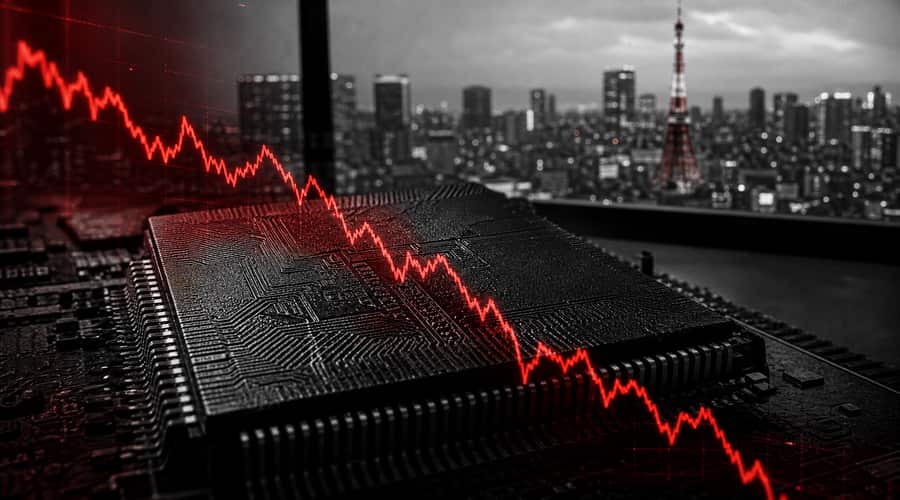
Kioxia briefly became Japan's most valuable company because investors treated memory as the backbone of AI. A few weeks later, the same trade started punishing it.
You don't often see a company go from Toshiba castoff to Japan's market-cap champion and then lose more than a third of its value inside a month. Kioxia just did it. The NAND flash maker's shares have fallen from a late-June peak above ¥110,000 to the ¥70,000 range, after a rally that had made it the best performer on the MSCI World Index. The trigger wasn't a failed product or a missed filing. It was one word: resell.
On July 1, Reuters reported that Bloomberg News had said Meta was building a cloud business to sell excess artificial intelligence computing capacity to outside customers. The plan was still in development, Reuters noted, but the market didn't wait for a finished product. Kioxia fell 13.47% on July 2, according to Japanese market summaries, while the Philadelphia Semiconductor Index dropped 6.3%, based on FactSet data cited by Axios. Micron and SanDisk each fell 10.6%. That's a hard move from a single report.
The logic was blunt. If Meta has spare compute to rent out, maybe the AI buildout isn't as insatiable as Wall Street assumed. Every stock riding the infinite-demand story got hit. Not just Kioxia. Memory names, chip equipment makers, optical networking stocks and data center suppliers all took the question in the face.
Then came the second pressure point. The Information reported that OpenAI engineers had found a software-only way to more than halve inference costs for some ChatGPT traffic, using better utilization of existing servers rather than new chips. OpenAI and Broadcom also unveiled Jalapeño on June 24, OpenAI's first inference processor, with the company saying early testing showed substantially better performance per watt and initial deployment by the end of 2026. For a memory maker whose investment case rests on AI models needing more storage and bandwidth, cheaper inference is not a small headline. It can mean less hardware than expected.
How high Kioxia flew
Context matters here. Kioxia didn't drift up. It went vertical. Bloomberg reported on June 12 that the company's shares rose 7.6%, lifting its market value above ¥44 trillion and replacing Toyota Motor as Japan's largest company by market value. Toyota closed that day at ¥43.8 trillion, using Bloomberg's figures including treasury shares. The stock was up more than 670% for the year at that point.
Those weren't only story stocks and message-board heat. Kioxia reported operating profit of ¥876.2 billion for the fiscal year ended March 2026, according to Seoul Economic Daily's summary of the company's results, and guided for ¥1.3 trillion of operating profit in the June quarter. Bloomberg reported in May that the company expected to earn more in that three-month period than it had earned in the full previous year. Those are real numbers. They also set a dangerous bar.
The crown didn't stay in one place. On July 13, Bloomberg HT reported that Mitsubishi UFJ Financial Group's market value rose to about ¥42 trillion, ahead of Toyota at roughly ¥41 trillion and Kioxia at ¥36.7 trillion. Rising rates put a bank on top. AI mania put a chipmaker there first. Toyota, oddly enough, was no longer the holder in either version of the story.
The doubt is spreading
Kioxia has plenty of company in the pain. Reuters reported that Kioxia dropped 12.86% on July 13 as chip-related stocks dragged the Nikkei lower and South Korea's KOSPI triggered a temporary trading halt. SK Hynix fell more than 15% in Seoul that day after its U.S. listing had briefly revived enthusiasm for memory names. By July 16, Investors Business Daily reported that SK Hynix had dropped again, while Sandisk, Micron, Western Digital and other memory-linked stocks sold off in the U.S. too.
China is another part of the pressure. Reuters Breakingviews reported on July 15 that ChangXin Memory Technologies had doubled its Shanghai IPO fundraising target to $8.6 billion, helped by a supply crunch that had even pushed Apple to seek clearance to source chips from CXMT. South China Morning Post put the implied valuation at about $85.2 billion. You don't need to believe CXMT can immediately match Samsung, SK Hynix or Micron at the high end to see the problem. More supply changes the mood.
Frankly, none of this proves Kioxia's business is broken. GuruFocus puts the stock at roughly 11.5 times forward earnings, which is not wild for a company that has just guided to an enormous profit quarter. Enterprise SSD demand, especially for AI inference and KV cache storage, is a real structural driver. The point is narrower. A stock that rises more than 670% doesn't need disaster to fall. It only needs investors to stop treating every AI spending forecast as guaranteed.
That is what the last few weeks exposed. Meta's cloud plan didn't prove there is too much compute; OpenAI's software gain didn't prove chip demand has peaked; CXMT's IPO doesn't mean China will own memory tomorrow. Together, they gave investors permission to ask whether the AI hardware trade had moved faster than the facts. For Kioxia, that was enough.
Also read: A Regulatory Filing Reveals DeepSeek Is Now Worth About $52 Billion • Moonshot's Kimi K3 Becomes the Largest Open-Weight Model Ever Built • Meta puts Muse Spark 1.1 on OpenRouter, then locks out the rest of the world