TSMC's Arizona promise is getting bigger, but the bottleneck hasn't moved as quickly as the money. The company is adding another $100 billion in US plans while its most important AI-chip capacity still runs through Taiwan.
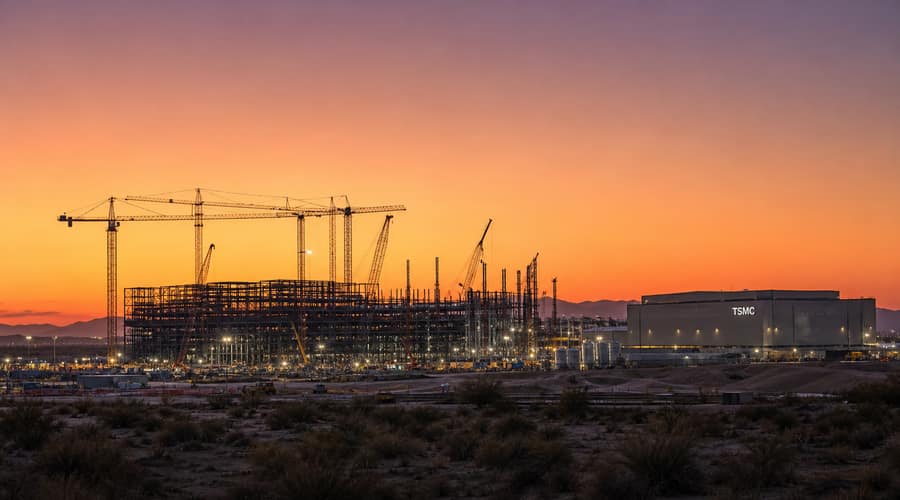
Taiwan Semiconductor Manufacturing Co. announced on July 16 that it plans to add another $100 billion to its Arizona expansion, taking its total US commitment to $265 billion. That's real money. According to the Arizona Commerce Authority, the plan now covers 10 fabs, two advanced packaging facilities and an R&D center in north Phoenix. AP reported that the new phase includes four more plants focused on 2-nanometer and more advanced chips.
The timing was not an accident. TSMC paired the expansion with a record second quarter. The company's own Q2 results showed revenue of $40.2 billion and gross margin of 67.7%, while AP reported net profit of NT$706.6 billion, or about $22 billion, up 77% from a year earlier. You don't have to squint to see the reason. AI demand is still outrunning the industry's ability to build enough advanced chips.
The Money Follows AI Demand
TSMC raised its 2026 revenue growth outlook to slightly above 40% and lifted its capital spending plan to $60 billion to $64 billion, up from the $52 billion to $56 billion range it gave a quarter earlier, according to reports from AP and Investor's Business Daily. For most companies, that would be a once-in-a-generation construction plan. For TSMC, it's what the AI cycle now requires.
Look at the revenue mix. As the Financial Times noted, high-performance computing, the bucket that includes AI chips, now accounts for 66% of TSMC's revenue. Smartphone chips have fallen to 22%. That doesn't mean the iPhone stopped mattering. It means Nvidia, AMD, Apple and the cloud companies behind them are all pushing into the same narrow lane at the same time.
Arizona is part of the answer, but it isn't the full answer yet. Apple said in February that it was on track to buy well over 100 million advanced chips made at TSMC's Arizona facility in 2026. Nvidia has also been talking up US-made Blackwell wafers from the Phoenix plant. Good. But wafers are not the whole chip supply chain, and packaging is where the story gets less convenient.
Arizona Is Not Taiwan Yet
TSMC's second Arizona fab, which will use 3-nanometer process technology, has finished construction and is expected to begin volume production in 2027, according to Arizona Commerce. The new $100 billion pledge adds four more fabs for 2-nanometer and more advanced nodes. That sounds close. It isn't. The first Arizona site runs 4-nanometer chips now. Taiwan remains the center of TSMC's leading-edge manufacturing and advanced packaging capacity.
Here's the thing: US chip independence doesn't arrive just because a bigger number appears in a press release. EE Times reported in March that TSMC said all of its advanced packaging was still in Taiwan, even though two advanced packaging facilities are planned for Arizona. That matters for AI accelerators. Nvidia's highest-end chips need advanced packaging as much as they need leading-edge silicon. A wafer made in Phoenix can still depend on work done across the Pacific.
So does $265 billion cut US dependence on a company sitting a hundred miles from mainland China, or does it simply move part of that dependence to Arizona? Frankly, it's closer to the second for now. Washington gets a huge investment figure, Arizona gets thousands of chip jobs, and TSMC gets to show its biggest American customers that it is building where they need political cover. What the US doesn't get yet is a domestic substitute for Taiwan's most advanced fabs.
Nvidia wasn't on TSMC's earnings call, but it was all over the logic of it. Every AI server order pushes pressure back into TSMC's fabs and packaging lines. Every Apple wafer order does the same. More Arizona capacity may eventually give both sides more room. Not yet.
Chip Stocks Split Apart
Wall Street's reaction was uneven. TSMC held up better than the memory names. Barron's reported that the PHLX Semiconductor Index had fallen 13% since late June, with Micron down about 25% over that stretch. MarketWatch reported that SK Hynix had lost roughly a third of its market value over the past month, while Samsung Electronics and Kioxia were also caught in the selloff.
Some of that selling had started before TSMC's report. Micron had already become a pressure point for the AI trade, and Korean authorities have been dealing with debt-fueled bets tied to SK Hynix and Samsung. TSMC's call added a cleaner signal: the AI buildout is still enormous, still expensive and still concentrated in a few companies that can afford to write the checks.
That's the odd shape of this story. The company at the center of the AI supply chain posted its best quarter yet and promised another $100 billion for American manufacturing. Several companies nearby in the same trade got punished anyway. Investors like the AI story, but they're starting to ask who pays for the next factory, the next packaging line and the next year of capacity that is already spoken for.
Also read: Kioxia's Market Value Has Nearly Halved Since Its AI-Fueled Peak in June, Moonshot's Kimi K3 Becomes the Largest Open-Weight Model Ever Built, and Meta puts Muse Spark 1.1 on OpenRouter, then locks out the rest of the world