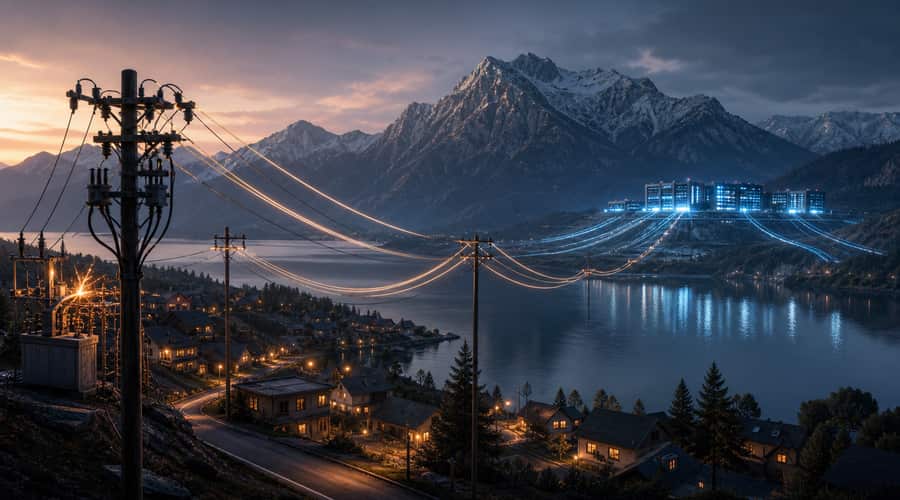
Lake Tahoe's electricity problem is not a simple blackout scare. It is an early test of what happens when AI infrastructure demand collides with small communities that have limited bargaining power.
Nearly 49,000 Liberty Utilities electric customers on the California side of Lake Tahoe are being pushed into a fast search for a new power supply arrangement. NV Energy, the Nevada utility that has long supplied most of Liberty's electricity, has told Liberty it will no longer provide the same full-requirements service once the current transition window ends.
The story matters because it shows how the AI boom reaches far beyond servers and software companies. Data centers need land, water, power lines, substations and long-term electricity contracts. When that demand lands in a constrained grid, smaller customers can discover that they are not competing in a polite technology market. They are competing in infrastructure.
As Fortune recently reported, Liberty gets about 75% of its electricity from NV Energy, with the rest coming largely from solar facilities it owns in Nevada. Liberty serves about 49,000 electric customers in California, most of them in and around the Tahoe basin. In a March filing with California regulators, Liberty said NV Energy had declined to continue the full-requirements arrangement, citing its own resource needs and constrained transmission in northern Nevada.
That does not mean every light in Tahoe goes out the next morning. Liberty has said it is seeking approval to run a competitive process for new energy partners, with bidding expected in summer 2026 and new supply agreements targeted for 2027. The more practical concern is that wholesale power planning usually takes years, while Liberty is now working under a compressed schedule in a mountain region with wildfire risk, seasonal tourism and limited transmission options.
NV Energy says this was not a sudden reaction to data centers. The company sold its California electric assets to Liberty in 2009 and has continued supplying power through extensions while Liberty worked toward its own long-term access. That point matters because it keeps the story from becoming too simple. Tahoe's current position is partly the result of an old transition that was never fully completed.
But Liberty's own filing also points to new pressure in the same system. It says the northern NV Energy territory is now extremely competitive because large loads, including data centers, are seeking to connect in the area. It also says transmission service is severely constrained until new projects, including Greenlink West, relieve some of the pressure.
That is where the AI infrastructure story becomes clear. Northern Nevada has become a major data center corridor, helped by land availability, tax incentives, existing industrial development and proximity to West Coast technology demand. Google, Apple and Microsoft have all been associated with facilities or plans around the Tahoe-Reno Industrial Center and nearby areas. The demand is not theoretical. It is arriving as megawatts.
Western Resource Advocates, drawing on NV Energy planning materials, has highlighted thousands of megawatts of requested capacity additions from large industrial projects in Nevada, with much of that load in the northern service territory. Fortune also cited Sierra Club testimony that about 75% of NV Energy's major-project load growth is tied to data centers. That is the kind of number that changes the tone of a utility planning meeting very quickly.
For entrepreneurs and operators, the lesson is simple. AI is not only a software race. It is a power procurement race. The companies that can secure cheap, reliable energy gain an advantage. The communities that sit near constrained wires may be asked to absorb uncertainty, regulatory complexity and eventually some of the cost.
Small grids have small leverage
Lake Tahoe's problem is unusually tangled because Liberty is regulated in California while its grid sits inside NV Energy's balancing authority in Nevada. Liberty relies on Nevada transmission rather than the main California grid operator. A direct connection west into California would be expensive, difficult to permit and disruptive in a sensitive mountain region.
That leaves the California Public Utilities Commission with only part of the problem in its hands. It can review Liberty's procurement and rates, but it cannot simply order NV Energy to keep selling wholesale power. Federal rules, Nevada planning decisions and transmission access all sit in the middle. For residents and small businesses, that can feel like being passed between rooms while the deadline keeps moving closer.
The timing is also less settled than early headlines suggest. Liberty's December 2025 extension filing said the NV Energy service agreement runs to the later of May 31, 2027 or the completion of facilities that provide enough capacity for Liberty to transition. A recent Liberty customer update says the official transition is expected to begin in 2028, after Greenlink capacity becomes available, and cites a December 31, 2027 date in NV Energy's most recent public posting. That buys time, but it does not remove the procurement problem.
The cost question is just as important as the reliability question. Liberty customers were already dealing with rising rates tied to wildfire mitigation, insurance and infrastructure spending. If replacement power is more expensive, or if Liberty needs short-term contracts in a competitive market, the financial impact could land on households and small businesses that had no role in attracting hyperscale data centers to northern Nevada.
This is the hidden bill of the AI economy. It does not always show up in a cloud company's earnings call. It can show up in a rural rate case, a transmission queue, a wildfire-prone service territory or a small utility suddenly forced to shop for power against much larger buyers.
What happens next in Tahoe will be watched beyond California and Nevada. If regulators manage a clean transition, it may become a model for protecting smaller communities in the path of AI infrastructure growth. If the process turns messy or expensive, it will strengthen the argument that data center development needs stricter planning rules, clearer cost allocation and stronger protections for customers who do not have the scale to bargain for themselves.
The next year will show whether Lake Tahoe is an exception or an early warning. Either way, the AI buildout is no longer just about chips and models. It is about who gets power first, who pays for the wires and who is left trying to catch up.
Also read: ByteDance Seed puts diffusion language models within startup reach • InternLM is making scientific AI smaller with Intern-S2-Preview • Tokyo researchers show a faster route around AI hardware's power wall