Mitsubishi's $7.5 billion Aethon deal is an AI power story wearing an LNG jacket. If you want to understand where the next constraint in artificial intelligence sits, look at the gas wells in the Haynesville Shale.
Here's the headline number. Fortune reported on July 15 that Mitsubishi Corporation finalized its purchase of Aethon Energy's Haynesville shale gas assets, after agreeing to the transaction in January. The Japanese trading house paid $5.2 billion in cash and assumed about $2.33 billion in debt, putting the total enterprise value near $7.5 billion. It's the biggest acquisition Mitsubishi has ever made. Full stop.
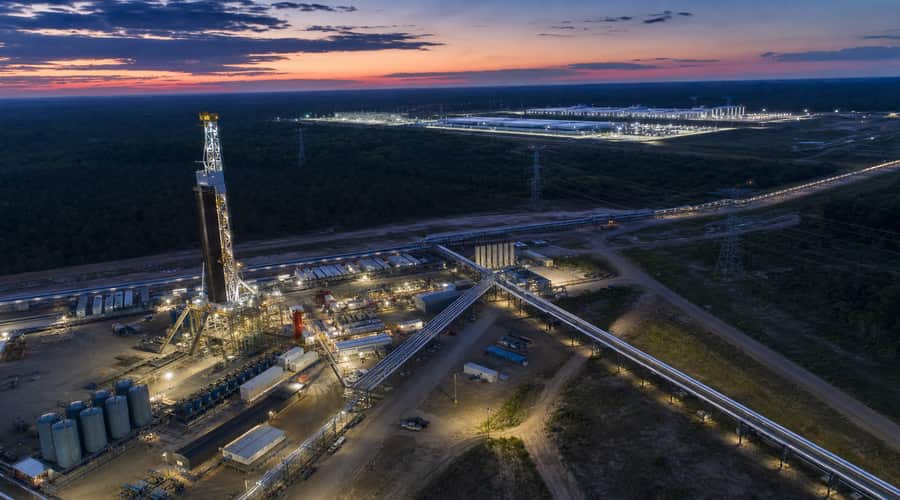
Aethon isn't a household name, and that's part of the story. The Dallas-based company was the largest privately held natural gas producer in the United States, with almost all of its output concentrated in the Haynesville Shale, the gas-heavy formation running through northern Louisiana and East Texas. The Financial Times reported in January that Ontario Teachers' Pension Plan and RedBird Capital Partners were among the investors selling into the deal. Mitsubishi spent months clearing the approvals. Now it owns the wells.
The gas has two buyers now
The assets produce about 2.1 billion cubic feet of gas a day, according to figures Mitsubishi gave when the deal was announced. The company has said production could rise toward 2.6 Bcf/d, or about 18 million tons a year on an LNG-equivalent basis. Some of that gas can move through the Gulf Coast LNG system and head to Japan, where Mitsubishi has spent decades building long-term supply relationships.
But don't miss the second buyer. It may never leave the United States.
Mitsubishi and Aethon also formed a non-binding, non-exclusive alliance to look at LNG, carbon capture, geothermal energy, data centers and digital infrastructure. The Wall Street Journal reported that Mitsubishi framed the acquisition as part of a U.S. energy value chain running from upstream gas to power generation and data center development. That's not a side note. You don't buy a major gas producer and then add data centers to the same conversation unless you've already decided that electricity demand is becoming the real market.
The AI industry likes to talk about chips. Nvidia can't make enough GPUs, and TSMC can't make enough advanced packaging - meanwhile Microsoft, Meta, Google and Amazon are still filling buildings with servers as fast as they can. Power is messier. It involves substations, turbines, pipelines, permits and local politics. It also arrives more slowly than software people like to admit.
Gartner forecast this month that global data center electricity consumption will rise 26% in 2026 to 565 terawatt-hours, with AI workloads using 175 TWh. The same forecast said AI-optimized servers could use more electricity than conventional servers by 2027. That's the demand curve Mitsubishi is buying into. Not a pitch deck. A load curve.
The grid is no longer the quiet part
Developers are already acting as if the grid won't be ready in time. The Washington Post reported earlier this year that tech companies and energy firms are building off-grid or partly off-grid data center power projects across Texas, New Mexico, Ohio and West Virginia. Investor's Business Daily reported today that Chevron and Microsoft, together with Engine No. 1, are working on Project Kilby in West Texas, where a data center would be paired with natural gas power from Chevron's Permian resources and GE Vernova turbines. That is the new pattern. Bring your own power, then ask the grid fewer questions.
Texas is where this gets blunt. A Houston Chronicle report last week cited the Environmental Integrity Project's finding that nearly half of 74 gas-powered plants being built across the U.S. for data centers are in Texas. Many are behind-the-meter projects, built to feed facilities directly instead of waiting for normal grid connections. That's not cheap. But waiting is expensive too, and AI companies are not being rewarded for patience.
This is why the Haynesville matters. It sits close to Gulf Coast LNG export terminals, but it also sits within reach of the data center buildout spreading across Texas and the Southeast. Land is available, pipelines already exist - and gas can move without waiting for a new global supply chain to be invented. The pipes matter.
Frankly, the interesting part of the Mitsubishi deal isn't only the $7.5 billion price. It's who's writing the check. A Japanese trading conglomerate, not a Texas driller or a hyperscaler, just made the largest acquisition in its history in American natural gas while openly pointing to AI-related energy demand. That is foreign capital underwriting the physical infrastructure the AI industry needs but rarely puts in the keynote.
Mitsubishi knows this business. It has LNG interests in projects including Cameron LNG and LNG Canada, and the FT reported that Aethon's gas can move through Cameron, where Mitsubishi already has a stake. What has changed is that a molecule of Haynesville gas now has more than one credible destination. It can go to a tanker bound for Asia, or it can go to a turbine feeding a server campus in Texas.
That optionality is the deal. If LNG demand stays strong, Mitsubishi has upstream supply near the export corridor, and if AI keeps outrunning the grid, it has gas near the power plants data center developers are starting to need. If both happen at once, the company has bought itself a very useful position.
The risk is just as real. Gas plants still need permits, turbines, interconnections and customers willing to sign long contracts, and communities are already pushing back over water, noise, power prices and emissions. New York just paused large data center development for a year, according to the Financial Times. Texas won't copy that easily. But public tolerance isn't infinite.
Mitsubishi isn't waiting for that argument to settle. It has put $7.5 billion into the ground in Texas and Louisiana, at the point where LNG and AI now meet electric power. Chips still get the attention. Gas wells are getting the capital.
Also read: OpenAI Researcher Miles Wang Wants $200 Million to Bet on Failed Drugs • Meta workers say its AI quietly decided who lost a job in mass layoffs • OpenAI Is Building a Moveable Screen-Free Speaker as Its First Hardware Product