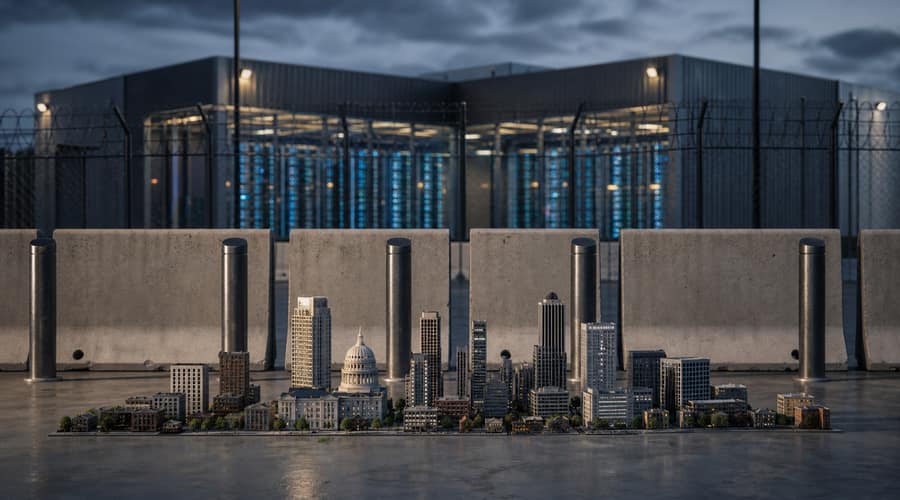
Monterey Park voters did more than reject one data center. They gave other cities a working model for slowing the AI infrastructure rush.
The AI buildout just ran into a ballot box. In Monterey Park, a Los Angeles County city of about 60,000 people, preliminary results showed voters approving Measure NDC on June 2, prohibiting data centers citywide unless voters later decide to end the ban.
According to preliminary election results published by Los Angeles County, the measure had 6,316 yes votes, or 86.27%, against 1,005 no votes. That is not a narrow zoning argument. It is a landslide, and it appears to make Monterey Park the first known U.S. city where voters directly approved a permanent citywide data center ban.
The vote matters because data centers are no longer just obscure industrial buildings sitting on the edge of town. They are the physical layer of the AI economy. Every cloud model, enterprise AI product and graphics-chip order eventually needs land, power, cooling and permits. Investors can underwrite demand. They can model electricity costs. They can sign anchor tenants. But they cannot easily model a community that decides it wants none of it.
Monterey Park did not arrive here in one step. The city had been weighing a proposed facility at 1977 Saturn Street, a long-vacant commercial site tied to HMC Capital and its data center business DigiCo. Public materials described the project as roughly 247,000 square feet, with 24-hour operations, more than 200 construction jobs and 26 on-site employees once operating.
The developer argued that the project would revive an underused property and bring recurring tax revenue. Its own project materials said the facility could generate about $6.5 million during construction and $5 million to $7 million annually for the city general fund. That is the usual pitch. A local government gets revenue without raising residential taxes, and the digital economy gets another facility close to a major metro area.
Residents heard a different story. They focused on power demand, noise, air quality, public health, water resources and whether the benefits matched the disruption. The employment figure was especially important. A data center may involve a large construction payroll, but once it is running, it does not operate like an office campus or a factory with hundreds of daily workers.
That gap between construction excitement and operating reality is where many data center fights now live. Communities are being asked to host infrastructure that supports national technology growth, but the benefits can feel abstract while the local costs feel immediate. In Monterey Park, the argument was strong enough that the city council first adopted a moratorium, then put the permanent ban before voters.
Permitting risk is becoming investment risk
For AI infrastructure backers, the lesson is not that every city will copy Monterey Park. The lesson is that local approval can no longer be treated as a late-stage formality. Data center development has always depended on power availability, fiber routes and land prices. Now it also depends on whether residents believe the project belongs in their city at all.
This is especially relevant in California, where land is expensive, environmental review is serious and electricity politics are never simple. California already has hundreds of data centers, but much of the newest AI-related buildout has been chasing markets where land and power are easier to secure. Monterey Park shows why. Even a project near Los Angeles, with a clear revenue argument and a vacant site, can become politically unbuildable.
The vote also changes the legal posture. Measure NDC amends the city general plan to prohibit data centers citywide, and the prohibition continues until voters end it. That means a future city council cannot simply reverse course in a routine meeting. For developers, that adds time, cost and uncertainty. For other cities, it offers a template that is harder to unwind than a temporary moratorium.
There is a broader pattern here. Denver has approved a one-year data center moratorium. Seattle officials have discussed a pause on large data centers. Charlotte is moving toward its own temporary halt. These are not identical fights, but they point in the same direction: local governments want time to understand how AI infrastructure affects grids, water systems, neighborhoods and municipal budgets.
That does not mean the AI infrastructure boom is over. Demand for compute remains enormous, and hyperscalers, private equity firms and power developers are still racing to secure capacity. But the easy narrative has changed. Data centers are now politically visible infrastructure, not invisible technology plumbing.
The next phase will depend on whether developers adjust before more cities force the issue. Projects that arrive with vague community benefits and narrow job claims will struggle. Proposals that come with clear power plans, enforceable local benefits, transparent cooling systems and real neighborhood engagement will have a better chance. Monterey Park has made one thing clear: in the AI economy, the server rack may be global, but permission is still local.
Also read: Meta Is Turning Employee Work Into AI Training Data • Meta is learning how employees work by watching their screens • Colorado keeps AI pricing rules on hold after Polis vetoes HB26-1210