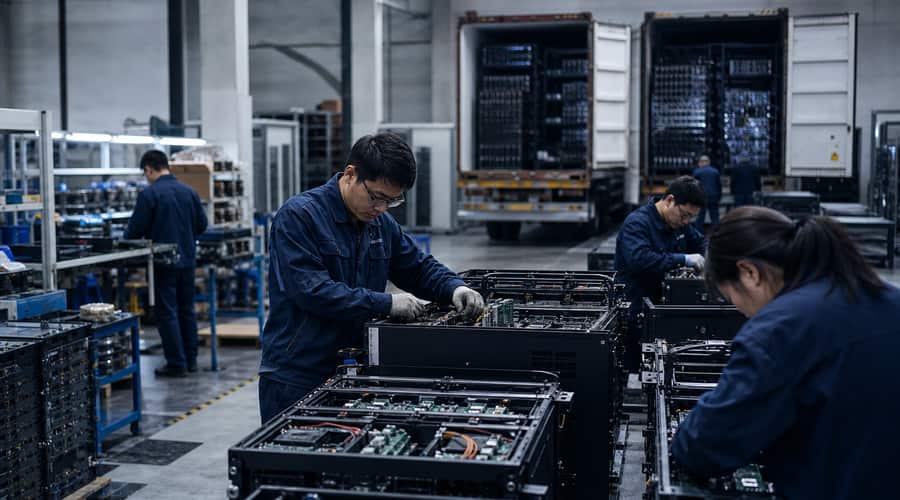
Murata's profit beat matters because it shows the AI infrastructure boom is no longer just a story about chips and cloud giants, it is now lifting the tiny components that servers cannot run without.
For all the attention paid to Nvidia, Samsung and the hyperscalers, the AI trade is quietly widening into the less glamorous parts of the electronics stack. Murata Manufacturing's latest earnings are a good example. Bloomberg reported today that Murata beat profit estimates as demand from AI data centers lifted component sales, and the company's own earnings materials point to stronger data-center-related demand, especially for capacitors, along with higher revenue and operating profit projected for the year ending March 2027. That is a useful reminder that the AI buildout is not just about the headline hardware. It is about the dozens of component layers that make the hardware function in the first place.
Murata is not a household name outside electronics circles, but it is one of the companies that makes the modern server stack possible. Capacitors, especially multilayer ceramic capacitors, are the kind of components nobody notices until there are not enough of them. They stabilize power delivery, support high-frequency switching and help keep increasingly dense server boards from failing under the load of AI workloads. As hyperscalers push more compute into data centers, the number of these components per system rises too. That is why Murata's numbers matter. They show the AI demand curve passing through a supplier that sits several steps removed from the model itself, but very close to the physical limits of the system.
Murata's own public comments make the opportunity even clearer. The company has said AI-server MLCC demand is expected to grow at a 30 percent compound annual rate through 2030, up from a previous estimate of 18 percent. It also said AI servers are mounting more capacitors per board, with the count on some systems rising from about 15,000 to 20,000. Murata has even discussed raising prices on high-end MLCCs because it wants to gauge the true demand profile before making a final decision. That is not the language of a cyclical supplier waiting for a rebound. It is the language of a company that sees structural demand and is trying to decide how much of that demand it can turn into pricing power.
This is what a second-order AI trade looks like. The first-order winners are the companies building models, training chips and cloud infrastructure. The second-order winners are the companies that feed power into those systems, regulate current, manage heat and connect all the pieces without failure. Murata sits firmly in that second tier. The market often treats that layer as boring, but boring is exactly where margins can become durable when supply gets tight. The more AI data centers expand, the more the market has to buy the supporting components whether or not anyone can name them in a keynote.
That matters because the AI infrastructure boom is starting to spread beyond the obvious beneficiaries. If Murata is seeing stronger demand for data-center-related capacitors, then the value chain is deepening. Power electronics, passive components and board-level parts become more important when every server is packed with accelerators and every rack needs stable power delivery. This is the kind of demand that does not look dramatic in the abstract. It shows up in factory utilization, pricing discussions and margin guidance. But that is exactly what makes it useful to investors. It is one thing to know that AI spending is rising. It is another to see which suppliers are turning that spending into profit.
Murata also gives the market a check on the idea that AI hardware demand is concentrated only in a few brands. It is not. The buildout involves a chain of specialized suppliers, and each layer can benefit as long as the demand persists. Samsung may get the attention for memory. Nvidia may get the headlines for GPUs. But Murata captures value from the fact that all those systems need stable power and dense packaging. As the AI stack grows, every layer that enables the next layer becomes more important.
Why The Outlook Matters
The company's outlook for the year ending March 2027 is what makes this more than a one-quarter story. Murata is projecting higher revenue and operating profit, which suggests management thinks the demand is not a short spike. That matters because a lot of the AI supply chain optimism over the last year has centered on whether order patterns are durable enough to justify new capacity and pricing discipline. Murata is signaling that the answer may be yes, at least in its corner of the market. If that holds, then companies making passive components can start behaving more like strategic suppliers than commodity vendors.
That is a shift worth watching. When a supplier decides it can raise prices or at least discuss it openly, it means demand is tight enough that customers have less leverage. In AI infrastructure, that can happen quickly because new data center buildouts create concentrated bursts of demand for specialized parts. Once those builds get underway, suppliers with the right product mix and the right capacity can benefit for multiple quarters. That is what gives this story staying power. It is not just about Murata's earnings beat. It is about the market slowly recognizing that the AI boom is reaching into every part of the hardware chain, including the pieces that nobody talks about until they become scarce.
For StartupFortune, the lesson is straightforward. AI is not only a software or chip story. It is a manufacturing story too. Companies like Murata are proof that the economics of AI are traveling down the stack, from models to servers to the tiny components that keep the servers alive. That is where the next layer of value is being created, and it is where the next set of bottlenecks will show up if the infrastructure buildout keeps accelerating.
Also read: OpenAI locked in 10 gigawatts of compute and the infrastructure race is now its moat • OpenAI locked in 10 gigawatts of compute and the infrastructure race is now its moat • Anthropic's Mythos fight shows frontier AI is becoming strategic access infrastructure