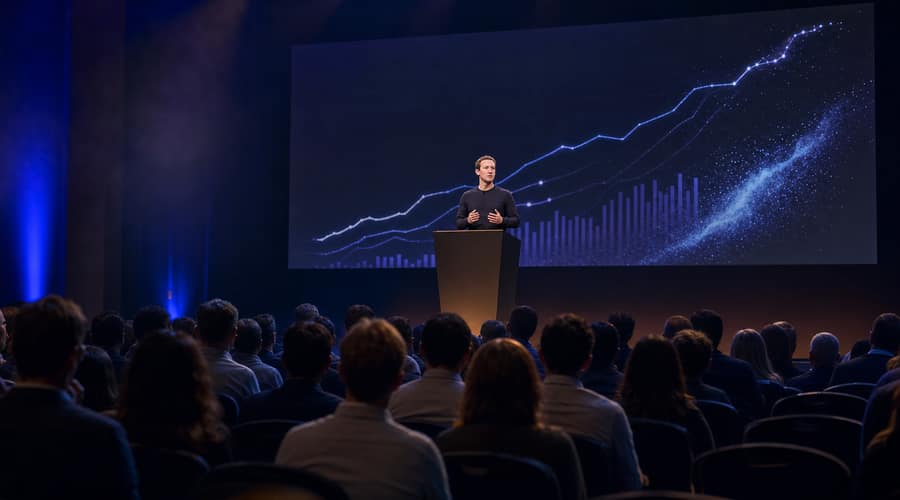
Mustafa Suleyman's 12-to-18-month warning is less a countdown than a stress test for founders deciding how much work should still be built around people.
Suleyman, who runs Microsoft's AI business, told the Financial Times in February 2026 that most computer-based professional tasks could be automated by AI within 12 to 18 months, pointing to lawyers, accountants, project managers, and marketers as exposed roles. The claim is sharp enough to get attention because it lands directly on a question founders are already wrestling with: should the next dollar go to another hire, or to a workflow that makes the current team more productive?
The fast timeline is anchored in real movement, but the market is not moving in one straight line. Thomson Reuters' 2025 Future of Professionals report found that legal, tax, accounting, and audit teams are already using generative AI for document review, research, drafting, and routine analysis. It also found that organizations with a formal AI strategy are far more likely to see positive returns than those treating AI as scattered experimentation.
That distinction matters. A model that can draft a contract clause is not the same thing as a system a law firm can trust inside billing, compliance, privilege, quality control, and client-facing workflows. The same is true in accounting, marketing, and customer operations. Capability can arrive quickly. Institutional adoption usually takes longer.
Official labor data also points to a slower and more complicated adjustment. The Bureau of Labor Statistics still projects employment growth for lawyers through 2034, even as it acknowledges that some analyst and professional roles are exposed to AI-driven changes in task mix. That does not disprove Suleyman's warning. It does suggest the first impact will be redesigning jobs before eliminating them outright.
Startups are already changing the shape of teams
Some startups are acting as if the 18-month window is plausible. They are building AI-native products, selling agentic systems into enterprise workflows, and pitching customers on smaller teams with more output. Investors like that story because it speaks directly to capital efficiency. Less burn, faster execution, cleaner margins.
But broad replacement of white-collar headcount still requires more than models that can write copy, summarize calls, or draft financial analysis. Enterprises need audit trails, access controls, fallback plans, and clear ownership when an AI system makes a bad recommendation. Recent enterprise AI research from McKinsey and other industry surveys points to the same bottleneck: many companies are still moving from pilots toward production, and governance remains a major constraint.
That is the practical middle ground. Suleyman may be right that many professional tasks will become technically automatable in the near term. It does not follow that most companies will rip out entire teams on the same schedule. The better expectation is uneven compression: junior research, first-draft writing, ticket triage, reporting, and repetitive analysis get automated first, while judgment-heavy and relationship-heavy work stays closer to humans.
What founders should do now
Founders should treat the prediction as a planning scenario, not a prophecy. The immediate move is to stop hiring as though every function needs to scale by adding people in a straight line. Before opening a role, ask whether the work is repetitive, measurable, and already digital. If it is, test an agent-plus-supervisor model before adding another full-time salary.
For a bootstrapped company, that might mean one senior marketer supported by AI tools for audience research, draft variations, landing page tests, and performance summaries. For a customer support startup, it might mean routing basic tickets through an agent while keeping a human operator for escalations, renewals, and sensitive accounts. The point is not to remove people wherever possible. It is to make sure the people you keep are doing work that actually needs them.
Hiring should also shift toward orchestration. The valuable employee in this environment is not just the person who can complete a task manually. It is the person who can design the workflow, judge the output, improve the system, and know when automation is creating risk. That changes the profile of early hires across operations, finance, legal, and growth.
Capital allocation needs the same discipline. A sensible founder does not need to redirect the whole hiring budget into software. But setting aside 20 to 40 percent of planned spending on repeatable knowledge work for AI tooling, integrations, data cleanup, and monitoring is now a serious operating choice. If the company's output depends on research, documentation, support, analysis, or content, that budget is no longer experimental. It is infrastructure.
The risk is moving too quickly without controls. Startups selling AI into larger customers will be judged on more than speed. They will need to show access permissions, audit logs, human review gates, rollback plans, and a clear answer for who owns the outcome when an agent gets something wrong. In many markets, that will be the difference between a promising demo and a signed contract.
There is also a political cost to consider. Rapid automation of professional work will draw attention from regulators, labor groups, and customers who do not want critical decisions hidden behind opaque systems. A founder building around AI leverage has to watch that environment closely, because adoption economics can change quickly when trust breaks.
For now, the useful takeaway is simple. Build the company as if AI will keep getting better faster than hiring plans can adjust, but do not confuse automation with strategy. The strongest startups will not be the ones with the fewest people. They will be the ones where people, tools, and judgment are arranged so the company can move faster without losing control.
Also read: AI may favor gray-haired operators more than junior coders • Claude's radio station refusal says more about AI reliability than laziness • Mistral's Arthur Mensch warns Europe has two years to stop AI dependence