Mark Zuckerberg has admitted Meta's AI agents are moving slower than expected, which is a blunt problem when the company is still defending a 2026 capital spending plan of up to $145 billion.
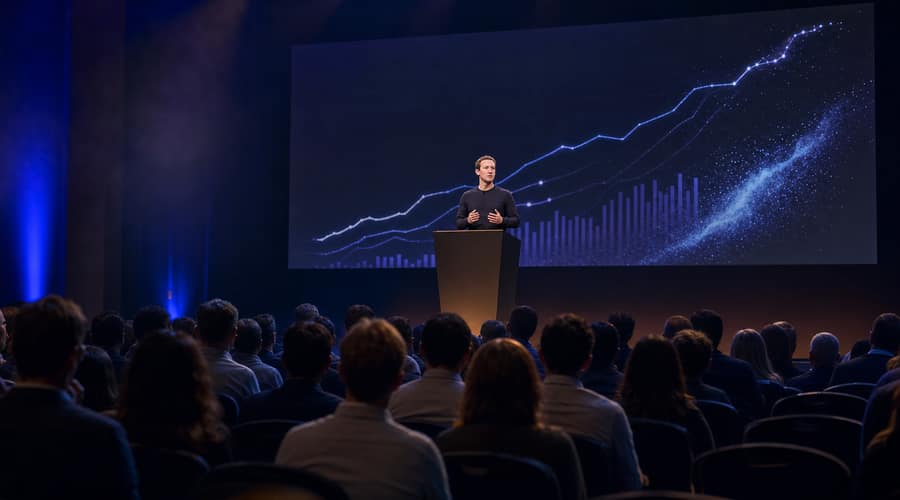
You don't often hear a Big Tech CEO tell employees that a major AI reset has not produced the acceleration management wanted. But that's what Zuckerberg told Meta staff at a Thursday, July 2 town hall, according to Reuters and Business Insider, after months of layoffs, reassignments and internal pressure around agentic AI.
Reuters reported that Zuckerberg said the trajectory of agent development over the past four months "hasn't really accelerated in the way that we expected." He also told employees the assumptions behind the reorganization "haven't come to fruition yet." That's the sentence investors should sit with. Meta didn't merely spend more money and hope the models would improve. It moved thousands of people around the company to make that improvement happen faster.
The reshuffle was large enough to be felt across the business. In May, Meta cut about 8,000 jobs, roughly 10% of its workforce, and Business Insider reported that around 7,000 other employees were reassigned into AI-focused groups, including Applied AI, Agent Transformation Accelerator and Agent Data and Optimization. Some employees called the move a draft. That word matters, because it tells you how the change landed inside the company: less like a clean strategic pivot, more like a forced march.
Zuckerberg also acknowledged that the execution was not as clean as it should have been. Business Insider reported that Chief Technology Officer Andrew Bosworth told employees Meta had done an "atrocious" job rolling out parts of the Applied AI effort, while a controversial training program that used employee keystrokes and mouse movements will be opt-in if it resumes. For a company trying to make its own staff train the next generation of tools, morale isn't a side issue. It's part of the machine.
Meta can afford a mess better than most companies. Its advertising business still throws off the cash that lets Zuckerberg take swings other CEOs couldn't survive. But you can't ask employees to absorb layoffs, reassignments and monitoring experiments, then shrug when the promised acceleration doesn't show up on schedule. The whole bargain was speed.
The spending makes the admission sharper. Meta's 2026 capital expenditure guidance sits between $125 billion and $145 billion, according to recent reports on the company's updated forecast. That figure has not moved because of one difficult town hall. Zuckerberg told staff he still expects more significant benefits from Meta's AI work within three to six months, according to Business Insider. Fine. That gives the company a real clock.
Alexandr Wang, Meta's chief AI officer, tried to narrow the damage in a post on X after the reports circulated. As Barron's noted, Wang said Zuckerberg was talking about industry progress on agentic capabilities as a whole, not only Meta's internal work, and pointed to an upcoming Muse Spark update with improvements in coding and agentic tasks. That's a useful clarification, but it doesn't erase the internal admission. If the industry is moving slower than expected, Meta still has to explain why its own expensive reorganization has not made it move faster than the pack.
Oracle shows why the market is getting less patient with this kind of story. Forbes recently reported that Oracle's capital spending reached 86% of revenue in the first quarter of 2026, while the cost of insuring its five-year debt against default has more than tripled since September. Across the sector, Forbes cited roughly $25 billion in AI services revenue in 2025 against more than $250 billion in infrastructure spending. That's about ten cents of revenue for every dollar spent.
Meta isn't Oracle. It has Facebook, Instagram and WhatsApp advertising revenue underneath the bet, and that gives Zuckerberg room to be stubborn. But the question is now painfully simple: do the agents get better quickly enough for customers, developers and Meta's own employees to notice, or does the company keep discovering that more headcount and more chips don't automatically produce a better product?
Frankly, the three-to-six-month window is now the only deadline that matters. If Muse Spark and Meta's agent tools show visible progress before the fourth quarter, this town hall becomes an uncomfortable but manageable reset. If they don't, the next earnings call will not be about ambition. It will be about why the company cut thousands of jobs to move faster and still ended up explaining delay.
Also read: Zhipu Turns Anthropic's China Tracking Scandal Into a Recruiting Pitch • Amazon is quietly building the AI chips that power your Echo • Macron and Modi Are Personally Courting Tech CEOs to Win the AI Infrastructure Race